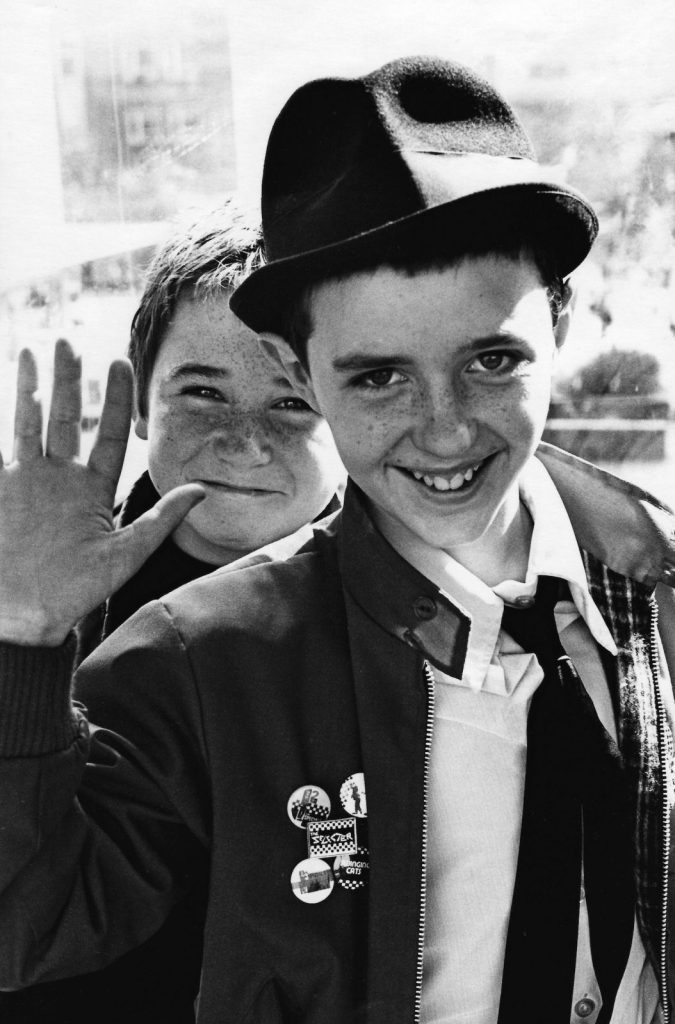
When the picture below popped up on social media, some commented that it showed a bloke called Bubbles and his crew from Brixton. Apparently, it was taken circa 1968/69 at the top of Granville Arcade (now known as Brixton Village), which is located at the junction of Coldharbour Lane and Atlantic Road. I liked the photo, but I couldn’t tell whether this lot were rude boys, skinheads, or neither. Clothes-wise, nothing strays too far from the original skinhead look.
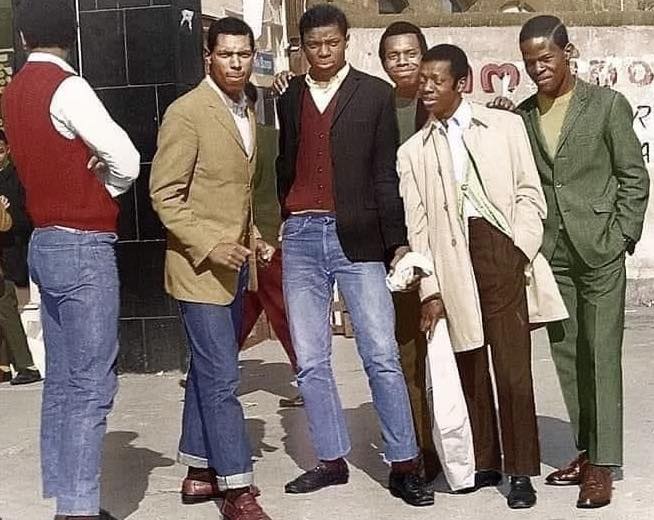
Then it occurred to me that, although rude boys are mythologised in reggae songs and often mentioned in passing in retrospective accounts of the original skinhead era, they remain photographically under-documented – which explains my considerable ignorance of their style, and why I can’t really place the lads in the picture.
The rude boy originated among the often violent, ska and jazz loving, lower working-class and lumpen youths of 1960s west Kingston, Jamaica (“A criminal class, no more no less”, according to Lloyd Bradley’s Bass Culture), before crossing over to the UK more or less during the transition to rocksteady. Whether in Kingston or London, rude boy gangs would defend ‘their’ sound systems with the same territorial fanaticism that English hooligans showed over ‘their’ football teams. I’m not going to repeat the information you can find on Wikipedia, but I’ll add this: while black skinheads were kids integrated into white British communities, rude boys in the UK tended to stick to their own, even if they rubbed shoulders with skins in the dancehalls.
As for the question of who influenced who, and by how much, that’s not easy to answer. Leaving aside absurd extremes – such as the claim that ‘skinhead comes from Jamaica’ at one end, and the equally baseless notion that skinhead was a ‘purely white working-class culture’ at the other – a more moderate view has tended to dominate in recent years. It argues that, while Jamaica was important in terms of music, the skinhead style was simply a seamless continuation of mod.
Maybe so. But looking into Paolo Hewitt’s still excellent Soul Stylists, Afro-Caribbean and black American influences clearly had some impact on the mod style itself. In the book, original mod Ian R. Hebditch recalls:
There was a very significant black influence, and I say black because it wasn’t just the West Indian influence, it was also the black American influence. The fashion influence that came through came from the style of the Tamla Motown stars (…) The influence was seen in the way they wore their clothes which was with a kind of arrogance the Mods had as well.
‘Black’ and ‘white’ cultures aren’t hermetically sealed – they cross paths, borrow, and blend. Hewitt points out that, in the early skinhead days, styles varied from manor to manor. Out in places like Ealing and Richmond, the Ivy League look was favoured, not least thanks to their proximity to John Simons’s Ivy Shop at 5 Richmond Hill. But in the inner-city parts of West London, especially round Notting Hill, the rude boy left his stamp: Crombie-style coats and trilby hats mixed into the look. Says original skinhead Lloyd Bradley:
In 1968 I was wearing narrow-cut trousers with little turn-ups and worn at half-mast, red socks (…) and my hair would be short with a razor parting, which was a Jamaican style … It was called a Rude Boy style and it was almost translated wholesale into Skinhead dress. The way we wore our trousers, for instance. We wore them high above our ankles, which Mods didn’t and which Skinheads did … Then the Skinheads adopted Crombies, which was the exact same look but in a heavier material because it’s so bloody cold here.
It’s only natural, then, that the rude boy style didn’t stay the same either once it reached Britain’s shores, but took cues from its new environment. Behold, for instance, Don Letts’s testimony from his autobiography Culture Clash: Dread Meets Punk Rockers:
I can remember walking around the streets of London around 1970–71 in my Crombie coat, brogue shoes, Levi’s Sta Prest and Ben Sherman shirt – and those of us who could not afford Ben Sherman had to make do with Brutus.
You couldn’t give a more classic description of skinhead attire if you tried. And yet, Letts considered himself a rude boy at the time – or rather, a British version of the original:
The sounds of Trojan struck an understandable chord for the lost tribe growing up in England with a confused duality, and its impact was crucial. I was fourteen in 1970, a rude boy, an Anglicised version of the Jamaican real deal and part of the first generation of British-born blacks.
So, would the Brixton lads in the picture identify as rude boys, skins, or neither? Was ‘rude boy’ a well-defined subculture or just a loose descriptive term? And what about that second generation of ‘rude boys’ – the British teenagers following 2 Tone in the late 70s and early 80s? What did they know about their Afro-Caribbean namesakes?
I decided to ask two mates you may remember from my history of the MA-1 flight jacket:
- Paul Thompson – South-East London skinhead 1968–70, though originally from Blackpool
- Steve – Coventry skinhead in the 1980s, and a 2 Tone ‘rude boy’ before that
Note that this article doesn’t claim to ‘tell you how it was’ – it’s just a modest go at exploring the subject through two individuals’ memories. Hopefully, readers will bombard us with pictures, info, and stories about rude boys that are completely new to us.
PAUL (London by way of Blackpool)
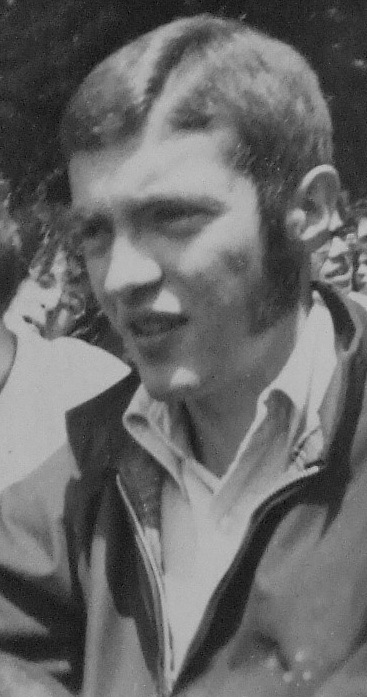
Matt: Welcome back, Paul. I really like this pic of Brixton lads in ’68 or ’69, but are they rude boys? Skins? Mods? I’ve never actually seen many photos of rude boys, so I have no clear idea what they wore as opposed to skins
Paul Thompson: Don’t worry too much about categorising. All that ‘rude boy’ refers to is Caribbean-British street culture, and you’ll find a lot of rude boy, mod, and skinhead crossover. They all shopped at the same clothes shops, for example, saw each other daily, copied what they liked. These guys are just typical of the time.
The black young men I saw in South-East London in ‘68/’69 all looked something like that. Sharp modern suits when out on the town.
In fact, there isn’t much clobber here that wouldn’t be acceptable for skinheads in the narrower sense, is there?
I think the suit-jacket-and-jeans look is more of a mod thing, as is the suit-and-crew-neck combination. I seem to remember being one of the last people to wear that in South-East London. To my mind, it was something I’d brought down from the North West, where the mod culture was strong. By ’69, if you were wearing jeans, it would be with a Harrington. But in general, yes, there’s no item in that photo that a skinhead wouldn’t wear. A skinhead wouldn’t mind being seen in that mac, though a (cheap) Crombie or a sheepskin would be more typical.
But I remember how, years ago, you mentioned that while black skinheads took their look from white British skins, the rudeboys who hung out at your favourite haunt, the Savoy Rooms, had their own fashions, somewhat different from yours. It sounded like there was a clearer distinction when it came to clothing.
Yes, there were some black skinheads, and they did take their styles from us. The actual rude boys though, while the styles were similar, took their fashion cues from each other. Although the looks were close, the rude boys could be flashier, less orthodox. Bear in mind that by ’69, skinhead fashion had solidified somewhat. It was less mod-like, more stereotypical, with less room for individual flair…
The rude boys could mod it up a bit. So the fashion was ‘somewhat’ different, not vastly different.
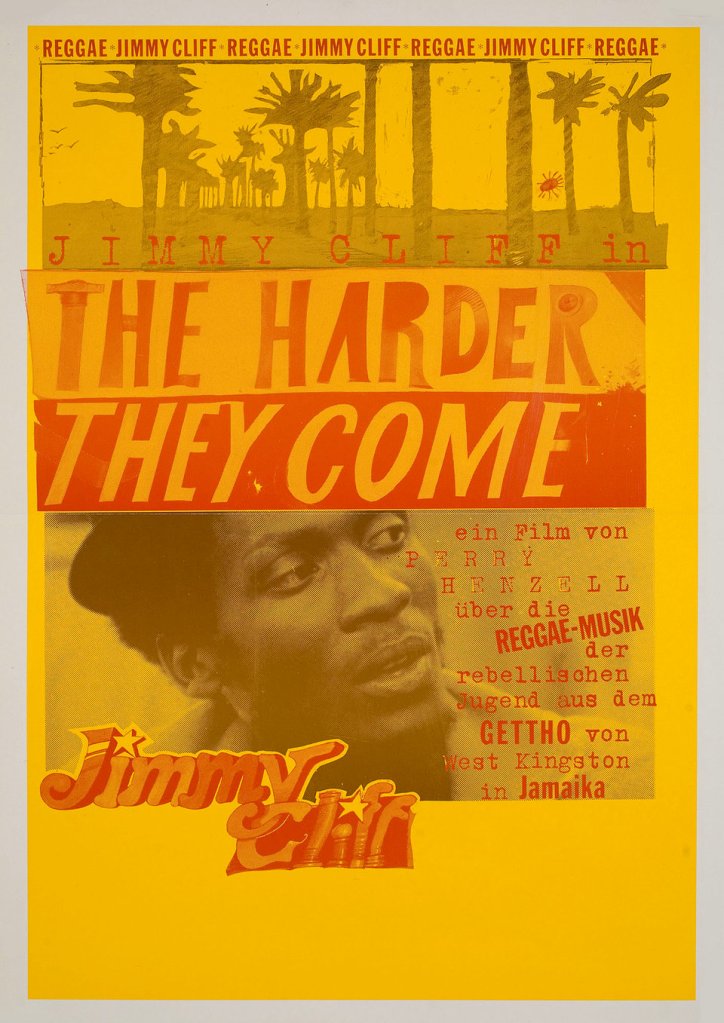
Did the rude boys actually call themselves rude boys? There were countless reggae songs about rude boys, rudies etc, so I’m guessing they may have?
I can’t confirm that. Strictly speaking, we were socially separate where I was, so didn’t talk to each other much. We went to some of the same clubs, but basically you hung around with your own mates. The latter might include some black skinheads, and indeed a couple of black skinhead girls. I never saw any trouble between us, but there was not much mixing. If you heard the term ‘rude boys’ it was generally someone talking about the black lads, not them referring to themselves.
With reference to the songs, the term also referred to the behaviour of black youth in Jamaica as well as in London.
Right. In fact, I remember that about 10 years ago in London, younger people often referred to black council estate kids into hip hop as ‘rude boys’. I don’t think they were aware of the ’60s usage of the term, but perhaps there’s some continuity in that it’s more of a loose label, like ‘gangster’ or whatever.
Yeah, the term both preceded and outlasted the original skinhead era and fashions. I remember one black skinhead used to regale us with tales of his home life, code-switching between Patois and London English, depicting his mum and dad, who were Windrush generation, speaking Patois… The couple of black girls in our mob were sisters. One was gorgeous and did modelling. Her sister was plainer, chubbier, more butch, and a real hard-nut. She had the nickname ‘Killer’ and she could fight. She could easily beat up guys. She and I seemed to get on well, though, and I never felt threatened by her.
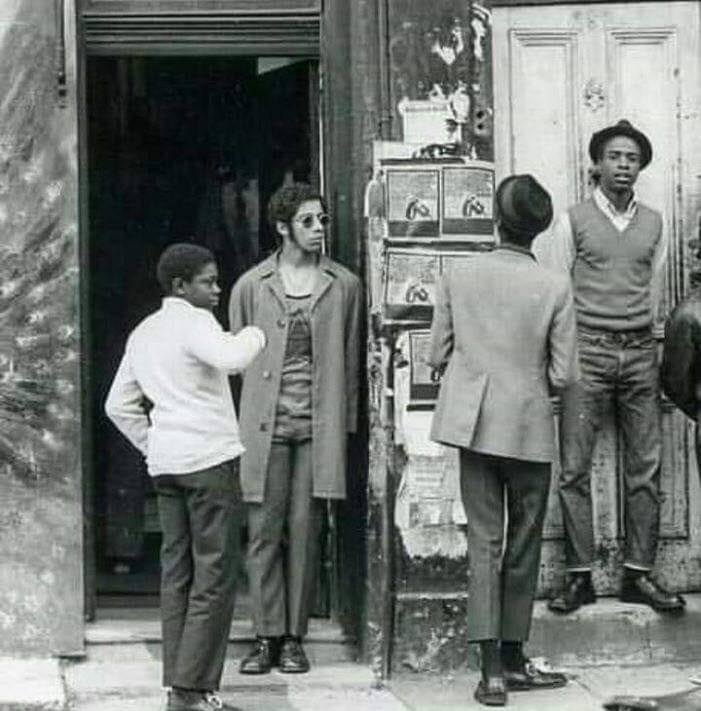
This photo is found in the Wiki entry for ‘rude boy’ and is captioned “Rude boys, Notting Hill, 1974”. What sez you?
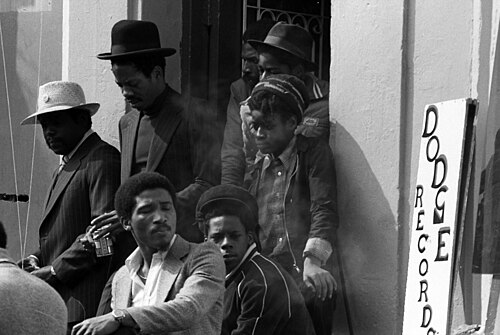
[Shrugs] Wouldn’t quarrel. Rasta influence by then, of course.
Yeah, but by the time they wear long dreadlocks, are they still ‘rude boys’? I guess by then the terms Afro boys or just Rastas became more common?
Again, I would say it depended on youth and behaviour, no matter whether they adopted locks. Remember that a lot of kids would still be at school anyway, and maybe not able to go full-on Rasta. The Rasta-as-fashion subject is controversial, of course.
Right. Maybe ‘rude boy’ became more narrowly codified during the 2 Tone era – a bit like skinhead the second time around?
Possibly, but don’t forget that both of these terms were originally applied by others. See, they continued to be applied, so like a mum or dad might simply call any bunch of disreputable teenage boys ‘rude boys’.
Or, to put it in Jamaican vernacular: dem ’ave no manners.
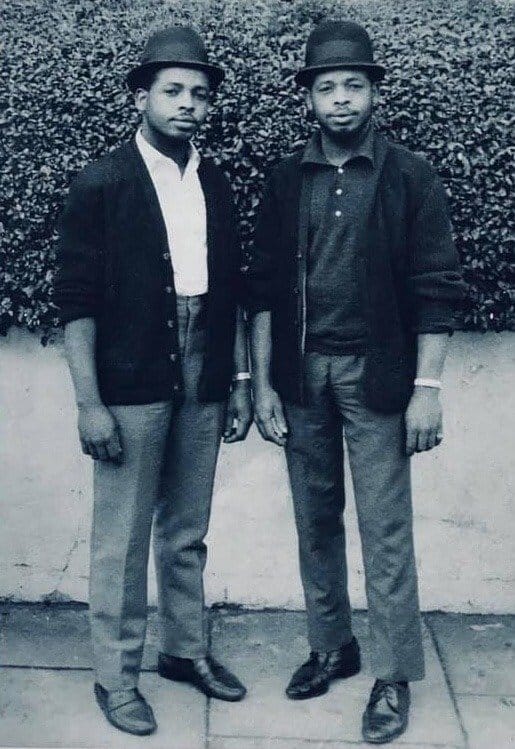
STEVE (Coventry)
Matt: Hi, Steve. What did being a ‘rude boy’ entail when you were a lad? Was it just following 2 Tone and dressing like a skinhead, but without shaving your head? Why not just go the whole hog and be a skin? Anything to do with parents disapproving of shaved heads?
Steve: The description ’rude boy’ was just shorthand for a person wearing the 2 Tone look, most widely seen in its essential form of a black Harrington and white socks. So, not dressing like a skinhead – just mixing in some items that had been worn by skinheads.
I had a black Harrington, white socks, Sta-Prest, Levis, Fred Perry, 6 hole DMs (mostly got by my mum from a catalogue), mixed in with things like an Adidas 3-stripe t-shirt and steel toe cap work shoes from my dad. But this wasn’t some plan to become a skinhead by stealth, it was just the trend.
To put this all in its proper context, when punk emerged in 1976, it was very easy for us 13-year-olds to adopt a look simply by tousling our school uniforms a bit more than usual. Over time, our generational rejection of the hideous ’70s centre-parting and flares began to evolve into a shorter-hair, narrower-trousers look that, in hindsight, laid the groundwork for both a mod revival on one hand and a skinhead revival on the other. Bridging these was the 2 Tone look, neither one nor the other, and nothing to do with Jamaican rude boys. It was one of those things that came and went without leaving much of a legacy.
Were ‘rude boys’ in Coventry mostly white, mostly black, or both?
There were not many blacks around, just one bloke in my council estate of several thousand, and those that were around were from one small area of the city.
Today you often get cosplay skins and older blokes at ska gigs who wear black-and-white checked ties or whatever, which looks super tacky. Was there any such thing back then? Or just generally, non-skinhead fashions that were 2 Tone-inspired?
I can’t think of anything that was specifically 2 Tone. The suit look was mod, the casual look was skinhead – but there were little touches, like band names in red iron-on letters on the back of a black Harrington, a service available at the market stall you got your black Harrington from. Some girls wore short dresses divided into four black-and-white quadrants, but I don’t recall any black-and-white shoes or anything else that was chequered. I didn’t see hats very much or even at all, porkpie or otherwise. The modern people seem to favour some kind of ‘Popeye Doyle’ hat I never saw at the time.
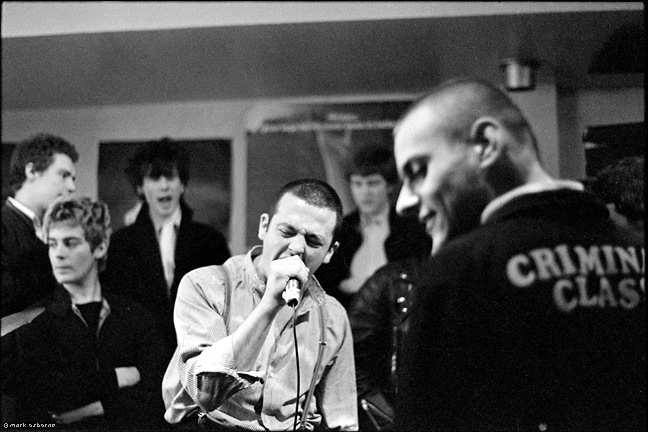
Actually I recall Coventry skinheads did the lettering on the backs of their Harrington too – you once showed me pics of a 1979 Criminal Class gig.
Those Criminal Class at the Zodiac pics must be the iron-on red letters I mentioned even though they look white.
This picture is captioned ‘Rock Against Racism gig, London 1979’. Are these 2 Tone ‘rude boys’?
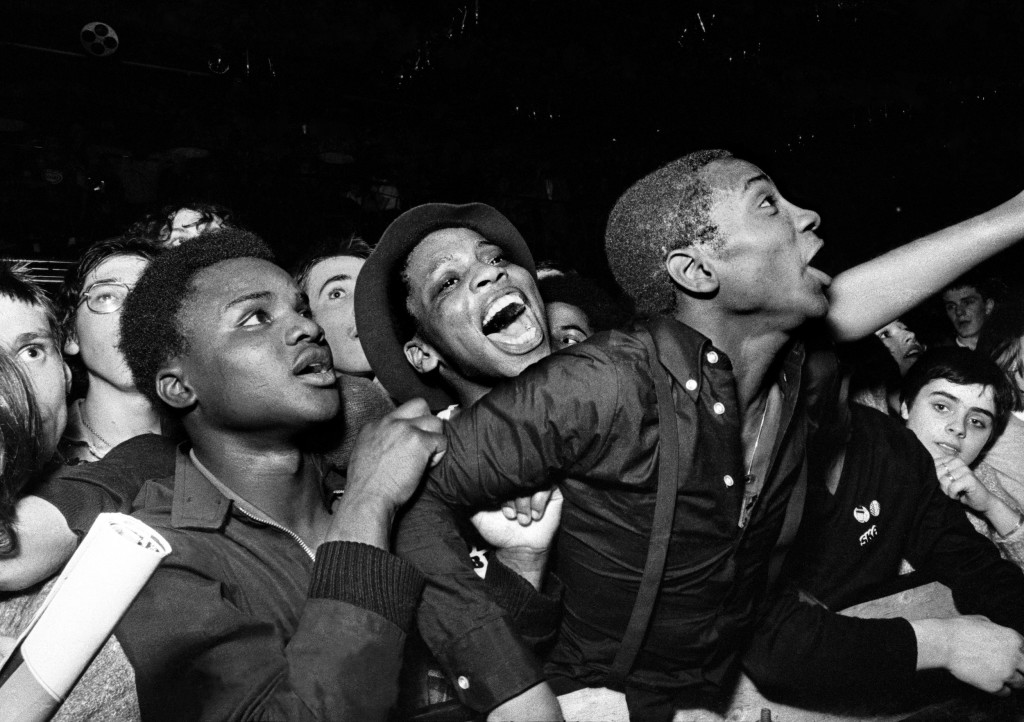
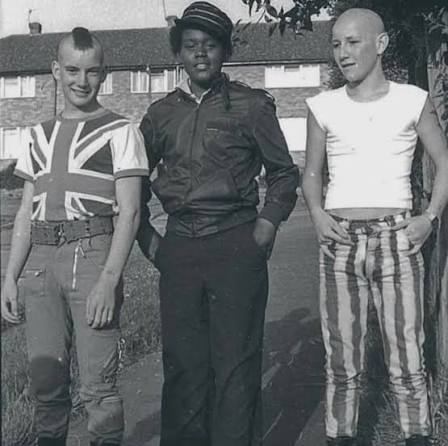
Left is the basic look I was talking about – he could be wearing anything under the Harrington. Right is more developed. Centre is hard to say but could be just one of those semi-rastafarian types that were the late 70s to early 80s equivalent of the Jamaican rude boy. Like the bloke in the middle below, they could be wearing just about anything.
How would you sum up the period?
All in all, it was a great time to be 16 and hearing ‘On My Radio’ on the radio. The difficult second albums were another matter, though, and 2 Tone was dead and gone by 1982. I never even went to see Dance Craze, and I don’t think people who were ‘rude boys’ back then even think that much about it now.
Did you get to read Paul Burnley’s recently published autobiography? Seems he also classed himself as a rude boy back in 2 Tone days, before becoming a nazi skinhead…
I read your article but wouldn’t bother reading the book…
Interviews and intro: Matt Crombieboy
 Creases Like Knives
Hello Matt, being 16 in 1979 and from Coventry, me and my best mate used to be rude boys mark 3 crops, crombies, Ben Shermans, tonic trousers, and brogues/loafers and 8 hole cherry red docs, both our 2 older brothers were original skins then suede heads so used to say we used to wear the same clothes back in the day, their was a lot of rude boys who wore the clothes but had long hair, I would say by late 1980 in Coventry the new skinhead look dominated and rudeboy was over.
LikeLiked by 2 people
Excellent roundup, here. BoxcutterBrigade, here. A few thoughts.
LikeLiked by 2 people
Many thanks for your comment, mate. I was actually going to make an aside on ‘roadmen’, even just in brackets, but I edited it out as I decided I didn’t really know what I was talking about.
LikeLike
Pingback: Qué son las tribus urbanas y cómo han evolucionado hasta hoy - El diario andino - El Diario Andino
Pingback: Xataka – Qué son las tribus urbanas y cómo han evolucionado hasta hoy – Yacal