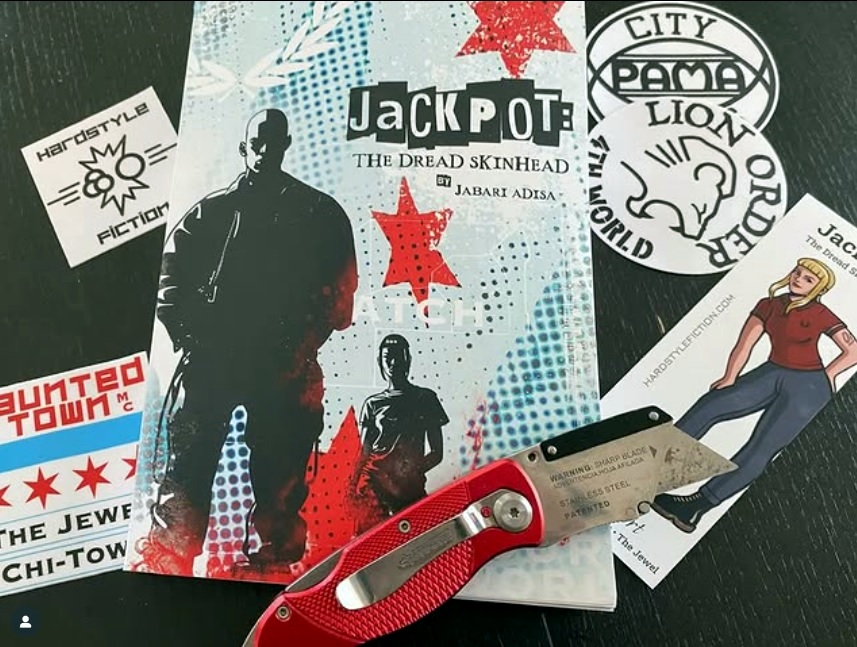
Our mate Jabari Adisa, aka Corky Boxcutter from Chicago, has recently published his first book, Jackpot: The Dread Skinhead. He also commented on our article about the rude boy style, and we think his take is worth sharing as a standalone piece:
“A few thoughts.
1. Rude Boy has always been a counter-culture and not a subculture. Rude Boys in both Jamaica and in England were a scorned, distrusted class (as you correctly call out in regards to the music), but at a certain point, being a rude youth became a badge of courage / defiance, a culture of resistance onto itself. That’s when you start to see ‘Rudie don’t fear’ and other pro-rude, proud rude tunes. And by the time Rhygin comes along, it’s a legitimate mentality.
2. It will always be difficult to find photos of ‘rude boys’ because, by the nature of them being a counter-culture, their looks changed frequently. Rude Boys have much in common with Casuals in this regard. The rudie wanted to stay a step ahead of Babylon and, as such, resisted easy codification/classification. As a result, you’ll find photos of black youth who are considered ‘rude’ but who look absolutely nothing like the ‘rude’ youth of old. This is, of course, nothing like Skinheads who cleave to traditions.
3. Rude Boys have always been the arbiters of the new and the next. They are always tuned in to the new sounds, new brands, etc.
4. The current ‘Roadman’ is the logical offspring of the Rude Boy (Rude -> Road, Boy -> Man). It would be a safe bet to say that some of today’s Roadmen are the literal grandson’s of yesterday’s Rude Boys.
5. A few really useful (and fun) reads that deal with Rude youth: Rude Boys by Gaylord Dold, Brother Man by Roger Mais, The Hills Were Joyful Together by Roger Mais, Clarks in Jamaica by Al Fingers.
6. My book Jackpot: The Dread Skinhead features a prominent character named Brixton who typifies some of what’s described above. That part of the book is based on a real life Rude Boy (black, English, Windrush offspring) with whom I was friends in the 80s.”
What do you think?
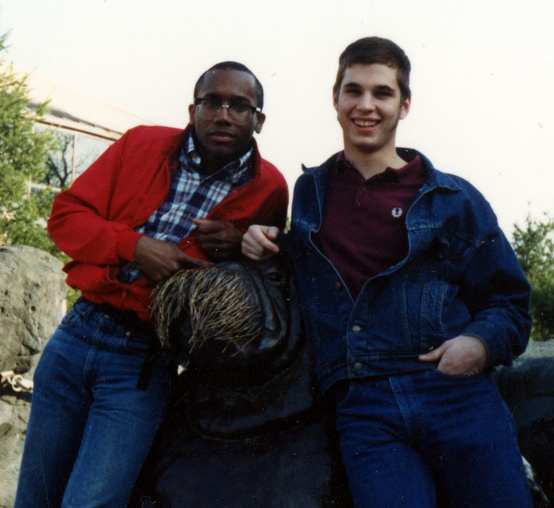
As for Adisa’s book, it’s definitely worth checking out. Jackpot: The Dread Skinhead could be classified as ‘autofiction’ – some events and topics reflect his real experiences growing up as a skinhead in 1980s Chicago, while others and certain characters are fictionalised.
For US buyers, signed copies, bookmarks and stickers can be purchased at Hardstylefiction.com. The paperback is also available on Amazon in the US, UK, Poland, Germany, France, Spain, Italy, Netherlands, Sweden, Japan, Canda and Australia. The extras are NOT available through Amazon.
Jabari aka Corky Boxcutter ran with one of Chicago’s rival skinhead crews, SHOC (Skinheads of Chicago). A few years ago, we interviewed him (link HERE) and a member of a rivalling crew (link HERE). His Instagram, @boxcutterbrigade, is also well worth following.
Chicago seems to have had one of the liveliest – but also one of the most factionalised – skinhead scenes in the 1980s US. We’ve had followers from at least two or three rival Chicago crews commenting on our Facebook page, usually to contest each other’s accounts.


Thanks for this! I put a lot of effort into staying true to Chicago Skinheads while also making the story worth the reader’s time.
LikeLiked by 1 person
Can join Don De Grazia’s “American Skin” on the list of Chicago skinhead novels. (I think those are the only two.)
LikeLike
I know of four novels:
NOTE: The “Moonstomp” listed above should not be confused with the excellent novel by Tim Wells.
And two memoirs:
1. Romantic Violence by Christian Picciolini
2. Rude Girl by Birgit Weyhe (https://www.instagram.com/p/C41JfKxvE7G/)
LikeLiked by 1 person
Incredible, thank you, and congratulations on your book
LikeLike
As someone from a so-called “third world country” I should add that common people didn’t take a lot of pictures back in the day. I know many people who grew up before the 1980’s or so who only have a couple of family photos from special events like their first communion or a few school pictures or whatever.
I suppose it was the same in Jamaica.
LikeLiked by 2 people
Just as a matter of interest, this set of photos from the Grauniad 😉 shows quite a bit about street attitude in the 1980s, and might throw a bit more light on why the term might have lasted, or might have been applied beyond its origin.
https://www.theguardian.com/artanddesign/gallery/2025/oct/14/an-unseen-side-of-black-britain-memories-of-1980s-bradford-in-pictures
LikeLiked by 1 person