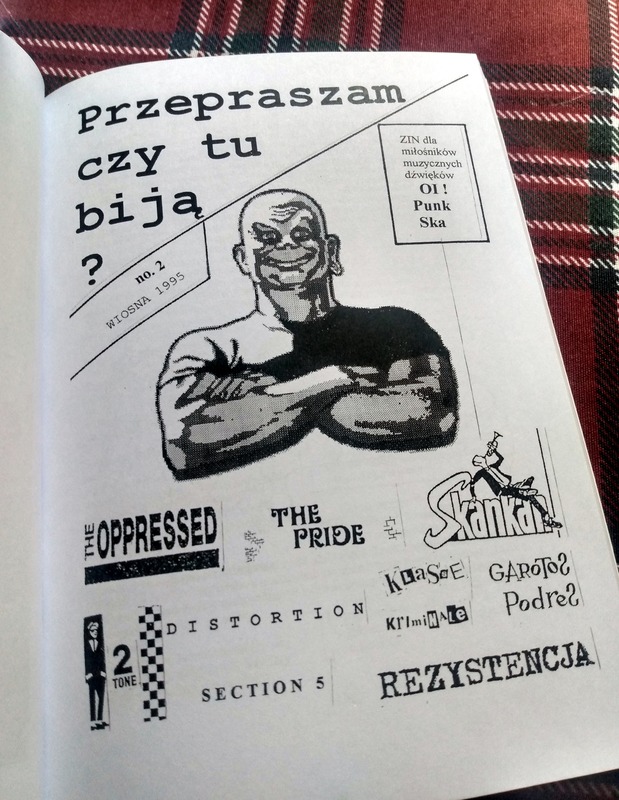
Readers will remember my exhaustive interview about the Polish skinhead scene of the ’80s and early ’90s, and this anthology, published by Bad Look Records of Warsaw (more specifically, Warsaw-Służewiec, which also happens to be the neighbourhood of my childhood), more or less picks up where that interview left off. It contains all issues of the Warsaw skinzine Przepraszam, czy tu biją?, which translates as ‘Excuse me, do they beat up people here?’ and ran from 1994 to 1997 – five issues in total.
Conventional wisdom suggests that prior to the emergence of SHARP, Polish skinheads were essentially boneheads – in other words, thugs with fascist sympathies and little appreciation for the finer aspects of skinhead culture. While there’s a certain truth to the stereotype, it is too simplistic to do justice to the skinhead scene of the Polish People’s Republic, which was no less contradictory than its counterparts in the western countries.
In anti-fascist accounts of the latter half of the 80s, all Polish skinheads are routinely referred to as naziskini [nazi skins]. Yet the Security Service of the Polish state had a somewhat more realistic assessment: in an internal report from 1986, it estimated that there were approximately 200 skinheads in Poland, of which it regarded 30 as “fascists”. By 1987, the overall number remained the same, but the count of “fascists” had increased to 50. This indicates a clear majority of “non-fascist” skins, although things were to change rapidly with Poland’s political transformation in 1989.
While one could argue that the emergence of skinheads in Poland was a symptom of globalisation, the politics and concerns of Polish skins often had distinctly local roots, shaped by Polish conditions and history. It wasn’t until the latter half of the 90s that neo-nazism – i.e. George Lincoln Rockwell’s fusion of German nazism with Southern U.S. white racism – became the predominant tendency. By that time, the neo-nazi faction was in competition with a traditionalist Oi revival and the budding SHARP movement.
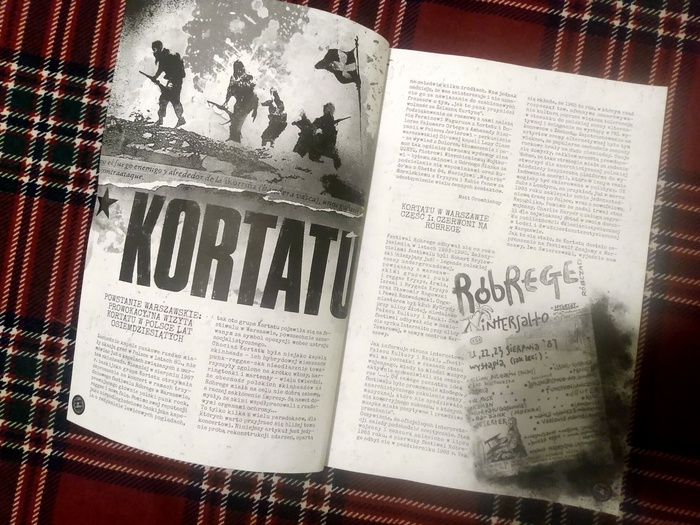
I was surprised to learn that the Polish magazine Alerta, which is published by an antifa group known as 161 Crew, ran an article about Kortatu’s 1987 visit to Warsaw. After all, I had written a piece on the exact same subject last year, focusing heavily on the skinhead presence at the Kortatu show. Had Alerta (“Anti-fascism, anarchism, music, DIY”) stumbled upon any information that was lacking from my own humble attempt at reconstructing the events, I wondered? Would their account contradict mine? They didn’t seem to be shipping the magazine outside Poland, but luckily a friend from Wroclaw helped me out.
Investigating the history of Poland’s skinhead scene is tricky. Even if the mid-80s beginnings were relatively apolitical (see our article on Kortatu’s visit to Warsaw in 1987), no clear demarcation between ‘boneheads’ and other factions emerged until at least 1992. Although the information flow from Western Europe to the Polish People’s Republic was somewhat hampered in the 80s, whatever made it through the Iron Curtain in the form of zines and tapes was happily absorbed. This eclectic mix included the likes of Blitz, Kortatu, Symarip and Angelic Upstarts, all of which earned mentions in the pioneering Polish skinzine, Fajna Gazeta – but also Skrewdriver, provocative nazi posturing and ultra-violence against enemy tribes. All of these influences added up to a subculture made up of hooligan ex-punks, determined to make a name for themselves as the most fearsome youth cult of all.
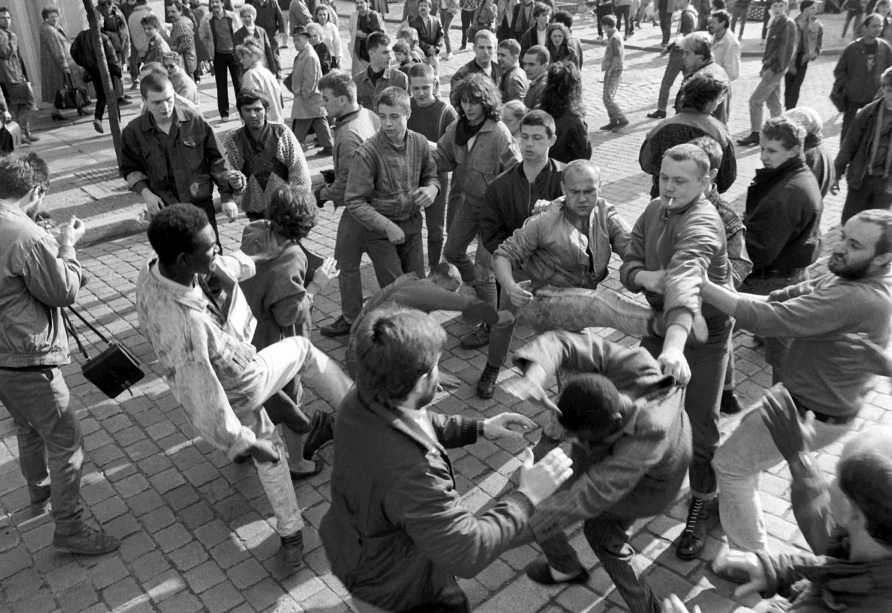
Western punk bands didn’t get to play the Polish People’s Republic too often back in the 80s, not to mention bands linked to skinhead culture. In August 1987, however, Kortatu from Basque Country were invited to play at Róbrege, a 3-day festival in Warsaw largely featuring native punk, reggae and new wave acts. Although a Basque independentist band with radical left-wing leanings, Kortatu thus appeared at a festival that was generally perceived as a kind of cultural opposition against the socialist government. And even though Kortatu were something of a skinhead group – cropped hair, Harringtons and DMs visually accompanied their punk, ska, and reggae hybrid – many say that the Polish skinheads who came to Róbrege were more interested in disrupting the festival than they were in dancing. Some even go as far as to imply that the skins were operating in cahoots with the state security services…
These are just some of the contradictions that made it seem like an interesting event to explore. Although this article should be seen as no more than an attempt to reconstruct what happened, based on a mere handful of sources, I still hope it’s an engaging account that doesn’t draw on too many ‘when punk brough freedom behind the Iron Curtain’ cliches…
 Creases Like Knives