For ‘Daily Terror part 1 – the punk years’ click here
By 1984, the German punk scene was in steep decline. Daily Terror’s second longplayer Aufrecht, released in February, was one of the few deutschpunk albums coming out that year. A late classic of the genre, Aufrecht stood heads and shoulders above the debut: in this case, the band interview cliché “harder and faster, but also more melodic” was definitely true. However, some of the sentiments expressed on the album now seemed strangely out of date. In ‘Zusammen zuschlagen’ (strike as one), the band pleads for unity between punks and skinheads, wrapping their message in leftist rhetoric: they urge punks and skins to “build a united front” against the state forces intent on “dividing the masses”:
There’s so many of us, we have power
But when you’re alone they just laugh at you
So stop all the squabbling
And get ready to strike as one
In an interview with a local paper that year, Pedder explained that the song was inspired a bad experience in Wuppertal, where guitarist Ebbie had been hospitalised by a bunch of skinheads before the show. In his view, the hostilities between punks and skins were fuelled by the media, and one of the band’s objectives was to reduce them: “After all, we all have the same problems with unemployment, our dying environment and all the other crap. That’s why we played at the punk and skin unification meeting in Hannover. The skirmishes that went down there are clearly the fault of the nazi skins and the police”.
But it was too late for all that: the ‘unity’ meeting in Hanover had achieved only one thing: uniting skinheads against punks. The subequent ‘Chaostage’ meeting in August 1984 descended into a weekend of violent clashes once more. The washed-out remnants of a drug-ridden gutter punk counterculture were confronted by a large mob of right-wing skins and football hooligans, who this time around had travelled into Hanover for the express purpose of punk-bashing.
The title track, ‘Aufrecht’, is imbued with similarly romantic ‘us against the world’ sentiments. Another anthem, ‘Der Countdown läuft’, rails against “nazi judges” and calls for the downfall of the West German state. ‘Bundeswehr’ is anti-militaristic, and ‘Armes Schwein’ mocks an ex-punk who has ‘sold out’ for a middle-class office career.
Elsewhere, skinhead interest creeps in: the Cockney Rejects-esque ‘Schluckspechte’ – a tune named after Pedder’s local football firm – celebrates the joys of terrace violence: “The north curve isn’t far away, and we’re always ready to invade, we’re going on a total football rampage, we like it real, we are Schluckspechte”. In an interview, Pedder boasted: “We’re the only football fan club that has its its own anthem now”. When asked if there were any right-wing tendencies among the club’s supporters, he replied: “No. It’s true that certain outward appearances allow for such speculation, but people should finally stop judging a book by its cover.”
On the front cover, Pedder can be seen sporting a number four crop, wearing a Specials t-shirt, an FC Braunschweig football scarf, a black trucker jacket, black jeans with turnups, and black 11-eye Dr Martens boots – clearly veering towards skinhead, though with a monochrome punk twist.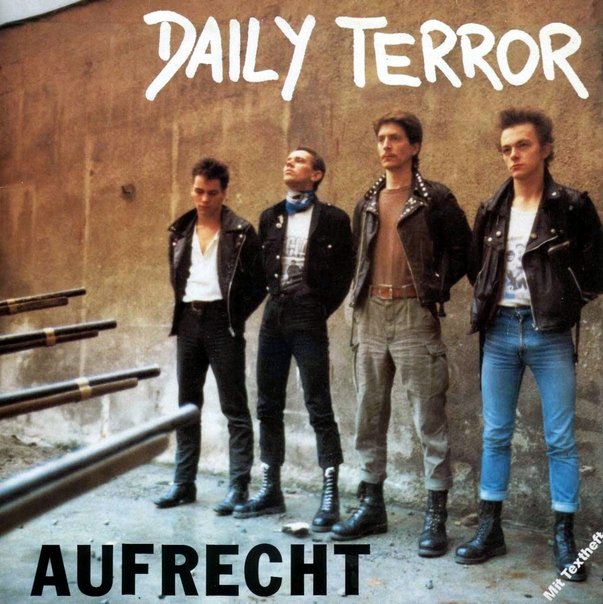
Of particular interest is the track ‘Hinterlist’, which some may retrospectively read as heralding an ideological shift. A haunting punk-reggae tune, perhaps Daily Terror’s greatest song, it depicts the 1982 Sabra and Shatila massacre of Palestinian men, women and children in a Lebanese refugee camp, all of whom were posthumously labelled “terrorists” by the Israeli government. So far, so on point – but then the third verse kicks in:
They gambled away their Holocaust credit long ago
They’ve counted on our pity for too long
If mass murder is their politics
Then the explosive revenge is only fair
It may cause an uproar, but that’s just the way it is
It’s the PLO settling an outstanding score
They gambled away “their” Holocaust credit? “They” can no longer count on our pity? Who is they – and who is us? Wherever you stand of the Palestine-Israel issue, conflating the Israeli regime with the victims of the Holocaust is foolish (even if the regime itself deliberately contributes to this misconception). While one shouldn’t expect too much nuance from punk songs, Pedder seems to be slipping into potentially dubious territory here.
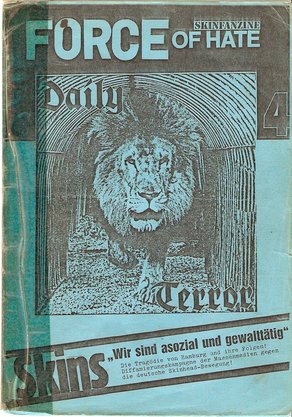
In the punk camp, where crude lyrics were the order of the day, the song didn’t raise any eyebrows – but the third verse was ambiguous enough to strike a nerve elsewhere. Two years later, the nationalist German skinzine Force of Hate still admired Pedder’s “courage”, specifically commending “that he wasn’t afraid to say ‘they’ve gambled away their Holocaust credit long ago’” (FoH #4, 1986).
 A chilling detail: uncredited and unbeknownst to most listeners, the main melodic theme of ‘Hinterlist’ was lifted from Walter Kubiczek’s soundtrack for the 1972 East German TV series Das Licht der schwarzen Kerze. Based on a novel by Wolfgang Held, the storyline involved a Communist spy infiltrating a German military division during the Spanish Civil War in 1937. The protagonist gets hold of a secret nerve gas formula developed by IG Farben, the corporation that would later provide Zyclon B to the nazi death camps. One hopes this musical choice was coincidence rather than some kind of hidden message.
In any case, word about Pedder’s transformation got out. Not ‘Hinterlist’ was the bone of contention, but the fact that he was now a skinhead and went to football with other skins and hooligans, including – contrary to his assurances – rightwing ones. Says Ebbi Hild, guitarist with Daily Terror until the end of 1984,“I suppose punk just wasn’t provocative enough for him anymore. Skinheads shocked more”. Even so, the back cover of that year’s album Aufrecht read: “Greetings to all punks and skins, except the fash”.

In interviews with Force of Hate Pedder later commented: “My attitude towards the punk scene had changed by that point. I had always been friendly with skinheads because of my commitment to football and the numerous Daily Terror gigs they attended, and my switch from punk to skinhead was already becoming apparent.”
“Our problems began”, he continued, “when certain circles learned that I had shaved my head. It got to the point where promoters received anonymous threats and had to cancel our gigs last minute” (FoH #6, 1986). At the end of 1984, Pedder’s bandmates got fed up with it all. Ironically, just after a sold-out show at Braunschweig’s spacious Jolly Joker club, where Daily Terror got to support major-label punk band Die Toten Hosen playing to a 2,500-strong crowd, they called it quits. Pedder was on his own.
Click here for Daily Terror part 3: Emotion, toughness, alcohol
 Creases Like Knives
Pingback: Until the bitter end: The story of Daily Terror and Pedder Teumer – creases like knives
Pingback: DAILY TERROR PART 2: TRANSFORMATION – Moje notatki
Pedder was a thinker, he saw things clearly as they are and did not care about mincing his words. Respect. And the song Hinterlist is one of the best, he was spot on with the lyrics.
LikeLiked by 1 person