Pedder Teumer was born in Braunschweig, a city in north-west Germany, and grew up in what one might call a solid working-class household. His father was a trade unionist and a card-carrying Social Democrat. According to most sources, he was born on 10th March 1956. That’s somewhat at odds with Pedder’s memory of visiting London as a teenage exchange student in 1977, where he watched Chelsea FC and heard punk music for the first time. If the birthdate is correct, he would have already been 20 or 21 at the time.
Other memories include growing up on glam rock, from Bowie to Slade. He would later acknowledge their influence when he recorded German-language covers of ‘Cum On Feel The Noize’, ‘Far Far Away’ and the Bowie-penned Mott the Hoople tune ‘All the Young Dudes’ in the 90s.
In 1977, Pedder returned to Hannover from London as one of as one of Germany’s first real prole punks – all leather and spiky hair. This was very different from the punk scene emerging from Düsseldorf around the same time, which was dominated by art students. In early 1979, he started fronting his first band, the short-lived Bombed Bodies. Their now rare cassette tape contained noisy and rudimentary ’77 punk songs in German, including the early Daily Terror lyrics ‘Schmutzige Küsse’ and ‘Knüppedicke Intoleranz’ (aka ‘Pack’). Released posthumously in 1982, it remains the group’s only recording.
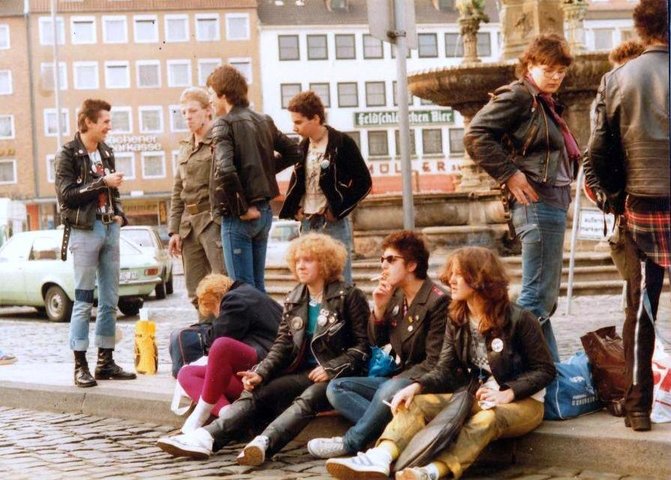
The history of his second band, Daily Terror, begins in 1980. The compilation EP Andere Zeiten captures this early phase, featuring Pedder on vocals, Ebbi Hild on guitar, Heiko Schünemann on bass and Frank Dernbach on drums. The title track, first heard on the various artists compilation ‘Hannover Fun Fun Fun’ in April 1980, was a reggae punk number. In the wake of The Ruts and Two Tone, it was obligatory for every punk band to have at least one song in this style in their repertoire… ‘Andere Zeiten’ was recorded live in 1980, presumably in one of the many radical leftwing squats that hosted punk gigs, such as Braunschweig’s Bambule. As was the case with many German punk bands, this politicised atmosphere left an imprint on Daily Terror lyrics:
If you look different, you’re next
If you think differently, you’re screwed
We won’t take any more of their crap
From now on, we’re fighting back
They’re cracking down with heavy hands
On leftists, gays, hippies and punks
They won’t tolerate any filth in their state
So they resort to terror
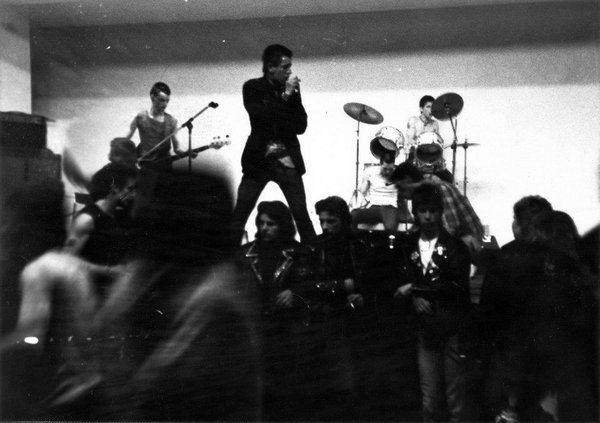
With similarly anarchoid gusto, their track ‘Führer’, driven by a Joy Division-like bassline and published on the Soundtracks zum Untergang compilation in 1981, proclaimed: “We want no leader, for us there’s no superman”. And on their second single, the anthemic ‘Klartext’, they declared: “Anarchy is not for sale, ‘no power for no-one’ is more than just a slogan – boycott the state, there are more than enough reasons”.
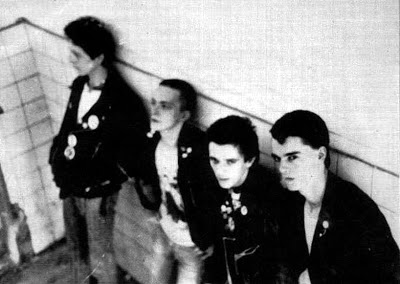
In 1981, Daily Terror signed a deal with Berlin-based Aggressive Rockproduktionen (AGR), Germany’s biggest independent punk label, which was run by Karl Walterbach, a shrewd ex-anarchist. Their debut album, Schmutzige Zeiten (1982), offered basic but melodic street punk somewhere between the 4-Skins and the Ruts, with German-language lyrics railing against society, the police and the state.
Recorded at a time when punk was a lifestyle choice for thousands of young people rather than just a hairstyle, the record is one of the classics of ‘deutschpunk’. Despite a couple of filler tracks, Daily Terror knew how to craft a memorable tune better than most, and thanks to the AGR deal, Schmutzige Zeiten was recorded under decent conditions. ‘Todesschwadron’, a dub-reggae track about the death squads of Brazil, featured some top-notch basslines to rival the best efforts of The Clash and The Ruts. ‘Kleine Biere’ only half-jokingly celebrated alcoholism – a demon that would remain with Pedder for the rest of his life.
Unlike most German punk bands of the era, Daily Terror were skinhead-friendly, and the influence of Oi was as evident on Schmutzige Zeiten as crude anarchoid sloganeering. Skinheads had only emerged in Germany a couple of years prior. They were largely right-leaning in big cities such as Berlin, Hamburg and Frankfurt – although ‘nazis’ only in the same sense as punks were ‘anarchists’ – and their relationship with punks was tense and often violent. Not so in Braunschweig and neighbouring Hanover, however, where skinheads remained apolitical for the time being, and the two youth cults got on fairly well. The photo collage on the back of Schmutzige Zeiten contained a picture captioned “some friends”: a group of young men sporting what could diplomatically be described as an early local interpretationof ‘skinhead gear’.

In 1983, two new Daily Terror tracks appeared on the Keine Experimente compilation: the poppy ‘Leichenberg’ and the quasi-hardcore of ‘Ein Kessel buntes’. That same year saw the highlight of their career to date: a live performance at the second ‘Chaostage’ punk meeting in Hanover.

The local punk and skinhead scenes organised the event as a nationwide ‘unity’ gathering, with leaflets demanding “Oi Oi Oi, not Sieg Heil”. The event attracted over 1,000 visitors, but soon descended into mass-scale violence between punks and skins.
Depending on which account you read, the reasons why things got out of hand are quite different. For one, the presence of ‘nazi skin’ contingents from Berlin and Hamburg didn’t help matters. Secondly, the mass meeting fully exposed the degeneration of the German punk subculture: heroin addiction had become widespread, and many ‘hardcore punks’ now more closely resembled vagrants begging for spare change when they weren’t passed out in their own vomit.
Arguably, the conflict had more to do with aesthetics than politics. In the ensuing battles, apolitical croptops joined forces with a vocal minority of far-right skinheads in the name of ‘skinhead unity’. For many long-standing punks, the mass gathering of drug-addled zombies was also the final straw. Some of them became skinheads – including Pedder of Daily Terror.
Click here for ‘Daily Terror part 2: transformation’
 Creases Like Knives
Pingback: Until the bitter end: The story of Daily Terror and Pedder Teumer – creases like knives
For me and my friends, as Germans, “Kleine BIere” was, first of all, a parody of Bettina Wegner´s “Sind so kleine Hände”, which transports a great message, but was nevertheless a bit too hippie for us at the time
LikeLiked by 1 person