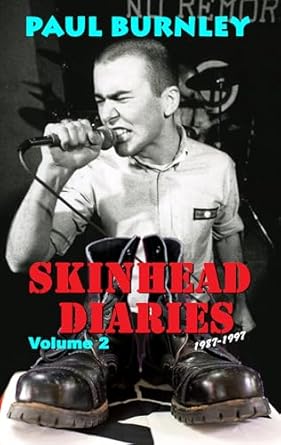
An interesting reader’s letter regarding our review of Paul Burnley’s Skinhead Diaries has reached us this week. It discusses the first volume of the book, which we reviewed HERE, but also the follow-up:
I read both volumes.
I agree with what Crombieboy wrote about the first one.
On one hand, there’s an obvious right-wing bias, selective memory, and what looks like revisionism and exaggeration – probably with the intention of normalising his particular take on skinheads. Basically: “Well, everyone was actually a nazi, and the ones who weren’t secretly wanted to be but didn’t have the guts.” This frames nazis as the ultimate skinheads, rather than just one specific subset within the broader scene.
On the other hand, it also exposes some of the perhaps well-meaning but mistaken revisionism from the other side, since far-right elements were, at least initially, much more intertwined with the rest of the scene than most people today would be comfortable admitting. As I mentioned above, though, Burnley applies the same distortion to non-white, left-wing and various other non-far-right skinheads, who were also obviously hanging about at the time.
All in all, it’s a very interesting read. You finish it wanting to know what will happen in the next volume.
The second volume, however, has much less to offer to those who, like me, were more interested in the skinhead angle than in the neo-nazi craziness. The music part is hilarious, though. The way he talks about the RAC bands as if they were artistically amazing – and that the only thing keeping them from becoming superstars was their political stance – makes you wonder whether he actually believed it and, if he did, whether this blatant proof of insanity could absolve him of his past sins.
Which – spoiler alert – it doesn’t. You keep waiting for the moment when he’ll explain his change of heart and the actual process that led him to abandon racism after it had been his reason to live for more than a decade. But it never comes.
Instead, one day he’s simply not racist anymore. That’s it. What he does explain is how the movement let him down and betrayed him after he had carried it on his back for years. He gets sick of it after being betrayed by former comrades, being threatened, and facing plots from people who wanted to control Blood & Honour, not to mention the conflict with his family.
In the end, it suggests that he became a “normal person” simply because there was no room left for him to live as a nazi and because he missed his parents – not because of any real education or change of conscience. He just couldn’t be bothered anymore; it wasn’t worth the effort to remain a racist.
Not only that, he never recants his earlier claims blaming black people – collectively – for his political stance. In the first volume, you can accept this as the “old him” talking. But since there’s no sign of an actual change of heart or mind, you wonder whether he still believes he was justified in being a racist, given that every black person in London was, apparently, trying to kill him for no reason at all times.
It’s not a bad read and it’s very informative. But you’ll end up with a bad taste in your mouth.
Pedro Carvalho
 Creases Like Knives