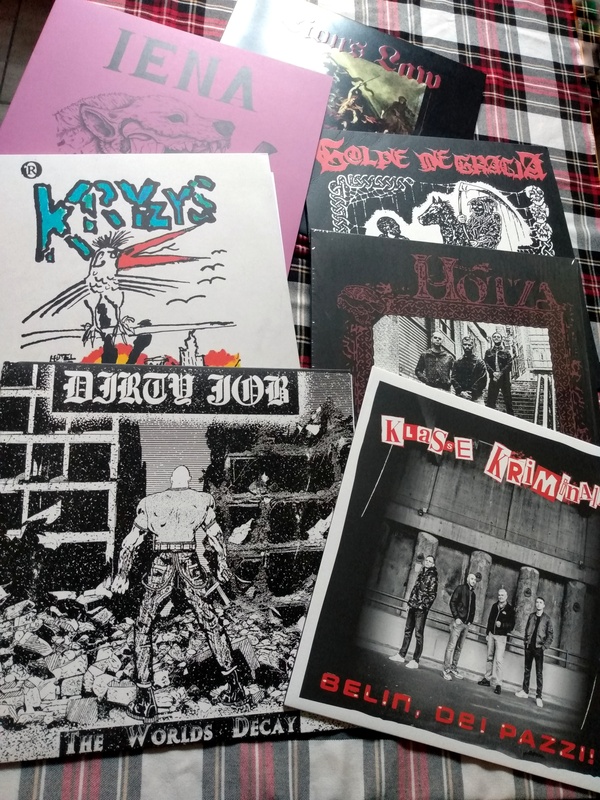
Before the year draws to an end, let me squeeze in just a few reviews, mostly of records that people have sent or handed me in recent months. We’re still in no danger of ever becoming a ‘professional’ publication – as always, some of these good folks have been waiting for months to get their stuff reviewed. I hope they still appreciate the thoroughness and sincerity I’ve tried to put into these write-ups. Many thanks to Timebomb Records, Un Vie Pour Rien, Hellnation, Magura, Golpe de Gracia, and Manufaktura Legenda! All reviews by me this time.
Matt Crombieboy
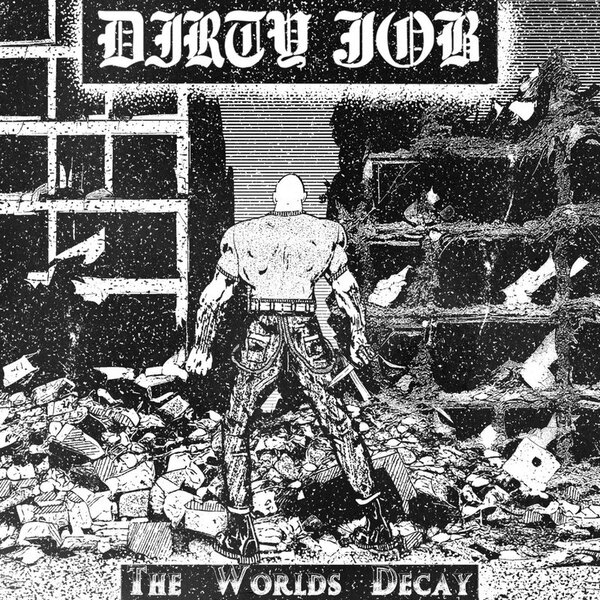
Dirty Job: The World’s Decay LP
(Timebomb Records / Hellnation / Subculture for Life)
One thing straight away: this is my favourite Oi album of 2024, and it hit me somewhat by surprise – even though I’ve been following the band’s activities from quite early on. Formed in the Milan area by members of bands such as Ostile and, formerly, Brutti e Ignoranti and Stanley, they first landed in my adopted hometown of Bologna in February 2023, playing at the Forever Ultras’ clubhouse. They immediately stood out from the majority of young Italian Oi bands by maintaining a certain skinhead orthodoxy, both in sound and appearance, rather than dissolving it into ‘ultras rock ’n’ roll’ or coming off as just ‘random tattooed dudes playing street rock’. The music struck me as harder than most of their peers – not faster or heavier, but harder – and disciplined to the point of feeling almost a little militaristic. Ancient ‘war Oi’ like Vengeance sprung to mind.
I was underwhelmed by the live album Live and Loud subsequently released on Bandcamp. It lacked the compact power I remembered from the actual live experience. Worse, the lyrics, written in shaky English and sung with a thick Italian accent, weighed the whole thing down. Why express yourself poorly in someone else’s language, I wondered, rather than make yourself clear in your own? Thankfully, whether spurred on by my ‘good advice’ or his own reflection, frontman Mauro has since started writing songs in his native tongue. Listeners can hear the improvement for themselves on The World’s Decay, where half the songs are in Italian.
After the Live and Loud letdown, The World’s Decay is a great rebound. It’s tight and punchy. The music isn’t minimalist in the sense of being crude or reduced to its bare bones – in fact, quite a lot of care has gone into the arrangements. But it’s restrained and economic in that Dirty Job know exactly when to avoid unnecessary chord changes or refrain from introducing superfluous sections. Their disciplined, almost stoic approach is what gives the album its toughness and sense of purpose.
As for their outlook, Dirty Job make a point of not being political. On the face of it, I can’t fault people who find politics as dull as I find mathematics for being apolitical – and, truth be told, even skinheads who pin the hammer and sickle, a celtic cross, or a circle-A to their lapel are often as apolitical as they come. Yet, just as no one can escape the laws of mathematics, we’re all subject to certain political realities. In Italy, since at least the late 90s, being a completely apolitical skinhead is something you may get away with in a small town in the middle of nowhere. Elsewhere, you choose sides – you’re with this lot or the other. And so, Dirty Job’s social media pages proclaim that they’re “strictly anti-racist”. At the same time, they state that they’re “against your political colour”. Why? I have no idea – ask them.
The lyrics, then, are mostly about the trials and tribulations of working-class life, wrapped in plenty of metaphors, alongside more straight-talking reflections on the joy and pride of being a skinhead. Musically too, the album delivers pure, old-school skinhead rock. At times, it recalls mid-to-late ’80s second-generation Oi, like Condemned 84 (see ‘One’), while elsewhere it veers towards the sound of Reconquesta (‘Just a Bootboy’) or early ’90s Jersey Oi (‘We Don’t Want You Here’ echoes Niblick Henbane’s ‘We Don’t Want to Play’ – though that’s likely a coincidence). Someone on the socials has described the album as akin to a punch from Bud Spencer. I’ll let that comparison stand, though it’s worth noting that there’s enough variety in the songwriting to keep your attention. For me, The World’s Decay stands out not just because of its sound but because of how often I’ve come back to it: I must have played it at least eight times since I got it. That happens rarely with new releases.

Klasse Kriminale: Belin, dei pazzi! LP
(Flamingo Records)
Klasse Kriminale’s latest album is a mix of music, archaeology and journalism. The cover design pays tribute to Sandinista!, on which The Clash left the boundaries of London and explored the West’s former colonies, taking listeners on a triple-album journey through Latin America, Africa, Southeast Asia, and the Caribbean before returning to the migration hotspots of London and New York. Klasse Kriminale take the opposite approach, embarking on an inward journey and unearthing forgotten relics of their native Liguria region, particularly the towns of Genoa and Savona. For this project, vocalist and band leader Marco Balestrino has reconstructed songs from obscure local 80s bands from memory. For others, he interviewed former members, hoping they’d remember enough fragments to piece them into a cohesive whole. Others still are straightforward covers of existing recordings, though the selections are far from obvious.
This kind of operation appeals to my strongly developed nerdy side, and you can tell Balestrino himself spent years editing a fanzine. One mustn’t underestimate the role he’s played in the local scene: he founded Klasse Kriminale and when few Oi bands were left in Italy – or, for that matter, venues for skinhead bands to play. The same goes for his zine, Kriminal Klass, and the tape compilations he published when many had forgotten about Oi. Balestrino carried the banner high when times were far from favourable. As such, it’s fair to think of him as an Italian Oi activist rather than just a musician.
The choices on this album aren’t confined to Oi, though. There is, for example, ‘Brucia La Città’ , originally an early track by Vanexa from Savona, often hailed as Italy’s first heavy metal band; ‘Skin della Lanterna’, which I understand was by a local folk act called U Boot; and ‘Demolizione Periferica’ by the early 80s new wavers Total Crash, among others. Klasse Kriminale cover no less than two tracks by Gangland, Genoa’s mythical answer to The Last Resort – both originally recorded by Balestrino for his O Con N’oi O Contro Di N’oi tape compilation in 1985. All of these songs are reworked into the Klasse Kriminale formula of well-played Oi ‘n’ roll with big choruses. Essential stuff. If Dirty Job’s The World Decay hadn’t edged it out, this would easily have been my album of the year.
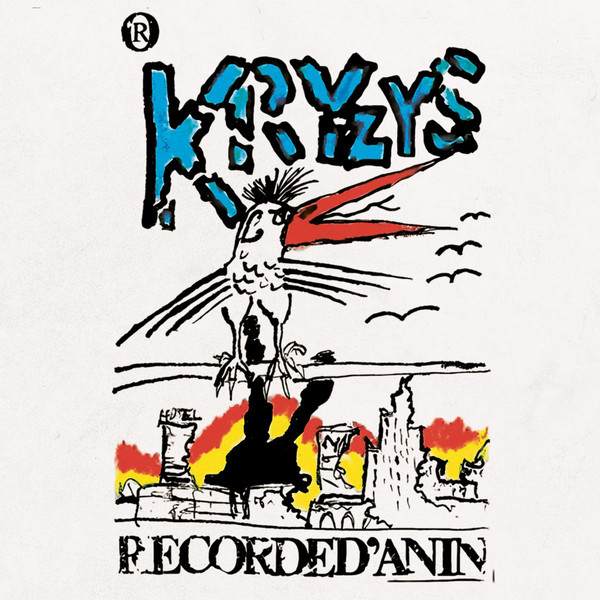
Kryzys: Recorded’ Anin LP
(Manufaktura Legenda)
Kryzys from Warsaw may not have been Poland’s first punk band – that honour probably goes to the Walek Dzedzej Pank Bend or to Deadlock, both formed in early 1977 – but it was among the earliest. Like the Walek Dzedzej Pank Bend, it would later feature Maciej ‘Magura’ Goralski on drums. In the late 70s and early 80s, Magura was Warsaw’s best-connected punk, having visited London, hung out with The Clash, and invited The Raincoats to play in Warsaw as early as 1978 (who, as Magura told me, were very fond of Poland’s bar mleczny: inexpensive restaurants serving traditional Polish staples for workers throughout the socialist period). Kryzys would have their self-titled album released by the French label Blitzkrieg Records in 1981, and much later, in 2010, re-recorded most of their vintage material for the album Kryzys Komunismu.
This recently unearthed recording of Kryzyz’s first gig on 26 May 1979, though, was cut before Magura’s entry into the band. Magura quipped that perhaps this material should have remained unreleased as it features the rudimentary first steps of a very young punk band. Titles such as ‘Shitass’, ‘Identity’, ‘Ramona’ and ‘Holiday in Siberia’ indicate there’s quite a bit of copying from Anglo-American sources going on here, and the band cheerfully steals riffs and choruses from the Sex Pistols, The Clash, Buzzcocks et al. Or rather, it tries to steal them, as the playing is rather abysmal. Within a year, Polish punk bands would produce material worth listening to, and Kryzys themselves would come into their own when Magura introduced influences such as Subway Sect and Television and the band began writing Polish-language lyrics that actually said something.
Although few are likely to play this album more than once, it’s still a fascinating historical document. Apart from capturing the rough early stages of a band that would improve dramatically over the next period, it also debunks the myth of an Eastern bloc that was culturally cut off. There’s no big difference beween Kryzys at this stage and, say, West German bands doing similar UK ’77 copy-and-paste jobs only a year or two prior. What’s more, this was a year before the big strike and the onset of the Solidarność movement. Wherever you see the causes, and whichever side you take – I’m a critical Polish People’s Republic patriot – one thing is undeniable: the system was in crisis. Kryzys was the cultural expression of a group of (relatively privileged) student youths in that period, and the real, unofficial name of the band was Kryzys Komunismu: the crisis of Communism.
This instant collector’s item comes in a gatefold sleeve and with a 40-page booklet chuck full of photos from the gig and eyewitness accounts and anecdotes from various scenesters – something like a mini-Please Kill Me of the early Warsaw punk scene.
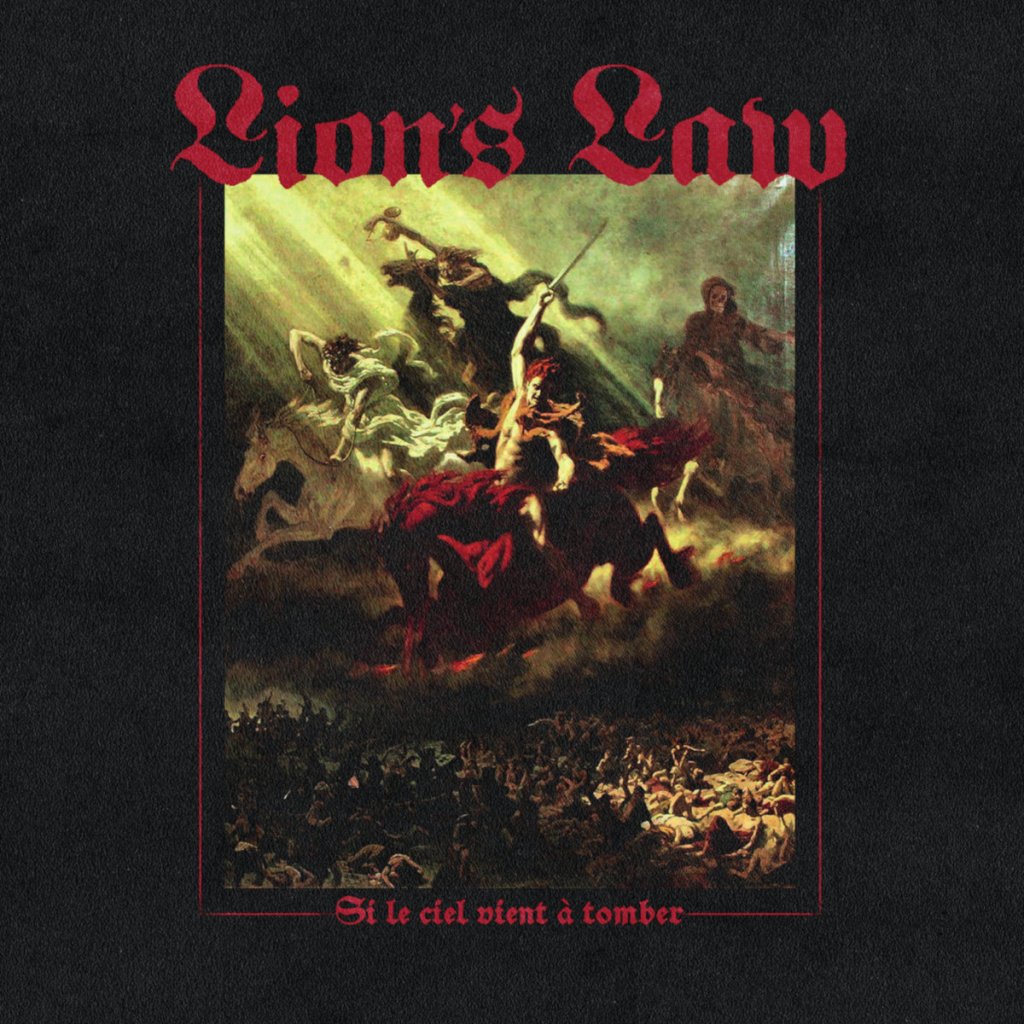
Lion’s Law: Si le ciel vient a tomber LP
(Un Vie Pour Rien)
I’m positively surprised by this. Weren’t Lion’s Law the one band that I disliked out of all projects by Victor (aka Wattie), France’s most prolific skinhead musician? Unlike Rixe, Maraboots, or Bromure, Lion’s Law always struck me as too polished, too professional-sounding – something like ‘mainstream Oi’. This impression was reinforced by the lyrics, written in dodgy English, which felt especially at odds with the patriotism of ‘Lafayette’.
Speaking of which, I find the veneration of a bourgeois revolutionary 200 years after the fact – almost as if nothing had happened since – a bit strange. Then again, this might be partly because I don’t get the French. While the grand apocalyptic battle currently playing out across much of the western world is between a neoliberal centre-left (‘woke’) and a liberalised far right (‘anti-woke’), in France, the liberalism vs conservatism conflict still seems to partly revolve around opposing sides from the French Revolution. And so, you get skinheads who view 1789 as a historical mistake and believe the Eiffel Tower should be torn down, while others sing eulogies to Lafayette. Both sides are sticking to the pure doctrine, as it were, barely troubled by later developments.
In any case, to my ears, Si le ciel vient a tomber is a vast improvement over Lion’s Law’s previous efforts. Apart from two new tracks, it’s a collection of songs from various eras of the band, but this time delivered in French and, unless I’m imagining it, with a somewhat rawer production. These tweaks make all the difference, and I enjoyed the album more than its predecessors – though I still prefer Victor’s other projects.

IENA: Fine alla morte 12’’ EP
(Timebomb Records / Hellnation)
IENA have been part of our journey with this blog since 2018, when, as far as I know, we were the first foreign publication to interview them (we were exclusively UK-based at the time). They’re a reliable factory of powerful, Nabat-inspired, riff-based Oi punk ‘Made in Italy’, and they deliver the expected quality product with the tracks ‘Nessuna Pieta’ and ‘Fino alla morte’. With ‘Gogna’ and ‘Ultima notte’, they exceed our expectations. In the latter case, they succeed in crafting an anthem that will be remembered for years to come, whether for its choruses or the sinister bass breakdown. This is the best song they’ve written since ‘Firenze nord’, perhaps ever – I’m reminded of tunes such as Lumpen’s ‘Fino alla vittoria’. Others have gone further with their superlatives, citing the song alongside classics such as Plastic Surgery’s ‘Rivolta’ and Nabat’s ‘Tempi nuovi’. Maybe they’re right.

Tigre: Nella tana delle tigri Cassette tape
(Flamingo Records)
Tigre, as we discovered last year, is the (fairly) new project of Lobo, formerly of Clear Cut – a Bologna Oi band that distinguished itself by eulogising the Free State of Fiume ‘from the left’. Now based in Genoa, Lobo is also the inventor of the term ‘Turbo Oi’. Much of his musical taste revolves around the harder second-generation Oi bands of the mid-to-late 80s, especially what we affectionately call ‘Neanderthal Oi’. He doesn’t have a lot of time for the genre’s originators: Cockney Rejects, Cock Sparrer etc. It’s curious, then, that Tigre – with their fairly clean guitar sound and Lobo’s clear, higher-register vocals – end up sounding much closer to first-wave and proto-Oi bands such as Menace, The Strike, The Business, and early Peter and the Test Tube Babies. If I had to pick a band from Lobo’s preferred time window that Tigre most resemble, it would be L’Infantierie Sauvage. In any the case, while their style has remained the same since Contro tigre!, their songwriting has improved. This time around, we have four little gems, ‘Insieme’ being the standout hit among them. The lyrics are workerist, defiant, sometimes poetic – and they contain a neat Upstarts reference.
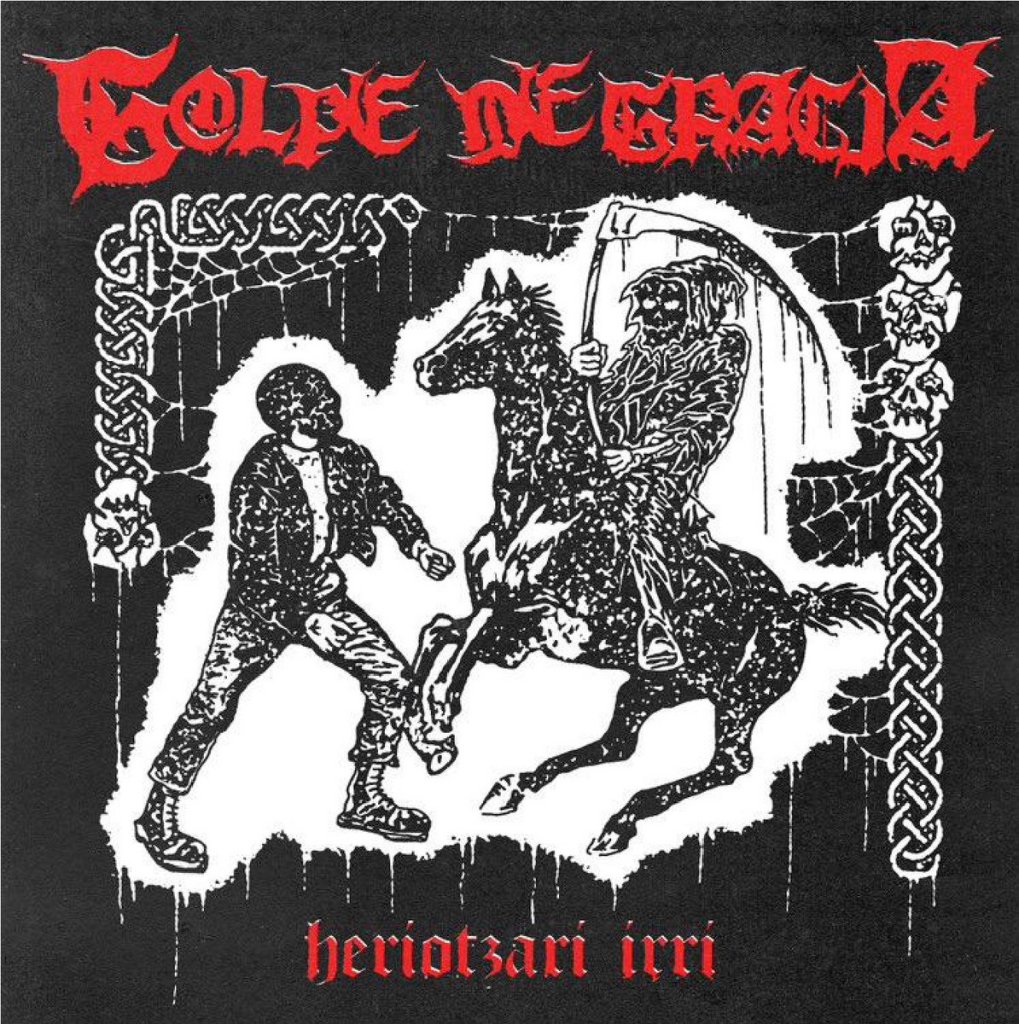
Golpe de Gracia: Heriotzari irri LP
(Primator Crew / Tough Ain’t Enough)
They say everyone remembers where they were when they first heard about 9/11, and probably the same is true of 7 October 2023. While the civilian death toll was roughly three times higher on 9/11, both events served as pretexts for genocidal-scale massacres that rapidly dwarfed the attacks they were ostensibly responding to. I had attended the first Italy gig of Golpe de Gracia from Madrid at a cultural centre somewhere outside Florence. They were decent lads, and we all slept at the venue. The next day, plagued by a massive hangover and affected by a train strike, the Creases Like Knives crew fought its way through the Italian late summer heat to somehow get back to Bologna, catching buses from town to town, as the first news about the Gaza breakout appeared on our phones.
I rather liked Golpe de Gracia live that night, but on record, not much has changed since I dedicated a long review to their previous vinyl outing. Essentially, the music isn’t for me: a kind of 80s-styled Euro hardcore punk cum street punk, sometimes verging on Oi, though not containing enough of it to really float my boat. Once again, I’m fond of some elements in these songs, which hint at directions the band could take, but unfortunately end up not taking.
For example, the riff at the beginning of ‘Mundu barriaren contra’ is great – but completely wasted when, a few seconds in, that well-known polka punk beat kicks in and the song becomes another case of oom-tah oom-tah ramalama. Strangely enough, Golpe de Gracia have saved the best for the end: in the last three tracks, they manage to create atmosphere, and there I’d liken them to a faster version of Bombardiers. Had these been published as an EP, my view would have been thoroughly positive. Maximum Rock ‘n’ Roll seem to be raving about Golpe de Gracia’s releases, so I suppose it’s simply a matter of taste.
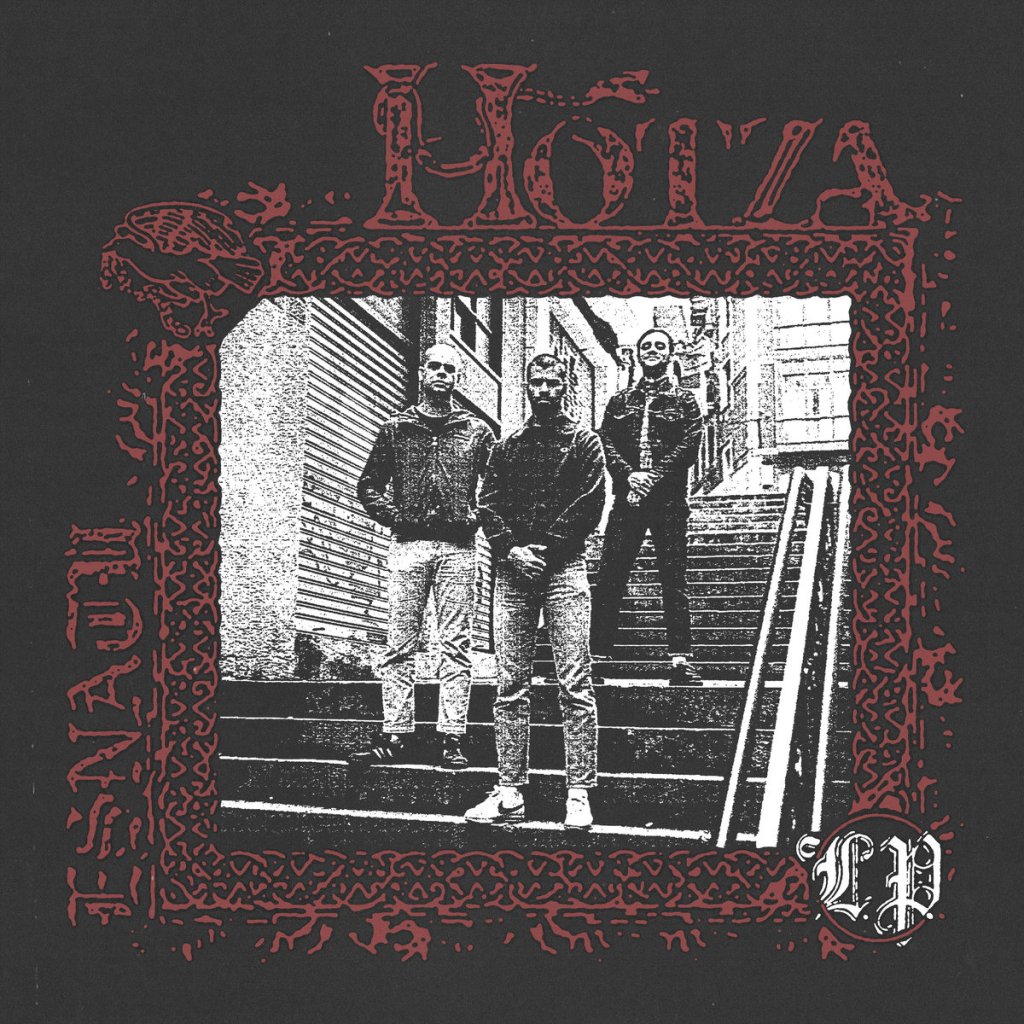
Hotza: Esnatu EP
(Tough Ain’t Enough)
Gruff, low-register vocals, combined with guitars not unlike the Templars’ circa their 1118–1312 EP. Hotza, from the Basque Country, are said to be influenced by 80s French Oi, but as far as French bands go, they actually remind me more of Kohorte IDF, who came around much later than the 80s. Scab Coma would be another reference point. Everything here is quite straightforward and primitive, and now that the skinhead scene has openened up a lot musically, maybe this just what we need now and then: something crude, insistent, and brutal that reminds us of the basics.
In brief: The Basque label Medeku Diskak continues to churn our quality product as if on an assembly line. Among its recent releases, Terre Neuve‘s traditional French Oi gave me the biggest thrill +++ Cesoia from north Italy straddle the divide between Oi and bovver rock on their debut album, now available on various streaming platforms +++ Askania Productions now features a mealy-mouthed ‘Warning! Mature content’ disclaimer when you open their website, giving it a vibe somewhere between ‘trigger warning’ and PornHub +++ Always worth keeping up with: London’s La Vida Es Un Mus label, even if a little hardcore-heavy. They’ve recently reissued the Rixe Collection LP, which contains the band’s releases up until 2017. If you didn’t buy it then, get it now.
 Creases Like Knives
Great review, Dirty Job is amazing, first time listener thanks to the blog.
LikeLike
Dirty Joy. I’d love to hear a duet with Amyl Nitrate from Abductee S.D.
LikeLike