In 1996 you interviewed Robson for the magazine of the anti-fascist association Nigdy Więcej (Never Again). What kind of organisation was it – more of an ‘official’ anti-racist association or a ‘militant’ anti-fascist group?

That’s a question for the founders of this magazine, not for me – although unfortunately the main founder of Nigdy Więcej has died. I don’t entirely understand your distinction between ‘official’ anti-racism and ‘militant’ anti-fascism, so I wouldn’t know where on that axis I would place Nigdy Więcej. Speaking only for myself and perhaps my closest friends from the first half of the 1990s, we opposed street thugs and nazis, but we weren’t active in any political movements.
Your interview with Robson testifies to a good knowledge of youth subcultures. Were you involved in any of them yourself?
Yes, I was a punk.
What were your relations with Wroclaw skinheads before you met Robson – did you know any of them personally?
Our relations with skinheads were obviously not very friendly. In the late 80s and early 90s, punks and skinheads in Wroclaw – like in other Polish cities – were largely at war. So if I had to deal with skinheads, it was in rather tumultuous circumstances. Once I had an enforced chat with a couple of them, namely Siudy and Blondas.
Your keen interest in the skinhead scene is evident throughout the interview. You ask about all the bands – not just the famous ones such as Honor or Legion, but also the lesser known early ones, such as Buty Doktora Martensa and Ramzes. You ask details about clothes, zines, everyday conversations… One can even sense a certain fascination on your part. Why were you so interested in them?
Well no, there was no fascination. I was interested in the world of subcultures. Skinheads especially, because they were our adversaries. But the kind of knowledge you mention wasn’t unusual in our circles.
In hindsight, do you think it was a coincidence if someone became a punk or a skinhead in Wroclaw in the late 80s, early 90? Were they a different ‘breed’, from different backgrounds, or were they quite similar to punks?
I think all the early skinheads in Wroclaw were originally punks. Maybe they were annoyed that punk had become a bit of a fashion and disliked the ideological leanings of some of the punk scene. So they picked a new edgy subculture and in the process turned against punk. Some of them additionally took an interest in nazism or in Polish national radicalism. And while I can understand to a degree why people got bored with punk, I could never quite work out why that made them want to become street thugs and nazis. In the late 80s and early 90s, new younger people began to join these early skinheads – people who had never been punks and became skinheads straight away. In the early 90s, there was even a kind of fashion for being a skinhead.
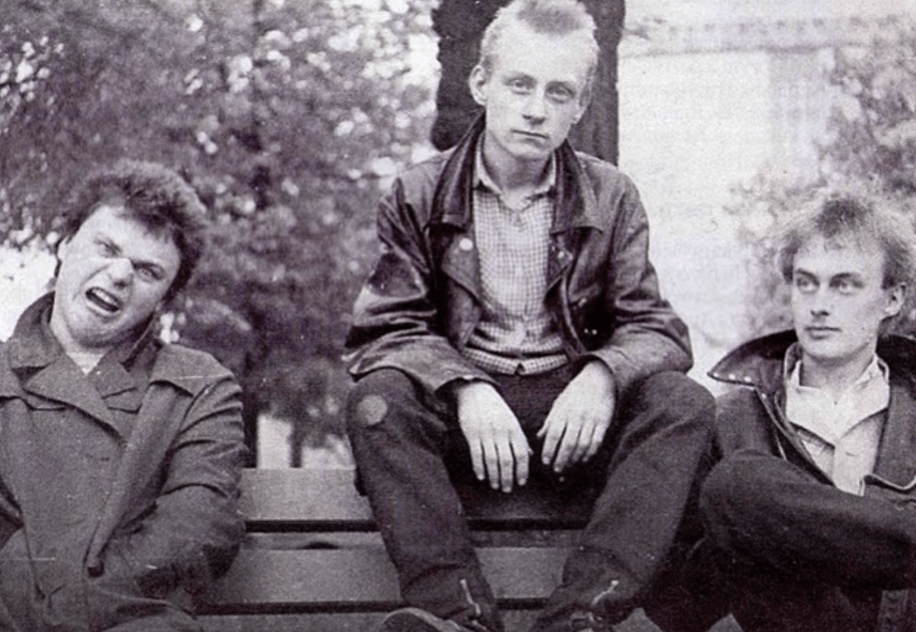
But were they different ‘breed’? From our point of view as punks, they probably were. In any case, they were our enemies, so we didn’t get into a detailed analysis of this ‘breed’. We just had a poor opinion of them.
The Culture.pl website has an interesting article about Wroclaw’s punk and alternative scene of the 80s, ‘A Pitched Battle for Peace’. The author says there was a ‘proletarian hooligan punk’ scene in Wroclaw, with bands like Sedes, and that it was at odds with the artier intelligentsia punks. Was there a genealogical link between those hooligan punks and the first generation of Wroclaw skinheads?
There was no division, let alone rivalry between ‘proletarian’ and ‘intelligentsia’ punks – at least not in my time. The differences in preference for particular strands of punk did not coincide with differences in background, in my opinion. But to find out how it really was, you’d have to do proper research. As far as I know, there are no such studies. Of course, as I have mentioned earlier, there was a genealogical link between punks and early skinheads. Among the earliest Wroclaw skinheads, we also find the earliest Wroclaw punks.
Did early Wroclaw skinheads mostly come from working class backgrounds, or was there a mix? And since we’re at it: were there any meaningful differences between classes in the Polish People’s Republic anyway?
I have no idea what their backgrounds were. This, too, would have to be properly researched if you wanted to make any theses on this subject. I won’t comment on class differences in the Polish People’s Republic, because I would have to prepare myself more thoroughly for this. That’s a question for sociologists.
In the early 90s, Wroclaw had a reputation as the Polish capital of nazi skinheads. Why Wroclaw – something to do with Silesia’s complicated historical identity? Robson mentions that some of his friends, almost schizophrenically, considered themselves German…
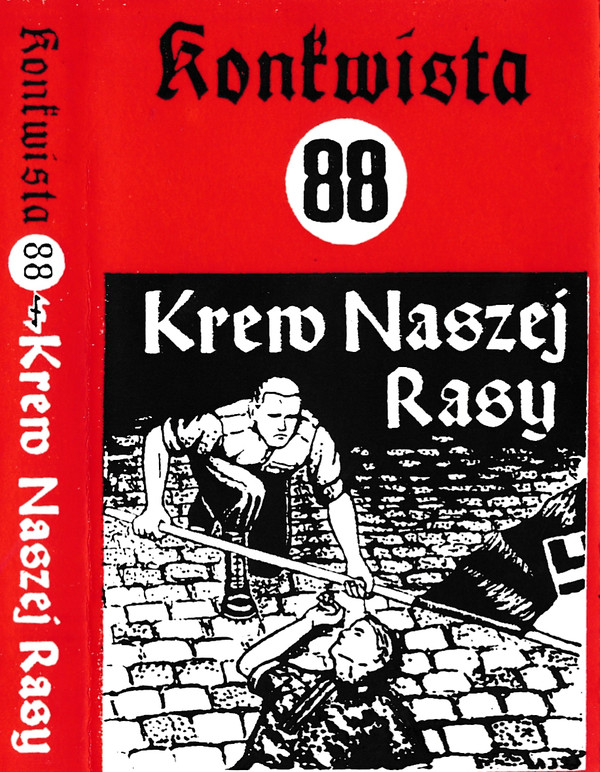
I don’t fully agree with the notion that Wroclaw had such a reputation at the time – you could make the same claim about Warsaw or Gdansk. Perhaps Wroclaw had the distinction that the local nazi skinhead contingent was small, but knew how to look after its own PR. They had a flagship organisation, the AFP – i.e. Aryan Survival Front. With Konkwista 88, they had a band that was known across the country. They exhibited certain organisational and business skills, and they established contacts with people abroad.
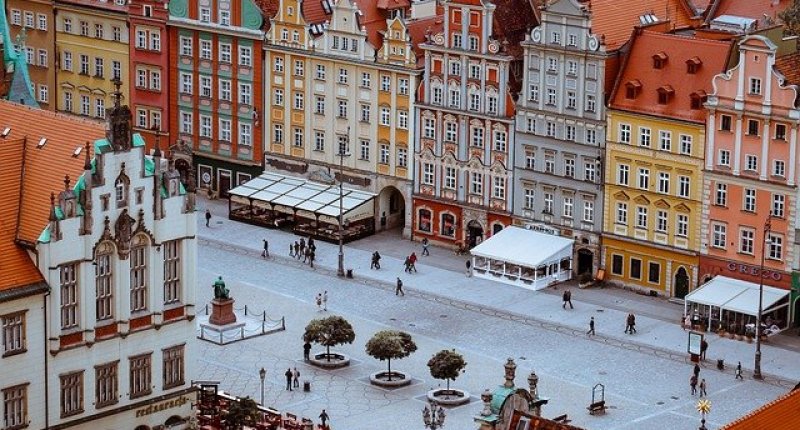
At the time, Wroclaw was a young and embattled city with a tendency towards radicalism. The local nazis drew strength from this foundation, but they were by no means representative of it – or of our town as such. Wroclaw is an open, safe and friendly city, not a chauvinistic or thuggish one.
Generally speaking, in western cities in the 80s, nazi skins didn’t bully random black people or immigrants, but normally attacked other subcultures, e.g. squatters, punks, anti-racist skinheads or street gangs. What was it like in Wroclaw – was it dangerous for black students to walk the streets, for example?
I wouldn’t be so sure that nazi skins generally didn’t bully random black people or immigrants in western cities. The activities of British nazi skinheads, for example, testify to the contrary. In Wroclaw, the most notorious incident was of course the demonstration in Świdnicka Street in early 1990, also described by Robson, where there was a clash between nazis and black students.
You mean the demonstration in honour of Nelson Mandela. Robson mentions that some of his mates were stabbed and hit with knuckledusters. The fact that black students were carrying such tools would suggest they had encountered bad situations before.
As far as I remember, attacks on immigrants and non-whites did occur. But fortunately they were not a common phenomenon. The attack on the black students’ demonstration in Świdnicka Street ended with a police operation, and the ringleaders of the nazis were brought to justice. Rightly so.
I imagine becoming a redskin was an unusual step in 90s Poland. Was Robson the only one, or were there others?
I remember a few mates who considered themselves redskins or at least were interested in this tendency. But it’s difficult to speak of a broader phenomenon in Poland. The fact is that Robson had distinctly leftist views and was happy to voice them.
What traces of the skinhead era of the 80-90s remain in Wroclaw, and what has become of the original members of that scene?
I would recommend articles by Jacek Harłukowicz from Gazeta Wyborcza newspaper, He has observed this milieu, and his articles provide a comprehensive, complete answer to your question. I myself have stopped bothering with this subject a long time ago.
Interview: Matt Crombieboy
Click here for intro and Robson interview.
Below: Krzycelismy Apartheid! (2006) – Polish TV documentary about the punch-up between nazi skins and Mandela supporters in February 1990 in Wroclaw. With Robson, Łukasz Medeksza and others. English subtitles.
 Creases Like Knives