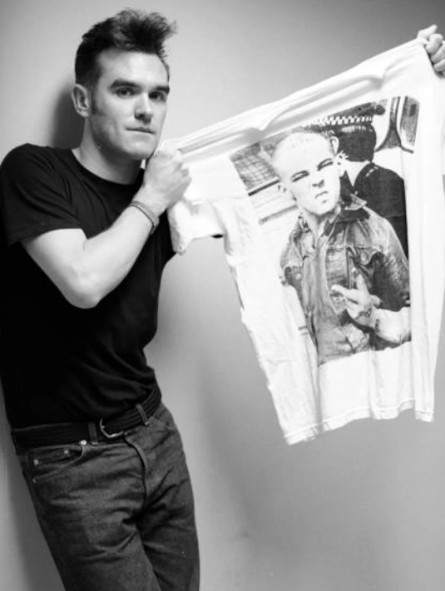
From early on in his solo career, Morrissey has held a strong fascination with skinheads, skinhead girls, suedeheads, and East London, defiantly championing a world on the brink of being bulldozed by neoliberal power. At Layers of London, Andrew Stevens has created a map of Morrissey’s East London locations, which you can explore HERE. This is his introduction.
Can anyone speak of an “East London demi-monde” for Morrissey? I thought as much a decade or so ago, penning this in the foreword for a new edition of Richard Allen’s Suedehead (Dean Street Press), as across much of his career the once avowedly Mancunian singer has returned consciously and decisively to East London – not as a heritage object but as a living myth. This distinction matters. Raised in Stretford, not Stratford, East London becomes in Morrissey’s imagination less a bounded geography than a portable identity: a code that can be adopted and inhabited. The bombsites and bath houses, spit-and-sawdust pubs and boxing clubs of Bethnal Green, Wapping, Dagenham and Plaistow form a counter-map to the depicted metropolitan glamour of Piccadilly and cabaret queens of the Royal Vauxhall Tavern. They are the stages on which he has repeatedly located a defiant, wounded, theatrical working-class masculinity – part elegy, part provocation.
 Creases Like Knives