 CONTINUED FROM PART 1
Skinkorps has been described as provocative, chauvinistic, nihilistic … How would you describe the attitude and outlook of Skinkorps yourself?
When a human being speaks about another person or entity, they need to classify them in order to be able to position themselves in relation to them – that is, to accept or reject them. The thing that many people cannot understand is that we were fully-formed, sovereign individuals. Even if we gave the impression that we were all going in the same direction, we were not necessarily taking the same road.
Take anti-communism, for example. Yes, we were anti-communist, but for different reasons. One of us was anti-communist for the sake of provocation; another one was anti-communist out of political conviction; and the third was not necessarily against the idea but against the methods. We accepted our differences. One of the few things we agreed on was music.
So Skinkorps were provocateurs, nihilists, chauvinists? Well, most people who talk about us don’t know us. They can say whatever they want, but it doesn’t really matter. We never had any pretensions that we were going to change the world. But I have to admit that we didn’t make it easy for them, especially when we were talking bollocks in interviews – if people asked us stupid questions, they got stupid answers.
We had serious lyrics and less serious ones, and sometimes the two would get mixed up. In hindsight, it can’t have been easy to put us in a box. I think that’s why the band is more appreciated in non-French speaking countries.
Some of your lyrics were obviously ambiguous, and sometimes it’s difficult to tell where sarcasm ends and seriousness begins. But I agree: most people don’t appreciate that skinhead bands, like all other bands, are made up of different people who don’t all think in the same way. What’s more, individuals can be complex, even contradictory.
Or both complex and contradictory!
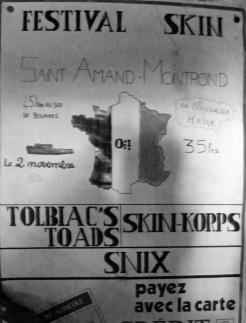
So how often did you get to play live in the 80s? Did you share stages with other first-generation bands like Warrior Kids, L’Infanterie Sauvage, Tolbiac’s Toads…?
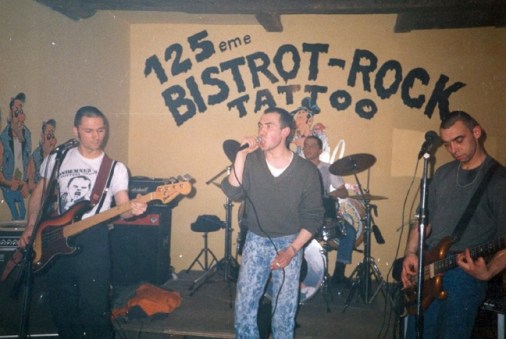
We played 23 shows from 1983 to 1989, and two shows in 1990. That’s not a lot, but at that time in France the infrastructure for amateur bands was very weak. And from the mid-80s onward, it wasn’t the bands or the venues that were the problem, it’s that the majority of skinheads were dumb as fuck. We shared stages with Brainwash, Snix, Komintern Sect, Trotskids and Brutal Combat – that was all.
It seems that you had a bit of a drummer problem?
In the beginning, I was the drummer. When our first vocalist left before we recorded the first EP, we had already lost a lot of time due to successive departures for national service from 1983-86. Instead of postponing the project to look for a new singer, I convinced the others that it would be easier to find a drummer and that I could do both in the meantime. We also played a gig with a drum machine.
Then we managed to convince our guitarist Rénald’s younger brother Cyril to play the drums for us, but he had a serious motorcycle accident and couldn’t play for several months. So we went back to the drum machine, and Boni, the Snix drummer, helped us out twice for gigs.
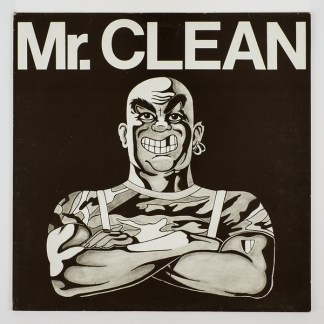 In 1987 you released your debut album Mr Clean, which is considered a classic of French Oi today – rightly, in my opinion. How do you feel about the album when you play it today?
I actually made a point of listening to the album again before the interview – it’s been years since I last played it. It really is a very good album, but as with all the other records we cut, the sound of the electronic drum kit isn’t great. We opted for this solution for reasons of time, but luckily, the drummer was very, very good… (grins)
The singing bothers me a little bit, but everybody was singing like this at the time. On the demo and on the first EP, I tried to sing like our first vocalist to avoid throwing people off, and then I just continued in that vein. There are some old Acide Vicioux songs on that album, plus newer ones that were written just before the recording. It’s when I started to write the lyrics and suggest some music.
We should have put the guitars louder in the mix, but with Rénald’s guitar playing it would have sounded too punk. Rénald was and remains a big Sex Pistols fan. He was born in 1959, so he was a bit older than us, and he had grown up with all kinds of 70s music culture that we weren’t quite as familiar with. We wanted to stay true to the spirit of the early days of Skinkorps, but the band and the sound had already begun to change.
In fact I noticed the other day how much the music on Mr Clean sounds like Never Mind the Bollocks, even though it’s technically an Oi album. I’m sure the production wasn’t as expensive, but it’s got that big wall of sound, and the riffs and guitar licks closely resemble Steve Jones’s style.
Yes, that’s right. To Rénald, Never Mind the Bollocks is the best punk album of all time.

The title track ‘Mr Clean’ is the high point of the album. Strange lyrics, though – something about a guy called Mr Clean who gets a tattoo and joins the National Front (FN) to make Le Pen happy. Is this some kind of satire?
Thanks for noticing the satiric tone – many people don’t. The idea was more or less mine. I stole the image of Mr Clean from the band Brainwash from Caen – to be precise from Beubeu, the guitarist’s brother. He was a real brother to me and an expert on punk and urban cultures. I learned a lot from him, for example how not to become intolerant or a dick. He used to draw, and one of his pictures showed Mr Clean hanging Boy George by his braces. It was dark humour. Beubeu was unfortunate. He was hit by a car when riding his bike and died. He was still young.
Anyway, I had met skinheads from Le Havre who boasted that they were members of the security staff for Le Pen’s National Front meetings. I thought it would be funny to link up the two: ‘Mr Clean’ and those boys who were proud of doing someone else’s dirty work. So, all those people preaching a very white France inspired me to write the song. And yes, the early lyrics I was writing were satirical. Like for example ‘La danse des peaux rouges’, where I made fun of French redskins without getting too nasty. At that time that you had to choose sides, and it was very difficult for skinheads like me to exist and remain neutral.
However, a lot of skinheads took ‘Mr Clean’ at face value. In a lyric that isn’t explicit, you understand what you want to understand, and I was a bit naive to think that most skinheads wouldn’t be so stupid. I also wrote the music for the song, which I wanted it to sound like Sham 69. It’s pretty good, isn’t it?
As a leftist, I find ‘Le danse des peaux rouges’ very amusing – anthemic, even [laughter] Either way, the album was the first release on Rebelles Européens, a far-right label that went on to publish albums by the likes of Bunker 84 and No Remorse. Why Rebelles Européens, of all labels?
Skinkorps used Rebelles Européens just to get the album out. We had already been going for five years, and the very few offers we had all fell through. We discussed the matter and decided to go with Rebelles Européens since it was the only offer on the table. Personally, I didn’t take their right-wing daze seriously since they were just a small handful of people at the time. In hindsight, I was completely out of touch with reality. Everything began to change. I couldn’t understand the craze for all those nazi bands, which I thought were very poor.
 It does seem that Skinkorps were far less politicised than many other French skin bands at the time. But from today’s point of view, it’s hard to understand why an Oi band would want to appear on a compilation like Debout! alongside Bunker 84 and Legion 88 – let alone play gigs with such bands.
We had taken a decision not to become political, but then we became political anyway through the choices we made. Taking part in the Debout! compilation was unnecessary. But one member of Skinkorps was listening to bands like Legion 88, Bunker 84, No Remorse and so on. It was he who was managing the band at the time, and the rest of us were just following. It was like, “we’re going to do this” – “ok”, “we’re going to play there” – “ok”. There was mutual trust. I found these bands so ridiculous anyway, it was inconceivable to me that we would be equated with them.
Now, it’s true that most of these bands had been around for a while, but they had been less active and less visible. It also seems to me that they were playing around with bad taste humour, no worse than most French people at the time – a bit beauf [a stereotypically provincial, slightly racist and sexist white male – Editor]. We were initially playing with this image too: the average French beauf was the Skinkorps trademark, as it were. Or at least I thought so, but maybe I was alone in playing with that image without taking it seriously.
We can’t avoid mentioning a certain festival planned in Brest for October 1987, where Skinkorps were to be part of an ‘illustrious’ line-up. Apparently, there were riots and even stabbings in Brest that night? Tell us about your memories of the event.
Not much to say on this subject. We went by car and arrived at Brest train station, which was the rallying point. The station was packed to the rafters with nazi skinheads… I think Bodilis was arrested by the police, and the show was cancelled [Bodilis Gael of Rebelles Européens records had organised the concert – Editor]. We immediately returned to Rouen, rather relieved that it had gone like that. For me, it wasn’t the same anymore.
 In fact, in your last fanzine interview – I think in 91 – you seemed disillusioned and made critical comments about the “surge of Nazism”, skinheads marching for the National Front (FN), and so on. Did any particular experiences make you more critical of the far-right politics infesting the scene?
Well, I already pretty much told you what I thought about it. I didn’t take any profound interest in the whole thing, but from what I understood at the time, a real structure and networks had developed. It had become a matter of great importance for some to be the biggest and baddest nazi of all.
There was a slight change of musical direction with your second album Il faudra vous y faire, which came out in 1990. It was still punk rock, but some typical Oi characteristics were gone: the vocal style was cleaner, the tempos a bit faster. Were you consciously trying to become more of a punk band and less of a ‘skinhead’ band?
Having left everything in my brother’s hands for so long, I realised that I had to take the lead because I was the singer and writer of the band. By that time, all the bands were nazis, everyone played the same, and all the vocalists were barking in the same way. I decided that we would be different – and that’s also why the album was very poorly received. A lot of morons criticised the cover artwork. They’re idiots, intolerant and brainwashed, and they listen to nicely packaged crap. Maybe the problem was that there were no celtic crosses on the cover. They can keep jerking off to Skrewdriver and stop getting on our tits.
As for the content, it’s true that it had nothing in common with what was happening at the time, especially in France. We were a bit ahead of the game. One can criticise the production and the mix, which would have needed far more time than we had. But I’m stunned to hear people say that the album is musically average! I don’t think these guys have any musical culture at all.
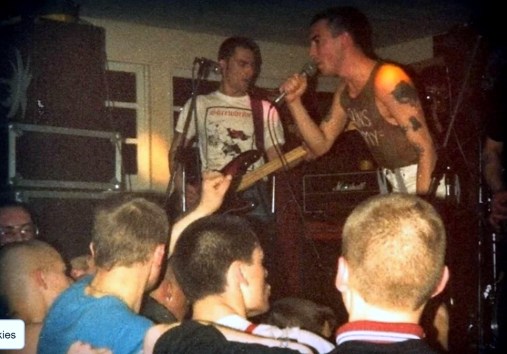 An online reviewer described the songs on the album as ‘disillusioned, bordering on nihilism and expressing disgust at the political class’. Did the tone of your lyrics change over time?
These are bullshit explanations from people who haven’t understood anything – but yeah, it’s true that we didn’t make it easy for them. Early Skinkorps lyrics were basically Acide Vicieux lyrics. When a bunch of very young punks sing stupid and nasty songs, it makes people laugh. But when a bunch of skinheads in their twenties sing the exact same lyrics, they stop laughing – why’s that? Later on, my brother would write lyrics that were more ‘skinhead’, more ‘warrior’. And after that, it was my turn. I tried to return to our original tone but didn’t have the same ease of writing.
On the second album and on the few releases that followed, I tried to make things clear when I said “in politics you have no friends”, by which I meant that we don’t support any party. ‘Enfants de toutes ces guerres’ (Children of all these wars) is about the fall of the Eastern Bloc countries and the Berlin Wall – a hymn to democracy. It’s very simple.
And in the song ‘Ça n’a plus d’importance’ (It doesn’t matter anymore), I explain that a page has turned, and that we are on top with the gods of rock ‘n’ roll, but you have to read all the lyrics of the album and rack your brains. There are messages in each of my lyrics. When I sing, “we’re not hiding behind any flag, behind any colour”, that’s not difficult to understand.
 Many young people were disillusioned with François Mitterrand’s government at the time, though, and the album did contain a song called ‘Génération Mitterrand’. What were the lyrics saying?
‘Génération Mitterrand’ was not written out of disillusionment, but to denounce this well-meaning fascist left, which set up an anti-skinhead campaign with the complicity of the media – see our song ‘Média Folies’ – and quite a few left-wing ‘intellectuals’, the champagne left. That campaign ignored all the Anglo-Jamaican and working class culture inherent to this movement, talking only about xenophobic aggression – which was real, of course – and giving the floor to complete moron ‘skinheads’. It put harmless young people in danger, and it helped to swell the ranks of racist skinheads. The Socialists in France are just a bunch of bourgeois who call themselves left-wing to clear their conscience. They aided the National Front (FN) to weaken the centre-right, while at the same time betraying the Communists. Either they’re complete fools, or they knowingly participated in the planned destruction of the French left.
Speaking of which: like many French skin bands from the 80s, Skinkorps were anti-communist, but today you’re wearing a Che Guevara t-shirt. Have you become a bit of a leftist yourself?
I got the t-shirt as a present. I’m not pro Che Guevara, but my friends know that I’ve always been anti-capitalist, even if I’m not a leftist. I find it amusing to make people think that I am, though. Communism is more frightening to the ruling classes today. In the 21st century, being far-right is no longer scary – it’s very ‘of the past’.
 Most of the bands from the 80s who said they were anti-communist were just groups with nazi tendencies. They wanted a ‘lite’ image in the beginning, but they discovered their real selves later on. My anti-communist side was a bit deeper than that. For me, it was the Communists’ contradictions that I couldn’t get my head around: their anti-militarism, their distrust of the police – as if the Communist regimes didn’t have repressive police, military means beyond what was necessary, and so on. The difference to the capitalist system wasn’t apparent to me.
I’ve always been more of an anarchist, but I get along better with people from the left, who aren’t so stupid, than with people from the right, who I can’t stand anymore.
By 1991, most members of Skinkorps were no longer skinheads. Did social pressures have something to do with that?
You see, educating people is a good thing. But you don’t necessarily want to explain all the time that yes, you are a skinhead, but no, you don’t attack non-white people, and no, you’ve never voted National Front, and no, the Skinkorps song ‘Barbie’ is not an ode to Nazism. So you try to go unnoticed, especially after the government’s anti-skinhead propaganda, and especially if you work in Stains, Pierrefitte, Bobigny or La Courneuve [multiethnic working class suburbs of Paris – Editor]. I didn’t become a skinhead because I disliked immigrants, I did it for the skinhead ‘way of life’, which had completely disappeared.
Changing to a lighter topic: you’re a tattoo artist. What styles do you specialize in?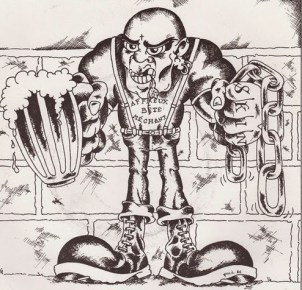
I’ve been a professional tattoo artist since 1995, but I already started tattooing in 1982. I don’t really have a speciality, I just do what I’m asked to do – that is, anything and everything. For me, there are no rules except the rules of hygiene, which are mandatory for this profession. I’ve been sterilising my equipment since 1983.
Have you tattooed any members of classic French skin bands from the 80s?
I have tattooed members of Skinkorps, of course… I have also tattooed the guys from Brainwash, Komintern Sect, Evil Skins, and maybe a few others I don’t remember. Sorry if I forgot you!
A few years ago, you posted some new songs under the Skinkorps banner on YouTube: ‘L’amour dans les cimetières’, which appears to be an old Acide Vicieux song, and ‘Rock baby, sur la plaque de verglas’…
All the ‘new’ Skinkorps songs on YouTube and on the Facebook page were in fact written in the period after the second album. We were rehearsing with three people and a drum machine for two years, and all these songs could have been released on a record if we had got an offer back then. The songs are even more punk, but still Skinkorps.
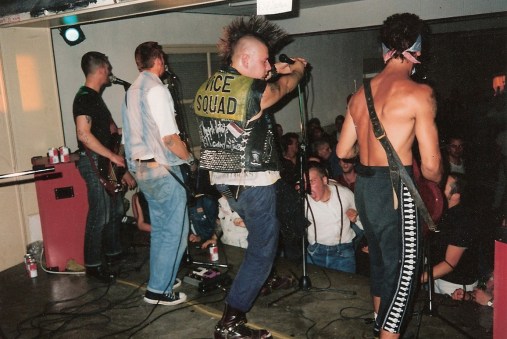
I suggested to the other band members to get a new singer and change the name of the band for good. Fabrice, a mohicaned punk I knew whose nickname was Sid, was singing with us just for fun. That’s why I decided to record them with Rénald because they seemed to be good compositions to me – and to render unto to Ceasar the things that are Caesar’s. The track ‘Rock sur la plaque de verglas’ was recorded alongside the tracks ‘Chaos’ and ‘Affreux et méchants’ at the same time as the second album.
On your Facebook page, you describe Skinkorps as ‘burlesque street punk’. Will we see any new albums or live shows under that banner?
I called it street punk burlesque because we’ve always played punk rock, and most of our lyrics are to be taken with a pinch of salt – even the more serious ones aren’t necessarily less funny. We were close to releasing an album, but it may never happen. The sound and the compositions are too ‘old school’ – maybe one day! No live shows, though. The band will never reform.
Do you have any regrets with respect to Skinkorps?
No regrets. The adventure continues!
 Creases Like Knives