 Skinkorps – what’s your take on them? Asking Creases Like Knives contributors and friends, I get a broad range of views. “They were one of the dodgier French 80s bands”, says one of them. And a French acquaintance adds, “We pretty much take for granted that Skinkorps was a right-wing band”. Another friend counters, “they had a bad reputation and some provocative attitudes, but probably no interest in politics”. And a fourth one agrees: “They were just a regular Oi band, no different to The Last Resort or 4-Skins in Britain”.
Whatever truth – or untruth – to each of these statements, it’s beyond dispute that Skinkorps from Rouen played some of the most bone-crushing Oi of the 80s. A typical Skinkorps song was mid-tempo to sluggish, featured a loud bassline that carried the tune along and a rough vocal with that arrogant, domineering intonation so characteristic of French bands from the period. The lyrics were often humorous, sarcastic, even cynical – too ambiguously so for some tastes. With Mr Clean, Skinkorps released one of the definitive French Oi albums of the 80s, every bit as hard-hitting as earlier classics by Komintern Sect and Camera Silens.
I spoke to Skinkorps lead singer Philippe Nicolas, who – much to my surprise – sports a Che Guevara t-shirt nowadays… I would like to thank Alain from Saint-Étienne for helping to bridge the language gap.
Matt Crombieboy
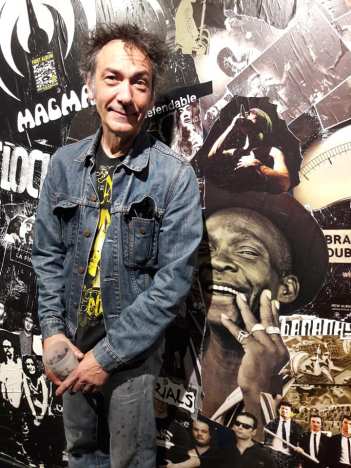 Hello mate – could you introduce yourself to our readers, please?
Hi, my name is Philippe Nicolas. I was the lead vocalist of Skinkorps on all vinyl releases. I also played the drums on the first two EPs (Une force, un hymne and Super-Picton) and on the first album, Mr. Clean.
You come from a working-class suburb just outside Rouen, the capital of Normandy. What was it like growing up there?
Growing up in the suburbs of a medium-sized French city in the 1970s was nothing exceptional. There were still fields in the city and a lot of wasteland, an open-air garbage dump, parks and a forest. If you were lucky enough to have a bike, what more could you ask for? Saint-Étienne-du-Rouvray, the commune just outside Rouen where my parents decided to settle and built a detached house in 1971, was and still is a working-class town. It may seem insignificant, but living in a detached house with a basement where you could make noise and music was essential – because if we had stayed in a council flat, everything would have been different.
Growing up in this place was very enriching, I met all kinds of people, but I was always more interested in the common people, the ‘people from the bottom’, as they were called at the time – especially thieves of all kinds, bad boys with their own rich and colourful vocabulary. Those were the really interesting people. I liked to be around them, observe and listen to them – and although I wasn’t like them, I was accepted. Everyone was aware that my father was a simple law enforcement officer, but all the same, they knew that my lips were sealed.
Almost all European skins from the early 80s had originally been punks, and you were no exception…
That’s right. Before I donned the skinhead costume, I was a punk and a bit of an anarchist. When I first became aware of the punk movement in 1977-78, it immediately caught my interest. The sound of all these new bands, the outrageous look that started out as hijacking and reassembling clothes… There was a lot of creativity, even if at the time everyone thought it was in poor taste.
Because of the subject matter he covered in his lyrics, Johnny Rotten of the Sex Pistols somehow changed my way of looking at the world and understanding life. That’s when I started to do what I wanted and in the way I wanted. Don’t get me wrong: I always respected other people’s choices, which often drove me to situations close to schizophrenia when I became the singer of Skinkorps…
When I was 13 or 14 years old, I started going to Rouen with a friend from school, whose job was to listen to punk records and buy them for his older brother. There was a small record shop called ‘Mélodies Massacre’ in the Rue Massacre, where you could find vinyl imports.
 Was there a punk scene in your hometown?
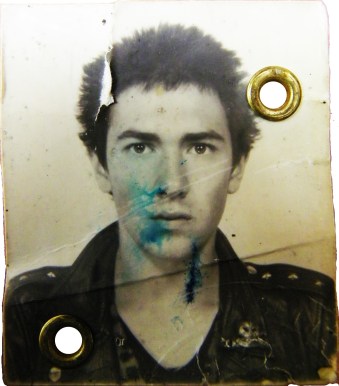
In Saint-Étienne-du-Rouvray, punk didn’t really exist. Some young people probably took an interest in it, but at my school I was the first to sport a punk look. In retrospect, mine was an offbeat look: the look of a person of modest means wearing short trousers, a jacket that is too big, a pink shirt and green tie. And the haircut was very important. The haircut is what shocked people the most – and as I would soon realise, a shaved head shocked far more than blue hair did.
I met this guy who lived near our place, who also embarked on a punk adventure. He had a minor advantage over me: in the summer, he would stay in the suburbs of London to improve his English. He had punk t-shirts that I didn’t have, and he became the singer of our first band, Acide Vicieux. My older brother Frédéric let himself be tempted by the adventure and became the bass player. We were joined by others, but they never dared to sport a punk look, although some of them became skinheads later. This was partly due to a hair problem: some of them had curly hair, and it wasn’t easy for people with curly hair to be punks!
But back to your question: Saint-Étienne-du-Rouvray is located on the left bank of the river Seine, and Rouen is on the right bank. Unfortunately, due to this natural barrier, it felt as though we were rubbing shoulders with the Rouen punks without having any real relations with them. I always found it strange. There were at most fifty punks in the whole Rouen metropolitan area – probably less.
Your punk band Acide Vicieux formed in 1978, right?
That’s right. The band was originally called Acide, then Acide Vicieux. At first, it was just a guitar-drum duo. I was the drummer. My mother had insisted that I learn to play an instrument to prevent me from loitering about. I wasn’t very interested in taking lessons, and I wasn’t too keen on classical music either. However, a jazz drum section was set up that same year, and the guitar was provided by my ‘best’ friend, let’s say the closest one, who had an acoustic guitar.
We started playing on Wednesday afternoons in my room with a guitar mic, a small portable tape recorder for preamp and a record player for guitar amp. Before long, my friend got a guitar and an amp from our maths teacher, Ms Planchon, who offered to buy them when she heard that we were playing together. At the end of the year, she made us play our first concert at school.
My brother Frédéric had some money because he liked to work during the summer holidays, so he bought a bass and became our bassist. He also introduced a friend called Renaud to our band, who became the singer.

I heard the Acide Vicieux track ‘Je ne veux pas crever maintenant’ from 1981 on YouTube. It sounds more post-punk than pogo…
We didn’t know what post-punk was, I’m not even sure if the term existed at the time. The guitarist came up with this riff, and the bass line and the drums just stayed the same all the way through the song. It sounded better played slow, and the vocal-guitar interplay was interesting. In hindsight, you might compare the way we approached the song to a reggae number, even if it’s a completely different music style.
We didn’t learn to play by copying others, but rather by composing our own songs, although of course we were influenced by what we were listening to.
What about your lyrics at the time?
They were written by a student who was a supervisor at the halls of residence of the professional high school that my brother was attending. When he learned that my brother was playing in a punk band, he suggested that we use his lyrics.
Some of these lyrics were later adopted by Skinkorps – sometimes we changed the music, sometimes we kept it. One fact that I enjoy telling people for a laugh: our lyricist was close to the far left and made us play for the Revolutionary Communist Youth twice. But of course, it wasn’t appropriate for Skinkorps to mention this in fanzines or even talk about our punk past… We had to be a slick and ‘irreproachable’ band!
You mentioned in an old fanzine interview that Swingo Porkies (the Oi band from Paris) and a bunch of skins from Caen were the first skinheads you ever met. Can you tell us about these encounters?
Meeting Swingo Porkies was a coincidence. We weren’t really into the skinhead movement, even if we knew of it through The Clash, Sham 69, Angelic Upstarts and Cockney Rejects – not to forget Madness and The Specials with their skinhead look in 1979-80. One time, Renaud (the vocalist of Acide Vicioux) and I went on a trip to London to try to meet other musicians. It was the time of the riots in 1981. We didn’t run into any skinheads, but the police stopped us because I had a fairly short crop and they thought that I was one.
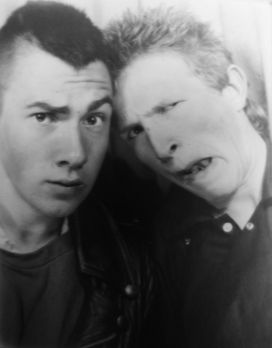 We even went to Coventry ‘riot central’ because we had a contact there who would let us stay at their university halls of residence. Finally, we could change and take a shower after nights spent at Victoria station! There was a party at the university with a band playing, and you could tell they had only started out. The singer was chanting ‘Oi! Oi! Oi!’, which was something completely unknown to us at the time.
The guy who had given us the contact details in Coventry was the same person who later introduced us to Swingo Porkies. He was part of the musical community in Rouen, but he originally came from a working class suburb of Paris and knew Swingo Porkies from high school. Our meeting took place in the basement at my parents’ place where we practised. After this encounter, my brother Frédéric became a skinhead.
The mix of punks and skins was not a problem at first, but it didn’t last long. My brother became obsessed with skinhead unity and wanted to meet other skins, so a skinhead and a few punks from Le Mans came to visit us in Rouen. We went to Rennes to meet the Oi band Trotskids, and we went to Orleans to attend a festival, where there was a weird atmosphere – not friendly at all.
And the Caen skins?
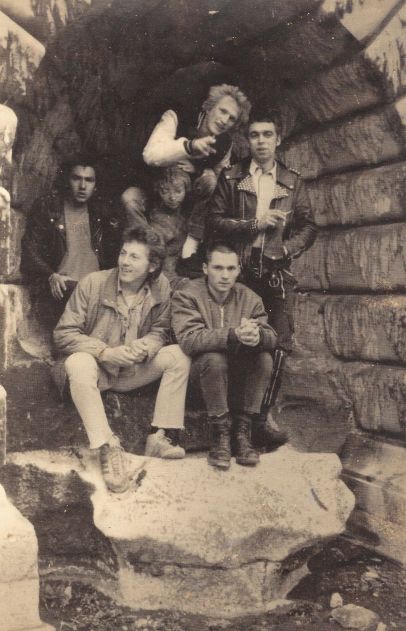
I was staying on the Normandy coast near Caen, where I had been invited by a friend’s parents. I befriended someone in town who told me there was a large number of punks and skinheads and a band called Brainwash there. We went to meet them at their usual hangout, and then we met again at various gigs. Ties were forged due to our common heritage, which was original punk. And they listened to a lot of reggae! Just like the Parisian skinheads from Les Halles, who would listen to all the Trojan standards, which are inseparable from skinhead culture.
When did you become a skinhead yourself?
In 1982. After the ‘punk’s not dead’ wave, the punks became even more divided, people were splitting away, and then the Oi! compilations arrived from Britain. For me, becoming a skinhead was a way to exit the punk movement, which had lost its spontaneous and creative side – or at least that was my impression. The skinhead movement, on the other hand, was still new to me and seemed boundless – this turned out to be a mistake.
In the beginning, skinheads and punks would mix no problem – at most, we teased each other verbally. But little by little, both sides became more radicalised: the punks more to the left, the skinheads to the right, even far-right. Not me, though. I stayed in the suburbs and hung out with ‘normal’ people most of the time. The only skinheads I would meet up with were the ones from my neighbourhood. Occasionally I went to Caen, where punks and skinheads got on well and the musical culture was very rich and varied.
The advantage of being skinheads was that the police left you alone and you could go anywhere no problem. Most of the time, we were mistaken for soldiers on leave. Being a punk for four years, on the other hand, had not always been easy.
Was football important in your early skinhead days – and did you ever get involved in football hooliganism?
I’ve never really been interested in football. I’ve been to three matches in my life: two in Rouen, including a fake match filmed for the movie A mort l’arbitre (1984). The third was a Paris Saint-Germain FC match in Le Havre. I had never seen a gathering of football hooligans so up-close, but I must honestly say that they made me feel ashamed of being white and French. A very good friend said about football that sport is like sex: practising it is good, but watching it is a bit unhealthy… Anyway, I shouldn’t talk too much about things I don’t know anything about.
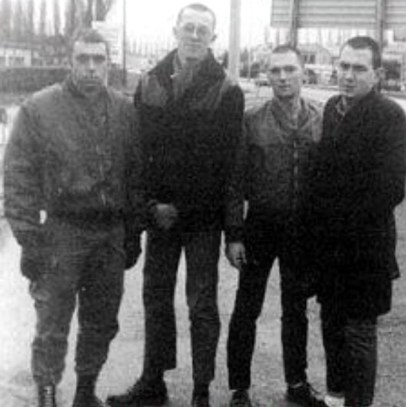
Looking at old Skinkorps pictures, you often sport a typically 80s paramilitary look à la Combat 84. But some of you also wear crombies, pockets squares, and other more traditional elements. How important were clothes to you when you were skinheads?
At that time, the first skinheads we saw were on record covers, and many of them wore military gear. We had already worn combat trousers and jackets in the days of Acide Vicieux, and we weren’t the only ones in the early 80s. Rastas wore military clobber; even the pacifists wore it. I think the revolutionary image of these clothes at the end of the 70s had something to do with it, but that obviously worked better if you were a bit scruffy or had long hair. With a shaved head, it was less obvious. In addition, this type of clothing had a lot of advantages: it was cheap, durable and comfortable.
 For all the rest, you had to go to London to find typical clothes. We didn’t go often, but whenever one of us went, they would bring back clothes for the others too. My brother was always the one who paid the greatest attention to his look. The others were more in ‘System D’: working class people improvising with what they had.
Sometimes would go to the Last Resort shop in East London. I remember going there once with my brother to buy t-shirts. On that day Ian Stuart hung out in the shop, selling National Front pins, handing out propaganda and explaining to everyone that immigrants were the problem – with Jamaican music playing in the background. It was quite surreal, like in an English movie.
What sources were available to you for finding out about the original skinhead period of the 60s – the evolution from mod to suedehead, the original styles and so on?
For me, it was whatever I picked up when meeting other skins, that’s as far as it went. It wasn’t that important to me.
My brother Frédéric had a book from England with drawings and detailed descriptions of all the different outfits to wear, hair length rules that had to be respected, and so on. Everything was engraved in stone. Not for me, thank you very much! I didn’t want to indulge in this mania of re-enacting the past. I have always lived in the present, and I always do what I want to do – even if I don’t want to do anything. That’s my point of view.
Your brother probably had Nick Knight’s ‘Skinhead’ book with all those fashion drawings?
Yes, that’s the one.
 Turning to a less wholesome subject, in the 80s there was a war between youth gangs going on in Paris: redskins against boneheads, skins against punks, black rockabilly gangs against skins, and so on. Did you have similar problems in Rouen?
No, there was never really a problem in Rouen. Maybe a bit with the teddy boys and other rockers in the punk era, but as skins we didn’t have any enemies in particular. In the beginning, skinheads were still unknown, and the only altercations were with people who were unreasonable because they had drunk too much beer. We were quite relaxed, even if people who came across us weren’t. For my part, I could go from one clan to another no problem. I started to practice tattooing, so I had a different status. There were very few tattoo artists in France at that time, and I was one of the first to work with a tattoo machine.
In general, problems were always caused by people who weren’t from Rouen or its suburbs. At the end of the 80s, SCALP [Section Carrément Anti LePen, an anarchist anti-fascist organisation – Editor], was set up in Rouen. I think the skinheads of the second generation, who were more politicised to the right, got some grief from SCALP activists. Nothing really bad, though – a few streetfights maybe. I don’t know more about it.
At that time, I preferred to go to a bar in Sotteville-lès-Rouen that was frequented by a lot of underground musicians. We played there twice: once as Skinkorps, and the second time as Les Mailfaisants. It was easier to play under a different name.
So you don’t remember the 80s as a particularly violent time?
I don’t think the 80s were more violent than previous periods. The violence had always been there – the youth gangs from the banlieues [working class suburbs] weren’t very friendly with each other, and when they went to their nightclubs they had weapons in the trunks of their Renaults 16 or 12. The ultra-violence of the skinheads was fairly incidental.
You have to remember that at the time shotguns were on sale in supermarkets, and all the people I knew who were walking around ‘tooled up’ were neither punks nor skinheads. I even had the chance to meet the last French death row inmate who had been pardoned; he had killed a policeman during a failed bank robbery.
 In late 1982, Skinkorps was formed. How did that come about?
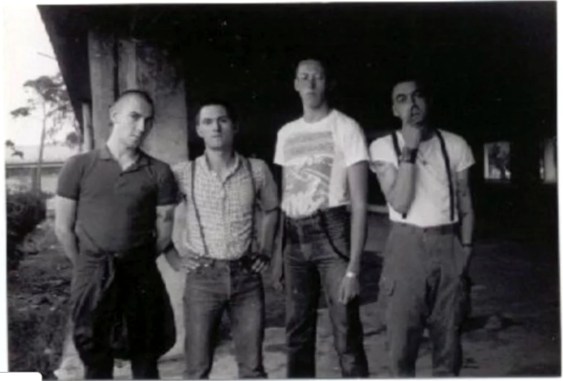
In June 1982, the singer of Acide Vicieux left the group. We unsuccessfully tried to find a new singer for a while. That’s when Frédéric told us about his plan to hire Frank from Doc Martens as a vocalist, set up a skinhead band and call it Skinkorps. He simply took over and convinced us, and we accepted his idea.
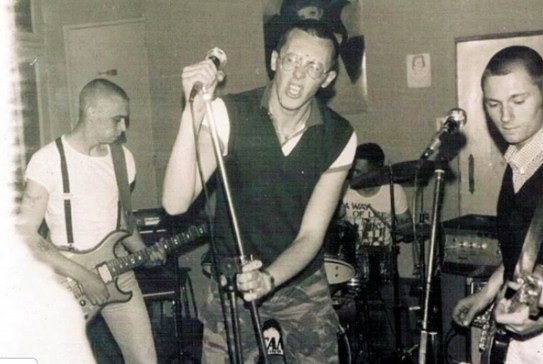
He immediately started writing new music and lyrics, and a few months later we were opening for Outcasts. But at the time the band sounded very punk. The singer of Outcasts told us that we were good, but that we were playing too fast. Most of the songs were Acide Vicieux songs from the previous period, played in the vein of The Exploited and GBH.
Up until the summer of 1983, there were five of us, including two guitarists. The sound of Skinkorps changed when the first guitarist Hakim left. Rénald was older but less experienced. He would remain our permanent guitarist.
Are these Frank’s vocals on your 1984 demo tape, Faut Assurer?
Yes, Frank left the band just before we did our first seven-inch single, Un Force, Un Hymne (1986). Prior to that, he had been the vocalist for all demo recordings and gigs. He didn’t write any lyrics or music during this period, and he left the band when we decided to self-produce the seven-inch, saying that he didn’t have the financial means. 10,000 francs split between four people, makes 2,500 per person, not the end of the world. I rather think that he felt Skinkorps would never become a real ‘skinhead’ band – i.e. a proper RAC band. But that didn’t stop him from using the band’s name for two little ‘info’ zines he published, Mr Clean and Il faudra bien vous y faire.
 In 1986 you recorded your first seven-inch single, Une force, un hymne. Any memories of the recording session?
The recording went well. The bass, guitar and drums were recorded together, then we added the vocals, and finally the backing vocals. We recorded Une force, un hymne with four people in one day. The fourth person was there for the chorus: a nazi skinhead, but he wasn’t a bad guy – a school friend. He was very proud of having met a former Hitler Youth who had fought all the wars as a legionnaire under the French flag…
We already had already gained studio experience recording a track with the first singer, Frank, in a studio in Caen. We were planning to release it on a split-EP with Brainwash, but that never happened. I gave Frank a tape with the track, the title of which was ‘Péta eul’, but he never did anything about it.
Was the single available in record shops, or did they tend to boycott skinhead records?
The record was mainly sold by mailorder. To my knowledge, we didn’t try to distribute it in any other way. We did drop some off at the record shops in Rouen – no problem – and I even did some promotion on a local radio station. At that time, skinheads weren’t considered the enemies of the ‘free world’ yet.
There is only one copy left at my parents’, which allowed me to make a second run. It sold 1000 copies each time. The money earned was invested in the band’s expenses, so Skinkorps never had any money problems, even though we never really earned anything either.
CLICK HERE FOR PART 2


 Creases Like Knives