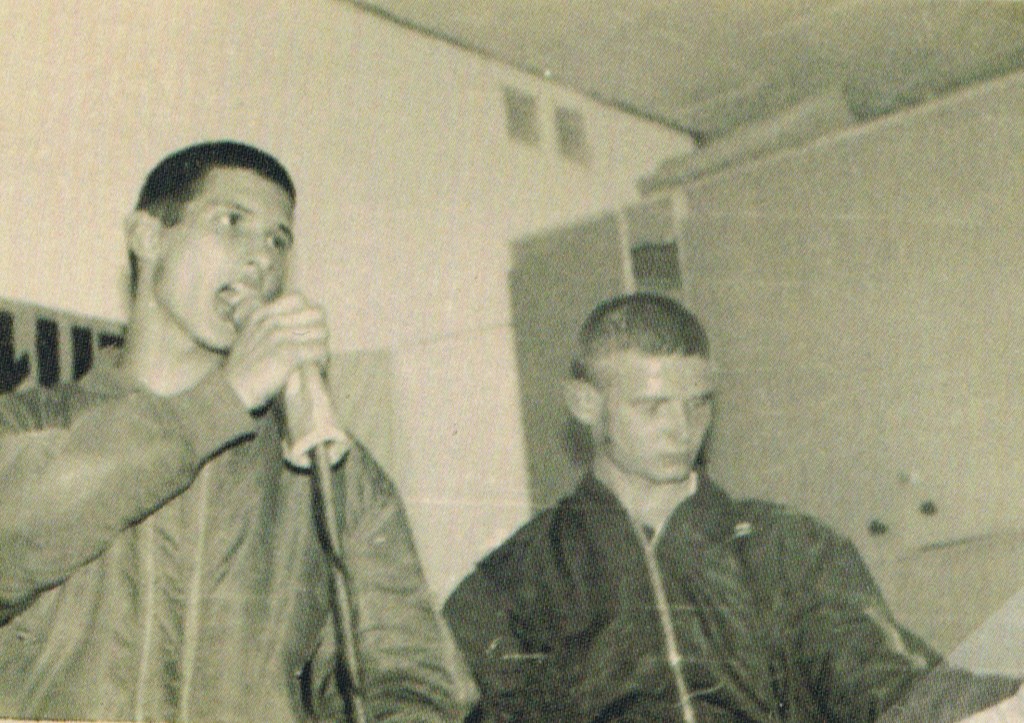
In 1989 you co-organised the first Oi! Dla Ojczyzny [Oi! For the Fatherland] concert, which took place in Bielsko-Biala. The bands on the bill were Szczerbiec, Polska (their only gig) and an early line-up of Honor. What are your memories of the event?
Well, the result was that I lost my job at the local housing estate club, where I had booked the gig… It was an invite-only event just for skins, so I hoped it would stay trouble-free. And trouble-free it was – perhaps even a bit boring, because the punters, most of whom were from out of town, had no one to have a scrap with. Majcher insisted on shoving people into the mosh pit against their will [laughs]. After the concert, I escorted everyone to the bus stop and watched them head home, thinking, “All’s well that ends well”. The next day, I learned that they had all gotten off at the next stop and made their way back to the estate, where they proceeded to pursue the local punks and metalheads…
In the same year, a TV documentary simply titled Oi! was filmed in Sosnowiec. You helped to make it happen by introducing Jerzy Bogucki, then a film student, to the scene. What did you think of the result?
I didn’t like it. I hoped to have some say in its structure, but the director pretty much went with his own vision. I thought the whole thing was a mess, and I felt that it presented the movement in an unfavourable light. I’ve since grown more lenient in my view, though – I’ve come to realise that it was meant to be something of an artistic film essay.
The documentary seems to show a sudden and intense shift towards politicisation: apart from the display of fascist salutes, some skins also boast about their connections with far-right organisations abroad. But there’s also a lad named Krzysztof, who distances himself from nationalism, anti-communism, and racism and talks about the roots of skinheads, rude boys etc…
The film actually captures this massive surge in the politicisation of skinheads really well. Note, however, the fascist salute towards the end – one of the skins is sieg-heiling to the camera while simultaneously swigging wine from a bottle. Not very solemn, is it? [laughter] Either way, it’s undeniable that the old apolitical Oi skins were pushed to the fringes. Some members of the original Sosnowiec crew managed to hang on and held their ground, like the lad you mentioned – there were others like him. It needs to be said, though, that I had returned to my hometown in September 1988 and basically lost touch with the Sosnowiec crew.
In 1989, rapid political and economic changes transformed Poland completely. Can you tell us in a bit more detail how the skinhead scene changed after 1989?
By the early 90s, it was a completely different world. You had two simultaneous developments.
First, there was a huge surge in the numbers of young people affiliated to subcultures. In my hometown, with around 30,000 residents, we had about 20–30 skins. Assuming this ratio was somewhat representative, there may have been something like 30,000 skins in the whole country – though of course, we should keep the high fluidity of the scene in mind. You could find skins on virtually every housing estate and in every town. There were even some local variations, such as the ‘champs’ in Gliwice. At the local discos, couples swayed to the power ballad ‘Biały honor, biała duma’ [White honour, white pride] by Konkwista 88. Thanks to mass production by Fan Records from Zabrze, cassette tapes featuring skinhead music became ubiquitous. In places like Katowice, you could buy them at newsagents inside the railway station. At football matches, entire stands would turn orange as skins flipped their flight jackets inside out. I heard a story about a ten-year-old lad spotted in Krakow’s market square sporting a flight jacket and boots. He wasn’t quite sure what subculture he belonged to, but he said that all his friends were dressing the same way… [laughter]
That being said, the skins often mingled with the local neighbourhood hooligan mobs. For instance, a crew of 10 skinheads from my estate could rally as many as 50 people for a skirmish between neighbourhoods. I recall a train journey home after an AC/DC concert – this was after I had taken a step back from the skinhead scene. Suddenly, the train came to a halt; someone had likely pulled the emergency brake. A mob stormed in, laying into the metalheads. It was a real mix. Alongside the skinheads, I spotted one guy who appeared more like your typical disco enthusiast of the time, sporting a fringe haircut, a Hawaii shirt, and white shoes.
The other development was a notable surge in the scene’s politicisation, mainly in the direction of right-wing nationalism.

What were the reasons for this?
I don’t want to bore you, but getting a grasp of 90s Polish nationalism requires a glimpse into the social backdrop. Poland underwent an economic ‘shock therapy’, dubbed the ‘Balcerowicz plan’, as ordered by the International Monetary Fund. This plan involved economic deregulation and global market integration. The immediate consequence was that countless state-owned enterprises went bankrupt, giving rise to mass unemployment, a phenomenon unseen in Poland for half a century. The majority of the population rapidly descended into poverty, and it’s in this context that nationalism began to take shape.
But why nationalism, out of all possible responses?
Because the transformation wasn’t led by the Polish national bourgeoisie, which was only just emerging. Instead, it was orchestrated by international capital and its aides, the comprador and bureaucratic bourgeoisie – i.e. politicians and bureaucrats grabbing public assets and enriching themselves. Polish businesses struggled against foreign competition in the open market. Many of them were bought up by foreign capital, often at prices below their actual value, resulting in layoffs and in some cases factory closures. Additionally, there were concerns about German property claims in the western regions, fuelled by instances of Germans buying property in Poland at significantly lower prices.
It was under these circumstances that the pre-war stereotype of the “Jewish capitalist” resurfaced as well (before the war, up to 50% of the Polish bourgeoisie had Jewish origins)[1]
Why did it resurface now?
Several factors played a role. Many of those who benefited from the transformation were ascribed with Jewish ancestry, whether accurately or baselessly. This extended to specific politicians, businessmen, journalists, artists, and more. Secondly, similar to the Catholic Church, Jewish religious communities were legally reclaiming pre-war properties, often sparking local disputes. Also, around the same time, court rulings often favoured individual descendants of pre-war property owners, allowing them to seize properties – and a disproportionate number of these individuals had Jewish backgrounds too. All of this was accompanied by intense media propaganda promoting the Israeli state’s rationale while also emphasising the role of the Jewish minority in Poland’s history.
Add to this the fact that the left and its language had been discredited. Given these conditions, it’s hardly surprising that a significant portion of society, certainly not just the skinheads, tended to frame social conflicts in ethnic rather than economic terms. Yet, we can’t discount the role of plain xenophobia in this equation. These aspects often closely intertwined.
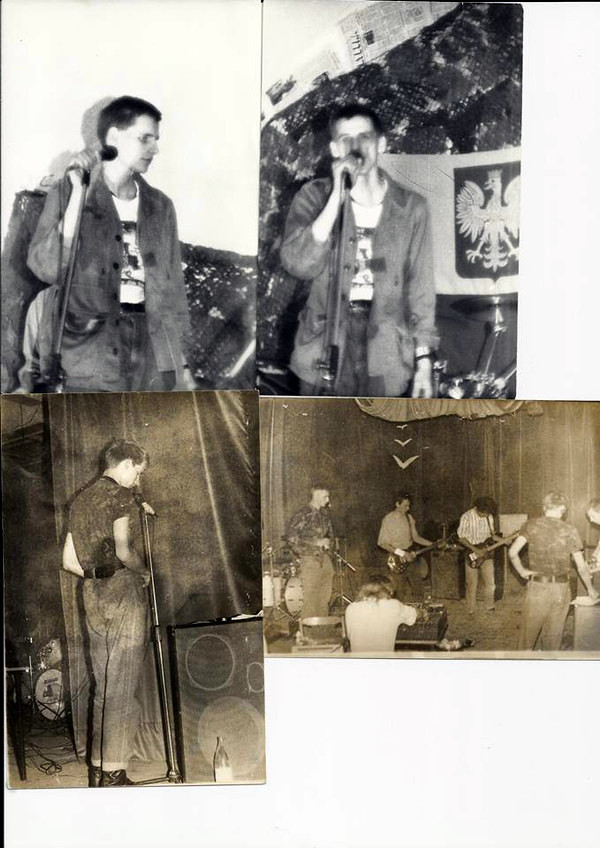
Tell us about your own politicalisation in 1989 – how does one go from being anti-political to becoming very political so quickly?
I simply succumbed to the spirit of the times. When Communism crumbled, it seemed like everything was allowed. Everyone was becoming politically active, and it is said that around 300 political parties were established in Poland during that period. The same was happening in my social circles – i.e. among skinheads – where two political currents were clashing: the neo-nazis and the neo-Endecja [National Democracy, the primary ideology of the Polish far-right before World War II – MC]. I distanced myself from both. Part of it stemmed from my left-wing past, and in the case of National Democracy, my aversion to the church. As for nazism, it contradicted the Polish patriotism I had grown up with.
But I recalled that in the early 80s, I had read about the Polish pre-war group Zadruga in the weekly magazine Płomienie – a nationalist, socialist and neo-pagan organisation. So I reached out to the last surviving Zadruga veterans, and I became fascinated with their ideology. It resonated with me because I found within it the cult of action, the cult of the will, etc, which I had already preached in our Fajna Gazeta zine. I began promoting it among skinheads. This led, for example, to the creation of the Kołomir skinzine and the forming of the band Zadruga.
One might ask, of course, why you didn’t get involved in more mainstream politics, like in some big party? After all, there was now democracy.
Well, if we set aside the influence of my milieu – just being a skinhead was extremist in itself – my radicalisation was fuelled by the general situation. Remember what I said about ‘shock therapy’. I was lucky to have a job, but as a fledging primary school teacher, my income was meagre. My salary wasn’t keeping up with inflation. Without exaggeration, there were times when I couldn’t even afford a beer. There were pensioners, miners and peasants in my family who also felt the effects of the transformation. On the estate where I was working, unemployment was alarmingly high. I recall asking a girl in the third or fourth grade what she had for lunch one day. “A margarine sandwich”, she said. “A margarine sandwich with what?” – “With nothing, just margarine.” Such circumstances push you towards rebellion… Sod it, I’ll admit it: I was filled with hatred.
Enable English subtitles below!
By 1990, the Polish skinhead scene had begun splitting into factions. The apolitical Oi types disappeared. The rest, as you already told me in private conversation, fell into one of the following camps: ‘neo-Slavs’; National-Catholics; nazi skins.
That’s right, except those distinctions were somewhat fluid and not that sharply defined. The dominant trend around 1990 to ‘92, of which I was part, was what you might call the ‘neo-Slavic’ or ‘Slavic-pagan’ camp, although these terms weren’t used at the time. This trend clearly positioned itself against the other two factions, saying: “We are not a nazi movement, and we do not confuse nationalist ideas with Catholicism”.
In terms of political influence, the ‘neo-Slavic’ faction drew inspiration from Boleslaw Tejkowski and his Polish National Community party. Tejkowski was quite an original figure. He started out as a Communist, but around 1956 transitioned to the so-called ‘October left’ opposition, where he collaborated with activists like Jacek Kuroń. In the 60s he shifted to nationalist positions, though they were somewhat unconventional, as he showed inclinations toward neo-paganism. Because of his unorthodoxy, he was somewhat isolated in neo-Endecja [National-Democrat] circles. His group was probably the tiniest among numerous minor nationalist factions, which numbered a few hundred or a few dozen members each. But in 1990, Gazeta Wyborcza published an extensive two-column interview with him, and that’s when Tejkowski suddenly became Poland’s best-known nationalist figure overnight. It marked the beginning of his brief yet remarkable career.
There were also a few marginal and ephemeral groups within the ‘neo-Slavic’ tendency, including Andrzej Wylotek’s Polish National Front (Polski Front Narodowy), National Breakthrough (Przełom Narodowy), the National Workers’ Party (Narodowa Partia Robotnicza), the Grunwald Patriotic Union (Zjednoczenie Patriotyczne Grunwald), the Social-National Union (Unia Społeczno-Narodowa) and the Polan Union – but for the most part, only the PWN really counted.


So, what were the basic political premises?
Tejkowski’s supporters and the ‘neo-Slavs’ in general aspired to create an original version of Polish nationalism. One characteristic trait was their greeting with a clenched fist. But they were eclectic because they had a very limited ideo-historical tradition, and unlike the nazi skins, they lacked international sources to fall back on. So they took inspiration from anything that even remotely aligned with their standpoint: neo-paganism, especially the pre-war Zadruga movement; Polish (non-nazi) national socialism; national communism; early (non-Catholic) National Democracy; National Radicalism; pan-Slavism; and the left-wing of fascism, with a special focus on Strasserism. And they were highly selective about it, cherry-picking the parts that suited them while dumping the rest without a second thought.
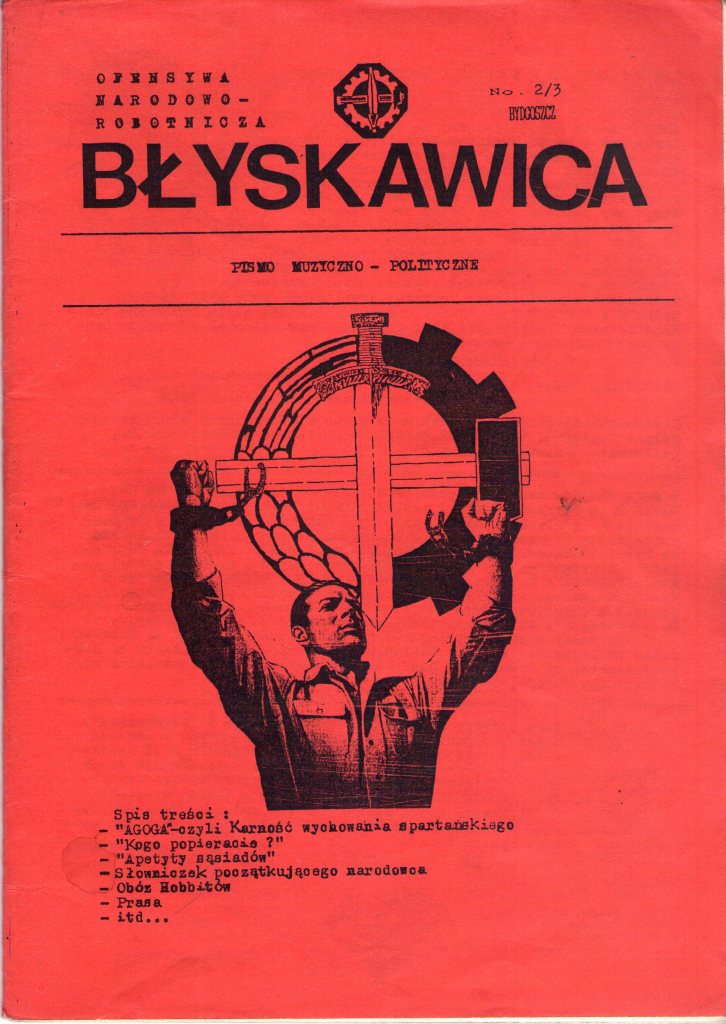
The Błyskawica zine, named as a nod to the pre-war magazine of the Polish national socialists, was representative of the ‘neo-Slavic’ faction. It defined its milieu as “Zadruga disciples, national revolutionaries and even national communists”. Even so, the pro-capitalist and free-market USN also found a place within this trend. You see, unlike nazism or National Democracy, this wasn’t a fully formed ideology. It was a hotchpotch of slogans, symbols and sentiments.
What do you mean by ‘non-nazi Polish national socialism’ – a left-wing or a right-wing movement?
Polish national socialism – as in the Party of National Socialists (PNS) – had its roots in the left wing of the nationalist workers’ movement, i.e. organisations such as the United Polish Workers’ Union (established in 1902), the National Workers’ Union (founded in 1905) and the National Workers’ Party (formed in 1920). It bore resemblance to Edvard Beneš’s Czechoslovak national socialists. Alongside the PNS, there were also groups more or less inspired by the NSDAP’s example before the war, although they were generally anti-Hitler.
And ‘national communism’? The term has been used to describe a number of different historical phenomena.
Speaking in the most general terms, the popular version of ‘national communism’ in the 90s was based on affection for the Polish People’s Republic, understood as a nation-state – and an ethnically homogeneous one at that – that guaranteed social justice and order. The west, especially Germany, was seen as a geopolitical enemy with ambitions of imperialist expansion (Drang nach Osten), while the Slavic nations were considered natural allies. Polish national communism had a fairly well-developed ideological and political tradition, which extended from the so-called ‘majority’ faction of the pre-war Communist Party of Poland (KPP) through the Polish Workers’ Party (PPR) to Władysław Gomułka (who tried to maintain a degree of independence from the USSR when he was the leader of People’s Poland), Mieczysław Moczar (initiator of the ‘anti-Zionist campaign’ of 1968) and even Edward Gierek.

You’re almost making the ‘neo-Slavs’ sound like a political think-tank… It’s not quite clear to me to what extent skinheads were involved at this theoretical level. Was it skins who worked out the ideology and wrote the magazines – and did they make up the majority of the rank and file?
Of course, there were only a handful of such ‘ideologues’ and the rest simply echoed their slogans, as is probably the case in most movements. But practically everyone who was involved in the movement was a skinhead. Zines and bands played the role of ‘think-tanks’ in this scenario, because the rank-and-file activists were generally vocational school students who hadn’t read the works of Jan Stachniuk or Władysław Gomułka.[2]
But there were some very well-read individuals, including pupils and workers. For instance, an article on pre-war Polish national socialism in Błyskawica was penned by a high school student, and the editor of Błyskawica himself was a construction worker. The leading authority outside the skinhead scene was Tejkowski, who had a great talent for distilling eclectic – and at times contradictory – ideological influences into simple slogans.
But the weakness of the movement was its lack of experienced cadre. Tejkowski was difficult to work with. If he clashed with someone, he automatically considered them a “Jew” – this happened to me too. A series of collaborators broke with him, and as a result, the party was mostly just him and the skins.
Did this tendency produce any skinhead music?
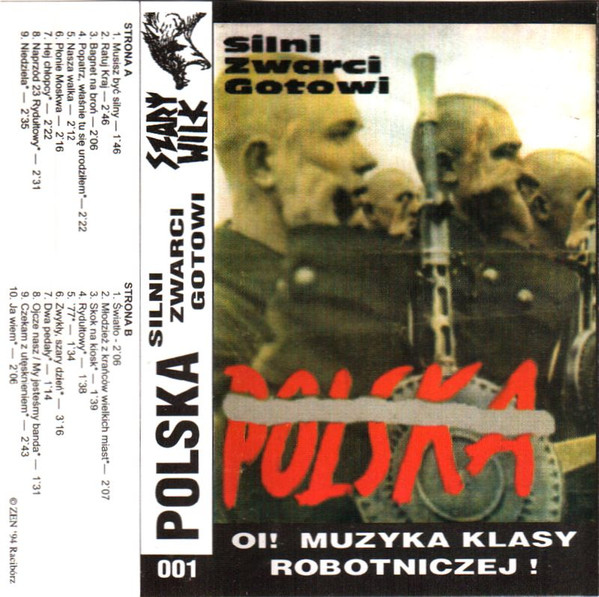
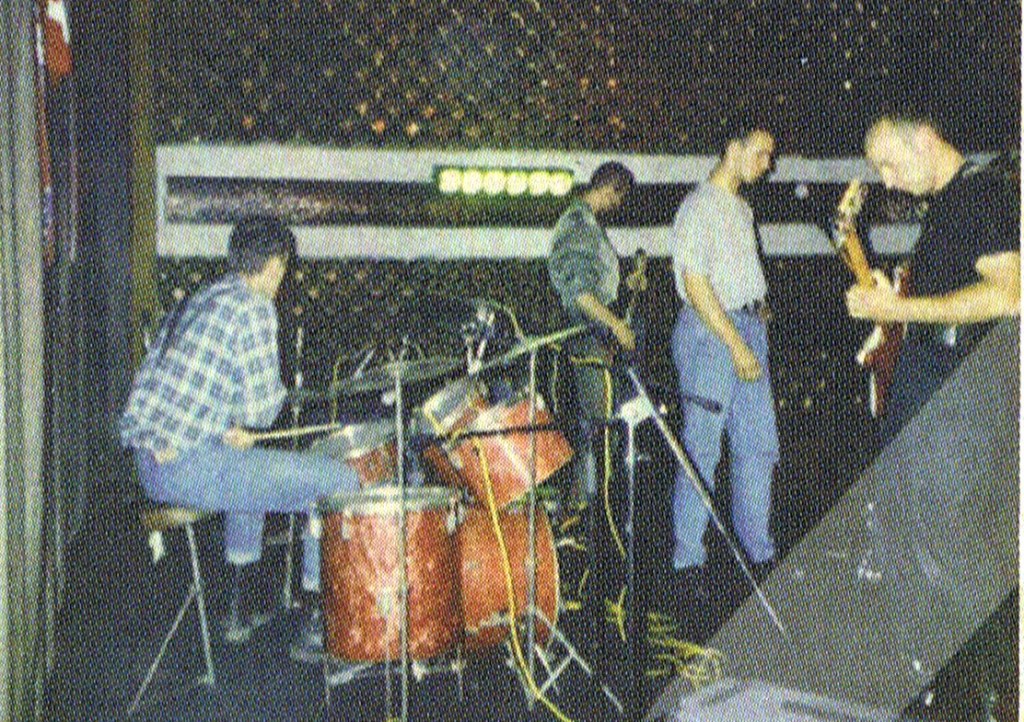
Bands that could be considered part of this trend were Zadruga (named after the historical movement), Sztorm 68, Deportacja, Ofensywa, and Szczerbiec in their late phase. There was also Polska, a band that had very nationalist songs, but interestingly also one titled ‘Put a Bayonet on Your Gun’ [Bagnet na broń], which featured lyrics originally written by the communist poet Władysław Broniewski. The poem revolved around the theme of defending the homeland against the invading German forces during World War II.
Let me throw in a little anecdote. During my time as a youth leader at a camp, kids brought tapes along that would get played on the local radio station. Among them, there was a Polska tape, and it had what they called a ‘hooligan side’, with some old Ramzes & The Hooligans tunes, and a ‘patriotic side’. The radio DJ played the ‘hooligan’ side without any objections. The ‘patriotic’ side kicked off with the aforementioned ‘Bagnet na broń’, featuring lyrics by the communist poet Broniewski. About halfway through, he abruptly stopped the song and announced that he was “not going to play nazi music”… [laughter].
Speaking of Polska, it’s probably also worth recalling the gradual shift of attitudes towards capitalist restoration under the banner of Solidarność. In the original Ramzes & The Hooligans version of ‘Musisz być silny’ the lyrics call for “chasing the Communists out of the country”, whereas in the Polska version this turns into “chasing Solidarność out of the country”.
Indeed. In any case, clearly the most notable band in the ‘neo-Slavic’ camp were Sztorm 68.

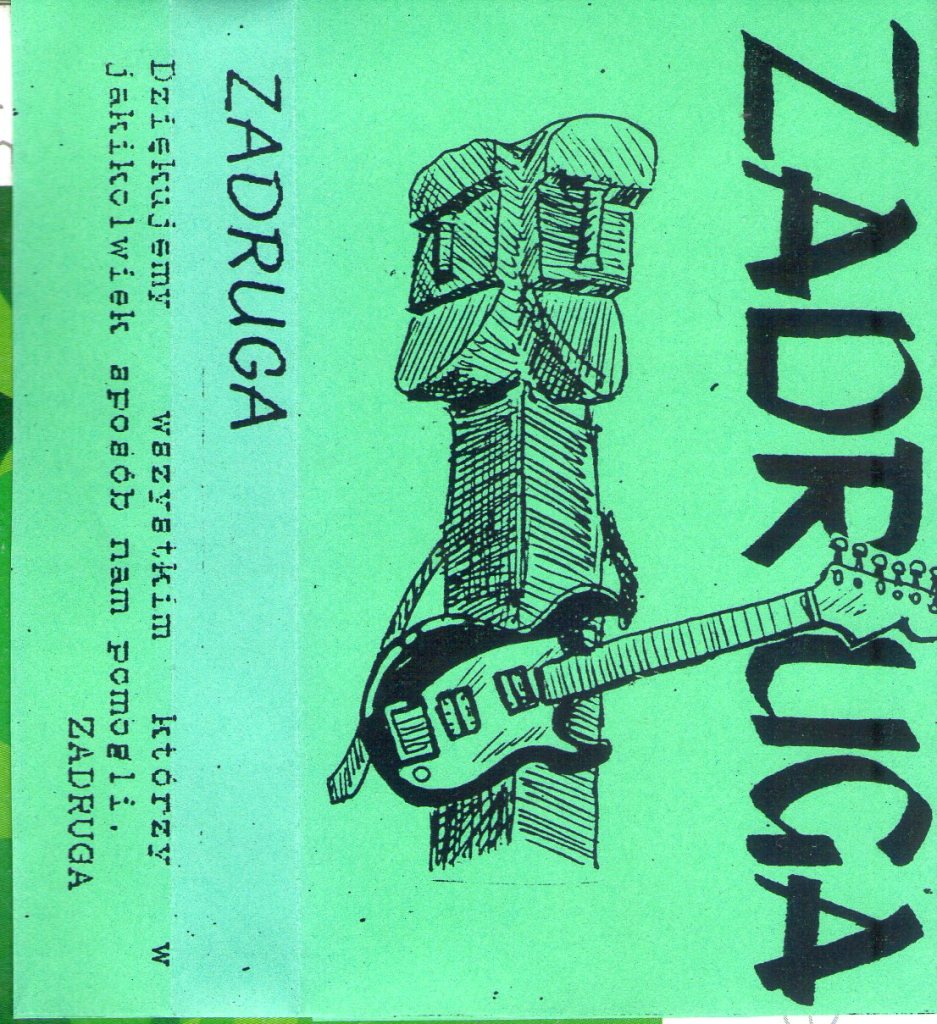
Sztorm 68 were also the most ‘national communist’ of the lot. They had songs that glorified the Polish People’s Republic, which wasn’t to everyone’s liking… It’s hard to imagine how they even played this material to right-wing Polish skins in the 90s.
Sztorm 68 played three gigs, each ending in a brawl because they were simply considered ‘communists’. One could talk about this for a long time. In Szczytno – I didn’t attend that one myself – the gig was apparently attacked by several dozen plain-clothes apprentices from the local police school. The attackers were hard to distinguish from the skinheads, though, as they all wore closely cropped hair and uniform black flight jackets…
In Żory, Sztorm 68 shared the bill with Szczerbiec. Although the two bands were ideologically similar by that point, there was hostility between their fans for reasons that were unclear to me. I spent the whole time that Sztorm 68 was playing at the bar, trying to persuade Ziut from Szczerbiec to let it go: “Come on, mate, you can’t do that. We’re all Poles at the end of the day, we all want the same thing…”. After an hour of placating him, Ziutek finally admitted that I was right. And then a youngster from his crew rushed in: “They’re done playing! Are we gonna give them a kicking now?” Ziutek responded with, “Yeah, we’ll kick them to shit!” And off he went… [laughter]
Apart from pro-People’s Republic and ‘communist’ slogans, there were also explicitly antisemitic sentiments though.
To understand this phenomenon, you have to take into account that in the Eastern Bloc countries, there was a strong emphasis on ‘socialist patriotism’ alongside anti-Zionism. As I mentioned earlier, when capitalism was reintroduced, there was a concurrent push to rehabilitate Zionism – for example, a special programme dedicated to promoting Israel appeared on TV. Around the same time, Jewish property claims emerged. All these factors contributed to the association of capitalists with Jews.
But surely the thread of antisemitism running through Polish political culture goes much further back?
Of course antisemitism had existed in Poland since at least the late 19th century. Of course people harked back to earlier stereotypes (“Your tenements, our streets”)[3] Even in communist Poland, there had been some anti-Jewish strands. Take, for instance, the ‘Natolin’ faction within the United Polish Workers’ Party, which later evolved into Mijal’s dissident breakaway group [the pro-Albania ‘Communist Party of Poland’, illegally founded in 1965 – MC]. And of course, there was Moczar’s ‘partisan’ faction.
But the point is that in the 1970s and 80s, antisemitism was dormant. During my childhood, Jews were an abstract concept to me (although somehow vaguely associated with calculation and shrewdness). As for the skinhead subculture, note that in 1987 BTM sang “Before the war it was the Jews, now it’s the gypsies” – even for them, Jews weren’t a current threat.
There was a Sztorm 68 video on YouTube a few years ago – now removed – that showed them playing live in the early 90s. I believe it was a concert together with Konkwista 88 in Wroclaw. It was bizarre: the Konkwista crowd was sieg-heiling as Sztorm 68 were playing hymns to a “war for the rule of workers’ and peasants’ councils” and eulogies to General Jaruzelski…
The gig together with Konkwista 88 ended in a brawl, like all Sztorm 68 performances. When the nazi skins from Wroclaw started sieg-heiling, the Cracovian crew, who were Sztorm 68’s crowd, objected. A scuffle broke out and the host of the concert, a member of Konkwista 88, said this was a concert for nazis and whoever had a problem with that should get the fuck out. The Krakow crew and the National-Catholic skins from Wroclaw, who were fans of Legion, walked out. That’s how the war with the nazi skins began.
In what sense was there a ‘war’? Were neo-Slavic, National Catholic and nazi skins chasing each other in the streets, just as they were chasing punks?
It wasn’t a war like the war on punks because the divisions were more diffuse, but it did come to scuffles. Once I was almost beaten up at a Konkwista 88 gig by their fans because I had criticised their sieg-heiling.
The most powerful Sztorm 68 track is in my opinion ‘Koło zębate’. The lyrics are like a cross between socialist realism and futurism.

‘Koło zębate’ is also my favourite track. But have a listen to ‘Fabryka’ [Factory] too, which they published as late as 2018. To give you the background to that song: The frontman of Sztorm 68, Kelian, used to be a worker at the Ustron metal plant. Then they drafted him to the army. When he returned home, he found that the factory had been closed down, and he was unemployed for a number of years. This was also the sociological background of the whole ‘neo-Slavic’ movement, as it were.
Besides, Kelian was very well-read. He single-handedly invented this ‘national communism’ of his before anyone in Poland had even heard of Limonov. He completed his secondary education at a working people’s evening college. Bear in mind that back then, it was much more difficult to get a higher education than after the educational reform. I read his high-school essay on the Sophocles play Antigone – it completely went against the grain of prevailing interpretations, which affirmed the right of the individual to rebel. He instead staunchly defended Creon in the name of a higher reason of state… Unlike him, I always had a tendency to split hairs, so his uncompromising attitude impressed me a great deal.
Sztorm 68 reformed a number of times. Are they still active?
As far as I know, Sztorm 68 have ceased operations for good. The conditions for them just don’t exist here. The only gig after the most recent reactivation of the band ended – naturally – in a brawl with nazis. Even friendly skinhead music distributors were only selling the album from ‘under the counter’ so as not to offend the anti-communists. And let’s not even talk about the left.
Frankly, I can’t imagine that the conditions for a band like Sztorm 68 exist anywhere – at most, in Russia in the mid-90s, during the heyday of Limonov’s National Bolsheviks and Grazhdanskaya Oborona.
Nonetheless, as recently as 10 years ago, Sztorm 68 had listeners both among nationalists and among leftists. Their songs have appeared both on the Xportal of the far-right Falanga organisation and on the website of the Trotskyist group Władza Rad.
I was just going to mention Władza Rad. I remember seeing that Sztorm 68 song on their website like nine or ten years ago, though I don’t recall which song it was. Such a politically incorrect move would be unimaginable on the western left.
Władza Rad were quite non-orthodox. They professed Trotskyism, but there was a clear Guevarist influence there.
Why did the ‘neo-Slavic’ tendency begin to recede among skinheads after 1992?
Well, unlike some of the other tendencies, the ‘neo-Slavs’ didn’t have any institutional backing, and they lacked support from a dynamic social stratum such as ‘small business’. They also had no international contacts, which was the strong point of the nazi skins. The key moment, though, was Tejkowski discrediting himself at an ill-fated demonstration in Zgorzelec in February 1992. Apparently, Tejkowski had failed to call off the march even though he knew it had been banned. Then, once everybody had arrived in Zgorzelec, he suddenly got cold feet and called it off. The skins, who had already assembled at the train station, decided to hit the streets anyway, which ended in a full-scale riot. But Tejkowski had stayed behind, hiding out inside the train station…
Perhaps the fact that the post-Communist left won the general election and took government office in the following year played a role too. It strengthened anti-communist and anti-left trends, especially the National-Catholic tendency.
But overall, I’m surprised that this region of the world hasn’t given rise to a strong left-wing nationalism akin to what we’ve seen with Irish or Basque nationalism. Within the global state system, Eastern Europe was, and in my view, still is, a semi-periphery. Nationalism here used to have an anti-imperialist character (though that has changed over time). To be fair, there were moves in that direction: Russia had the lyubers,[4] whereas in the Czech Republic, Daniel Landa [of skinhead band Orlik] tried to launch an anti-fascist Czech nationalism rooted in the Hussite tradition.[5]
CLICK HERE FOR PART 4: CATHOLICS, NAZIS, REDS… AND THE REBIRTH OF OI
[1] See Społeczenstwo polskie od X do XX wieku [Polish society from the 10th to the 20th century], authored by historians Irenausz Ihnatowicz, Antoni Mączak, Benedykt Zientara, and Janusz Żarnowski, and published in Warsaw in 1988. On page 630, where the bourgeois class during the interwar period is discussed, the following passage can be found: “The Polish bourgeoisie, however, was marked by considerable ethnic heterogeneity. Approximately half of this social class was of Polish ethnicity, while the other half comprised Jews and a small percentage of Germans. This diversity resulted in a division within the bourgeoisie, where disparate milieus sometimes found themselves at odds with each other. As a result, the overall significance of the bourgeois class, including its political role, was weakened. While it did wield substantial power in economic decisions through its representatives, its influence on other aspects of society was relatively limited”. [translation mine] Source provided by Trojan upon request. ↵
[2] Jan Stachniuk: leader of the pre-war Zadruga movement. Władysław Gomułka: Prime Secretary of the United Polish Workers’ Party (PZPR) and de facto leader of Poland from 1956–70. ↵
[3] Before the war, the reverse saying, “Our tenements, your streets”, was attributed to Jews, whom antisemites accused of harbouring conspirational intentions to dominate Poland’s economy and culture. These smears were particularly aimed against Jews who migrated in large numbers from the depths of the Russian Empire around the turn of the century, often lacking Polish language skills and having little contact with Polish culture. During the interwar period, the phrase became a key element of the antisemitic stereotype. ↵
[4] The lyubers were a youth subculture in the late 70s and early 80s in the USSR dedicated to an athletic lifestyle and to ‘cleansing’ Soviet society of the influences of various western subcultures (hippies, punks, metalheads), which they viewed as decadent. They also held strong anti-fascist views. ↵
[5] The Hussites were a Czech proto-Protestant Christian movement that followed the teachings of reformer Jan Hus, who became the best known representative of the Bohemian Reformation. ↵
 Creases Like Knives