
Let’s talk about Kortatu’s performance at the the Róbrege festival in Warsaw in 87. It was a big event from a general punk rock point of view, but also because Kortatu were a kind of leftist skinhead band from Basque Country. Many skins attended the gig. You too?
Yes, I was at Róbrege that year. Mainly to make trouble, but Kortatu was a band I did enjoy listening to. I even had their album, and truth be told, I have a soft spot for Kortatu to this day.
How did the other skins feel about Kortatu?
Kortatu were generally well-liked among Oi skins in Poland, primarily for their music. Their political leanings were somewhat secondary and not widely known among us. Many of the bands performing at the festival played music that wasn’t exactly our cup of tea – some kind of new wave and roots reggae. So when Kortatu took the stage, it was a blast for our crew. Having said that, I do recall Szczygieł – the Sosnowiec skin editing the Mañana art zine – shouting “Viva la Contra!” when Kortatu played ‘Nicaragua Sandinista’.
How do you respond to this description of the events at Róbrege 87, as provided by the Never Again Association’s Brown Book 1987-2009:
„Between 21 and 23 August, dozens of skinheads armed with sticks, metal pipes and knives terrorised the audience of the fifth Róbrege music festival … Among other incidents, there were dozens of beatings and a big brawl between skinheads and the audience involving knives and other dangerous weapons. The incidents were chauvinist in nature – the attackers regarded the youths attending the alternative music festival as ‘filth’ and ‘inferior’ Poles.”
I’d say that’s a significant exaggeration – an attempt to portray relatively minor events of the time as some kind of epic battle between good and evil. I can’t recall any major brawl, especially one involving weapons. Smuggling a stick or a metal pipe into the venue would have been quite a feat – the bouncers even made us swap our boots for soft slippers, believe it or not! There were some minor scuffles, often triggered by attempts to rip ‘enemy’ band badges and patches off people’s jackets.. But the clashes were multidirectional. For instance, some skins had a stand-off with a group of sztajmy [colloquial term for criminal riff-raff and jailbird types], who were drinking at a nearby beer stand.
There wasn’t any ideology behind it at that point. What kind of ideology are they even talking about? Polish chauvinism against other Poles? White racism against fellow whites? The political aspect of the Polish skinhead scene emerged later. In 1987, what you had were subcultural conflicts and some petty crime, like mugging people for jackets or boots.
There were reports of sieg-heiling Polish skins even back in 1985/86, though. Piotr Wierzbicki of QQRQ punk zine shared that many were just “ordinary thugs”, but that others began to identify as nazis, or at least presented themselves as such, because that’s what they had read about western skinheads.
You have to realise that, although pseudo-nazi gestures were made by early skins, and various other pseudo-nazi – but essentially anti-communist and anti-social – subcultures existed, to identify with nazism in 1980s Poland automatically put you on the margin of the margins. Anti-nazism, both in its ideological and national aspects, was the state ideology of People’s Poland, and virtually everyone agreed with it. I won’t deny that some fascist sympathies were evident among skins even in the 80s. I think it was in 1986 that I met a skinhead from Gdansk with the nickname Adolf, who declared himself a fascist. Interestingly, I met him because he was the boyfriend of the singer of anarcho-punk band Konwent A, which just goes to show that the boundaries between subcultures were fluid. In any case, in the 80s fascism wasn’t dominant among skins yet.
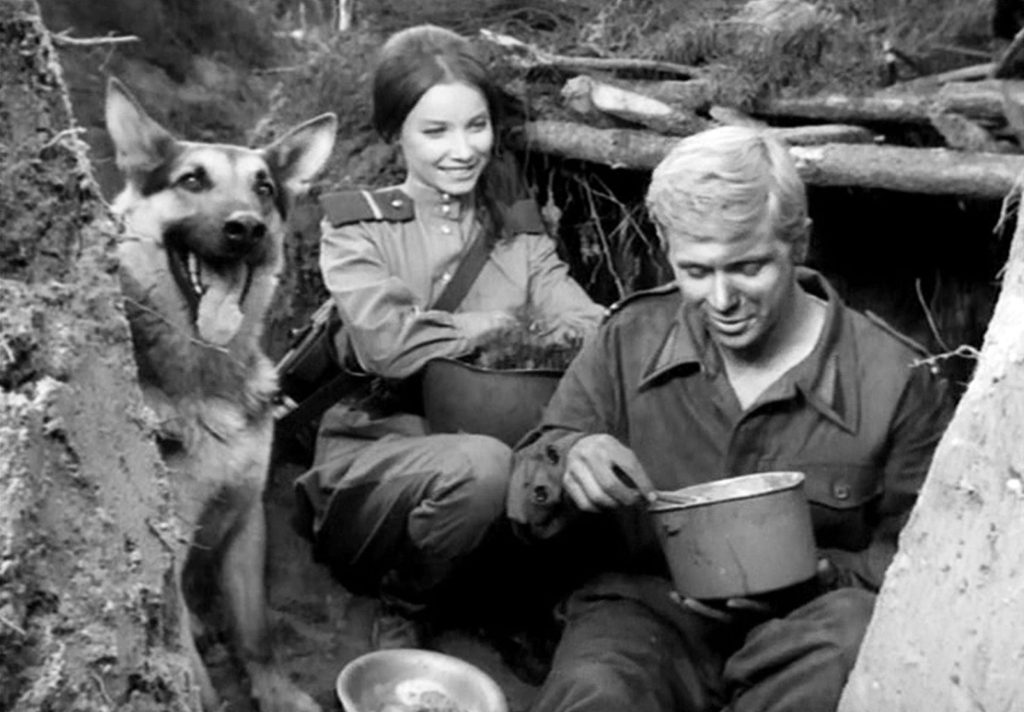
This didn’t change until the early-to-mid-90s. I once asked a nazi skin from my estate why he supported Hitler instead of Polish nationalism. He replied: “The difference between us is that you were born 20 years after the war and I was born 30 years after the war”’. He had a point. I had grown up with patriotic socialist-realist cinema, such as the cult WW2 series Four Tank-Men and a Dog, and stories from the elderly about the horrors of the German occupation. He, on the other hand, had grown up on western pop-culture, which portrayed the nazis as an abstract evil.
Turn on English subtitles in the video below!
What about the native Polish nationalist tradition?
People knew very little about it back then. You might learn in school about the Endecja [National Democracy] movement before the war, and some may have heard about a pre-war organisation called ONR (National-Radical Camp). Still, the information available was quite vague. Access to original sources was limited, with pre-war publications typically found in restricted collections in academic libraries. The nationalist current – i.e. the neo-Endecja – was probably the weakest political tendency in the Polish opposition. It was made up mainly of old-timers from the 1930s and 40s who had little connection with the youth. Crucially, the Polish nationalist tradition was closely tied to Catholicism, whereas the skins in the 80s were fiercely anti-clerical.
Why was that?
It came quite naturally. It’s not easy to align an evangelical worldview with lyrics like “Tomorrow we’ll break into the local corner shop” (Ramzes & The Hooligans). Skinheads were proletarian and lumpenproletarian youths, mostly ex-punks, rebelling against society. And later, as we moved into the 90s, the Catholic Church was seen as supporting capitalist restoration, which didn’t sit well with a lot of people.
So when did skins pick up on Polish nationalism?
I think the Polish nationalist tradition was referenced for the first time when the band Szczerbiec wrote the song ‘Narodowe Siły Zbrojne’ – but this was no earlier than 1989 [Narodowe Siły Zbrojne = National Armed Forces, the WW 2 underground military organisation of the right-wing Endecja/National Democracy movement – MC]. Before that, for all the reasons I just mentioned, even skinheads interested in the far right were tapping in the dark. I once saw someone with a ‘Polish National Front’ patch and asked him what this organisation was. Turns out, he had only made up a name based on the British National Front…
BTM (Brzydka Twarz Młodzieży), who formed in Kraków in July 1986, are often credited as the first Polish skinhead band. Their name, which translates to ‘The ugly face of youth’, was reportedly inspired by an article on Oi music in a German teen magazine. They recorded two demo tapes, one in late 1986 and another in early 1987. Did you know any of the BTM members personally?
I had already met their vocalist Bogdan, who went by the nickname ‘Cytryna’ [= lemon], back when he was playing with a punk band called INRI. We bumped into each other on several occasions. But when he started getting all political with his slogans, I was still in my anti-political phase – and ironically, by the time I got into politics, he had shifted back to Oi. I never got the chance to catch any of their gigs, though.
The tone of much of BTM’s material was ‘Oi’ and punkish-confrontational, not yet ‘RAC’ in a more ideologically cohesive sense. But about half of their few songs leaned towards extreme chauvinism and already seemed informed by a specifically Polish nationalist narrative. There’s ‘Słowiańska siła’ (Slavic power), for instance, which depicts Poland as a country swamped by “Russians, gypsies and krauts”… If these two tapes are an accurate reflection of the Polish skinhead scene of 1986–87, wouldn’t this actually suggest a relatively early politicalisation?
So, let’s break this down because there are a few threads here. Firstly, BTM – as we already noted, a band quite particular about skinhead orthodoxy – were something of a vanguard within the movement, always the first with everything. Later on, other bands followed a similar path, like Ramzes & The Hooligans: in their output, there’s also a considerable inconsistency between their earlier hooligan-themed songs and the later more patriotic ones.
Secondly, context is essential. In the late 80s, Polish society got increasingly radicalised to the right. While in the early 80s notions of ‘socialism with a human face’ were widespread, the year following the 1981-83 martial law period saw a shift towards rejecting all forms of leftism.
Thirdly, as for the song ‘Słowiańska siła’, each of the nationalities mentioned in the lyrics has distinct roles and connotations. The reference to Russians was due to Soviet military presence, the pervasiveness of the Russian language in schools and the enforced ‘Polish-Soviet friendship’, which many viewed as ‘Soviet occupation’. The Romani people may be a small minority, but – let’s not kid ourselves – they can be troublesome; it’s not just the skins who had their problems with them. The Germans, on the other hand, were an adversary of great symbolic significance – not just in the tradition of National Democracy, but also in the propaganda of the Polish People’s Republic.

According to its own official information, the National Rebirth of Poland (NOP), a fascist organisation that became big among skins in the 90s, was founded as early as November 1981, presumably operating illegally. Did the NOP not have any youthful supporters or activists before the late 80s?
I haven’t come across any evidence to suggest so. The NOP was primarily an elitist, student-oriented organisation, and a fairly small one at that. What’s more, in the 80s it didn’t have the radical character that it would later adopt in the 90s, especially when it fell under the influence of the International Third Position. Suffice it to say that the current leader of the liberal Union of European Democrats, Michał Kamiński, was a member of the NOP during that time… Admittedly, NOP chairman Adam Gmurczyk claims that they played a BTM tape on university radio during the 1988 student strike – but it wasn’t until the 1990 Congress of the Polish Right in Warsaw that the first actual skins appeared in the organisation’s orbit.
Now, back to the topic of violence at gigs – there’s a widely held belief in Polish antifa circles that skinheads collaborated with the state Security Service (SB) to combat the alternative scene. In the Beats of Freedom (2010) documentary about the Jarocin Festival, the lead vocalist of the anarchist punk band Dezerter also advances this theory: “It seemed inappropriate for the Communists to be chasing punks, so they groomed themselves a bunch of thugs to do the dirty work for them … They were clearly under some kind of protective umbrella. Of course, in the end the police would come along and arrest those who had been beaten up”.
The Security Service had people everywhere, and in subcultural circles it was very easy for them to extort cooperation through blackmail. It’s hard to speak of skinheads as a whole, though, because skins were generally people who were difficult to control. Yes, there was a scuffle in Katowice or Sosnowiec between skinheads and members of Fighting Solidarność [a radical split from the Solidarność movement], and allegedly this was instigated by an SB officer. But I can only share this as hearsay since my ties with the Sosnowiec crew had already loosened by then. Starting in September 1988, I was working in my hometown, and I had limited time for socialising. Besides, I was becoming politicised while they wanted to continue just being louts.
On another occasion, skinheads stormed the premises of the Polish Socialist Party/Revolutionary Democracy in Warsaw [an oppositional socialist party formed in early 1988]. Once again, there were rumours suggesting SB involvement, but none of these claims were ever substantiated. It’s worth noting that the so-called alternative scene – and by that, I don’t mean hardcore punk but rather new wave and so on – was organised through official institutions. In fact, the Solidarność movement accused the alternative scene of diverting youthful rebellion into more controlled channels.
And in fact, I often get the impression that old punks and new wavers somewhat exaggerate their former role as ‘resistance fighters’ nowadays. How did the skinheads view Solidarność before and after 1989?
Before 1989, we were broadly sympathetic, though most of us didn’t actively participate in the movement. I do remember Struś chanting “So-li-dar-ność No-wa Hu-ta” at one gig when there were strikes happening in Nowa Huta. But after 1989, our perspective turned critical because Solidarność was seen as the driving force behind capitalist restoration and its consequences.
Turn on English subtitles in video below!
Now, beside causing trouble at punk concerts, Polish skins also had their own bands in the 80s – although not too many that I’m aware of, and gigs were few and far between. In addition to BTM and Ramzes & The Hooligans, there were Baranki Boze from Slupsk, Boikot from Olsztyn, Buty Doktora Martensa from Lodz, Szczerbiec from Ustronie and Severe and Honor from Gliwice. Oh, and SexBomba – something like Poland’s answer to Slade in ’70 or Skrewdriver in ’77, dressing up as skins to find an instant audience. Were there any others?
You know more than me, then [laughs]. I’ve never heard of Boikot, and I only heard about Buty Doktora Martensa, but I never heard their music. Apparently there was also a group called Oi!polans in Opole, but I don’t know if this was just a project or a proper band. There was one called Bialy Chłopcy in Wodzisław, but I never heard them either. Szczerbiec were initially called Kwiat Jabłoni.
Ramzes & The Hooligans were a street-punk combo. Skins considered them ‘their’ band due to the track ‘Biała siła’, where they mainly just heard the chorus: “White power, that’s us”. But the lyrics in fact carried satirical undertones, describing a frustrated skin who beats up random passers-by in the street – Poles, of course – while shouting ‘white power’.
Ramzes & The Hooligans attracted a mixed audience beyond just the skinhead subculture. True to their name, their songs featured hooligan-themed lyrics like “Come here brother hooligan, let’s smack someone in the gob”, but they gradually incorporated political elements. For example, they wrote a song that said “You can only be a real Pole if you live in Poland”. At a gig in Gliwice, Ramzes was still trying to convince me that East Germany had a Slavic past. [laughs]. And then he suddenly left for West Germany! The remaining members of the Hooligans transitioned into a nationalist band called Polska.
Before there were skin bands, Polish skins were fond of the hardcore punk band Siekiera. The fact that Siekiera’s martial lyrics would probably be considered ‘fascist’ today is a different issue entirely…
In my opinion, Siekiera didn’t just play fantastic violent hardcore punk, their second incarnation also recorded the greatest cold wave album of all: Nowa Aleksandria. Strangely enough, cold wave has become a very fashionable influence for French skinhead bands in the past few years.
Siekiera’s frontman Tomasz Budzyński, in turn, later founded Armia together with musicians from the reggae-group Izrael and went on to play Christian hardcore punk…

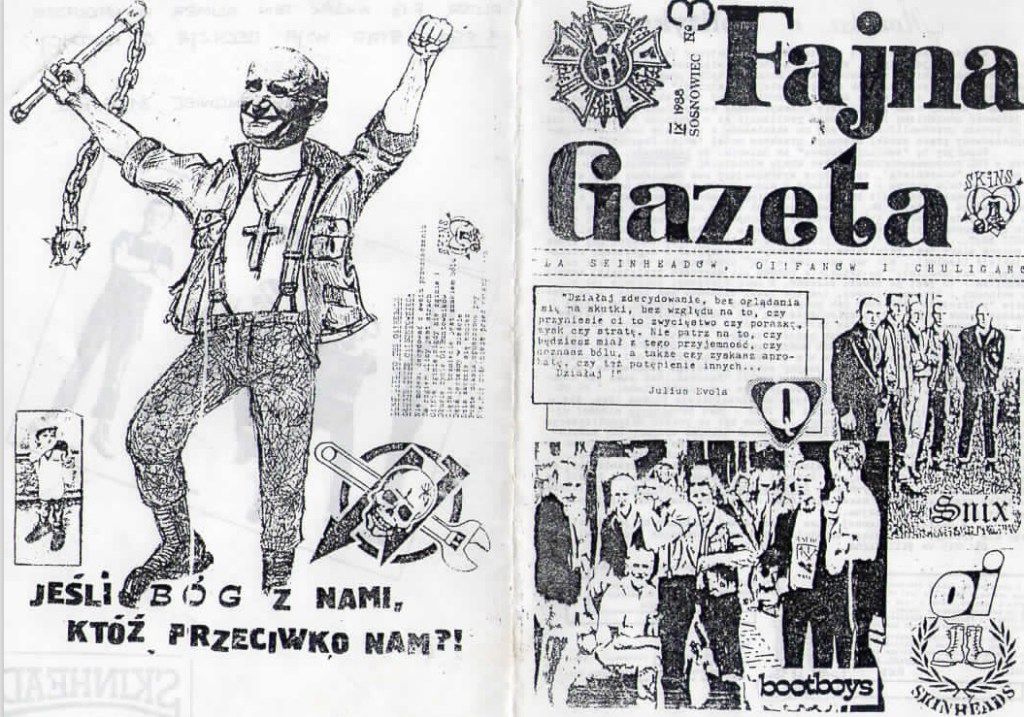
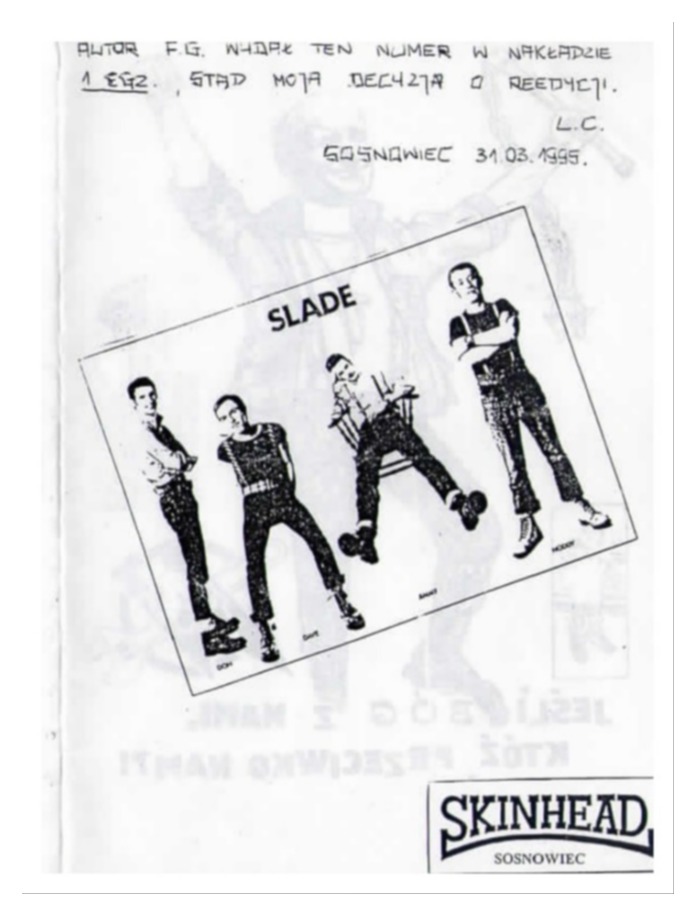
Armia, another great band… But let’s turn to Fajna Gazeta, perhaps the first real Polish skinhead zine, which you edited in 1988.
I was involved in the Fajna Gazeta zine during my Oi skinhead period, although I wasn’t the sole editor; Mądry also worked on it with me.
The zine featured quotes from both Baader/Meinhof and Mussolini, all the while declaring itself ‘anti-political’ and even citing The Apostles [a controversial band from the British anarcho-punk scene] with the line: “There’s only one place for communism, fascism, and anarchism: the scrapheap”…
There was also a quote from the US New Left theorist John Gerassi in one issue. I remember that his appearance in a violent Polish skinzine came as a huge shock to the American anarchist Laura Akai, who had attended his lectures. [laughter]
Fajna Gazeta was quite intellectually inclined for a skinzine, especially when compared to western counterparts. For example, it ran an essay by the Russian Christian-existentialist philosopher Nikolai Berdyaev titled ‘Thoughts about the Nature of War‘ from 1915. Could we say this reflects the decent level of education that the Polish People’s Republic aimed to provide, particularly for the working class?
The level of public education and literacy was higher in the Polish People’s Republic without the slightest doubt. But let’s not fool ourselves that Fajna Gazeta reflected the level of the average skinhead. I doubt anyone else besides me was reading Berdyaev, and my own knowledge of him at the time was limited…
At the time, I had ambitions of fleshing out a philosophy of ‘violentism’: a cult of struggle for its own sake, embracing struggle as the essence of life. A bit like the Blitz song: “We fight to live, we live to fight”. Hence references to both Mussolini and Baader/Meinhof, yet at the same time rejection of any involvement in politics. I wrote an article titled ‘Remember Ernst Röhm’ for Fajna Gazeta, cautioning skinheads against political entanglements on the grounds that the fascists would use them just as they had used Röhm’s stormtroopers. But later, as you are aware, I ventured down that path myself…
Maybe you’ll disagree, but my impression from reading Fajna Gazeta is that perhaps even during these nascent stages there were inklings – the cult of direct action, the cult of violence for its own sake – which, given the right conditions, could evolve into fascism (though not as an inevitable outcome).
Does the cult of direct action lead to fascism? It’s a possibility. That, at least, was the fate of many syndicalists in the early twentieth century, But it can also also manifest as a form of class struggle. As Ramzes & The Hooligans once sang: „This ain’t about fascism, my dear pacifist / It’s about giving someone a good old fist/ And if life’s not working out, it’s true / I’ll knock the teeth out of someone like you”… The left, on the other hand, has evolved in a bourgeois hipster direction, and that has also played a role in this dynamic. It’s no coincidence that Gary Bushell has moved from Labour to UKIP. All the polls show that the left is now a movement of the educated middle class rather a working-class movement.
I’d argue that Bushell not only broke with the middle-class left but also turned his back on the working-class movement. He crossed the picket line at Wapping during the 1986 printers’ strike, which was a strategically important battle against Murdoch and Thatcher. So, with the best will in the world, I don’t see how Bushell’s later turn to UKIP could be framed as an expression of class-consciousness.
I wasn’t aware of that. But this isn’t just about Bushell, it’s about a much broader sociological phenomenon. In my opinion the left that has abandoned class struggle in favour of identity politics.
On this you’re unfortunately right. There still is an authentic left, but at this point in history it’s fairly marginal… In what sense was skinhead violence in the Polish People’s Republic a form of class struggle, though? There weren’t many wealthy people. The middle class, as far as I’m aware, was more of a self-conscious ‘intelligentsia’ – an aspiring middle class rather than a true middle class in the economic sense. Or do I have a wrong idea of classes in the PRL?
Not entirely… What I was getting at is that the cult of violence could be ideologically framed within the context of the class struggle, not exclusively tied to fascism. Undoubtedly, skinhead violence was an outlet for the frustration experienced by working-class youth. Punk was also a plebeian subculture in the 80s-90s – but there were more kids from intelligentsia families among punks, while skins tended to attract more proletarian and lumpenproleterian youths. In a society with more equal wealth distribution, what we call cultural capital played a significant role in setting different social group apart. In a way, this might relate to Machajski’s ideas.[1]
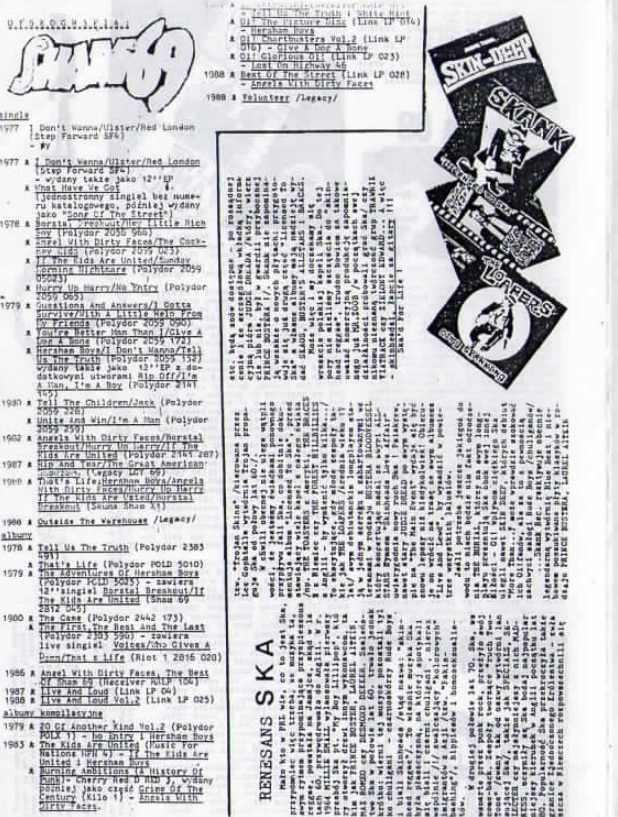
In Fajna Gazeta you wrote: “I like the music of Skrewdriver, Red London and Attila the Stockbroker equally, yet I’m not a communist, nationalist, or anarchist”. Beside Oi bands such as Snix, there’s an article about the history of reggae and ska, references to Skin Deep and The Burial and a positive review of the Redskins album. There’s even a nod to Test Dept somewhere… It’s worth mentioning all this because in the west, the prevailing image of Eastern Bloc skins is that of total boneheads who didn’t know anything apart from Skrewdriver…
Well, we did know a little bit… [laughs]. Bushell’s Oi! compilations were quite renowned, for example. Personally, I made an effort to translate Oi writings, like the ‘People’s Pub Party Manifesto,’ from album covers. In those early days, the most popular bands were 4-Skins and Cockney Rejects, but we were also into groups like Toy Dolls, The Pogues, and The Meteors – at least I was. German, French and Spanish records also found their way to us… Agnostic Front from the US were popular. Ska wasn’t really such a big thing for us, but my nickname did come from the ‘Trojan Skins’ badge I used to wear.
Political, i.e. nationalist bands came later. The first Skrewdriver songs I came across were the Smash The IRA and Voice of Britain singles, I believe it was in 1987. And I won’t lie – I did enjoy them. I wasn’t the only one. One time, a hippy friend visited while Skrewdriver was playing on the tape recorder. “Oh wow, great sound. Who’s that?” he asked. “Skrewdriver”, I answered. “So these are the bastards? … Well, they’re pretty fucking good”.
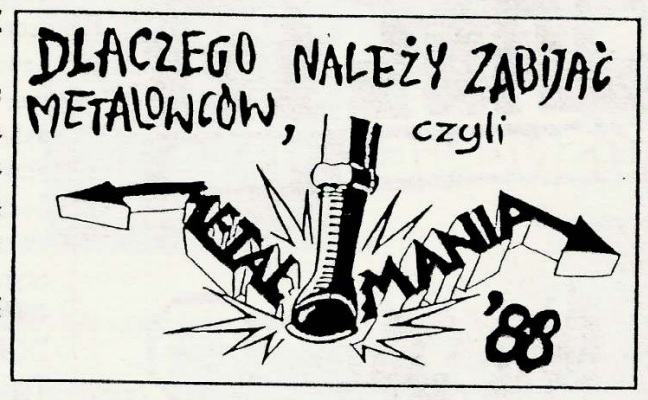
Speaking of longhairs, would you like to talk a little about the clashes between metalheads and skins – especially the Sosnowiec crew’s intervention at Metalmania ‘88?
You see, perhaps the Oi tradition that we tried to maintain locally, i.e., cooperation between skins and punks, pushed the Sosnowiec crew to find themselves another enemy: metalheads. Actually, I’m not sure why they were chosen – it didn’t have any ‘ideological’ undertones, they were just available targets. The most notorious action was the breaking up of the Metalmania festival in 1988, which Szczygieł reported in his article ‘Why metalheads should be killed’. It must be said, though, that the article is a classic example of ‘false success propaganda’, not unlike today’s war propaganda: the cowardly enemy suffers setback after setback, yet it’s unclear why we are retreating. [laughs]
In reality, a small group of skins did succeed initially in controlling the space in front of the stage, but after a break, they succumbed to the vastly greater numbers of the metalheads. They had to withdraw outside the Spodek hall and resorted to ‘partisan attacks’ against smaller groups of metalheads on their way home… These hostilities continued for a couple more years, and in 1990 a young skinhead, a GKS Katowice fan named Tomek, was fatally stabbed in a clash with metalheads near the Spodek arena. For a time, there was a graffiti message that read “We will avenge Tomek” at the very spot where he lost his life, and people would gather there to light candles in his memory. Jerzy Bogucki made a short documentary about the incident in 1991 – it’s called Krew walki [Fighting blood].
Crikey! Any other memories involving Metalmania?
I remember one night, as I was walking through the park on my way to Katowice train station, a couple of guys approached me in the pitch dark, asking for directions to the trains. I suggested they walk with me, and we struck up a conversation. It turned out that both they and I had attended Metalmania. When we reached a well-lit street, I discovered they were metalheads, and they discovered that I was a skin! We had both been at Metalmania, but on opposing sides… But since we’d already become friendly, it didn’t come to blows. When the conductor came to check our tickets on the train – neither they nor I had any – we tried to charm him with a bit of persuasion: “You don’t want to help the Communists, do you? Come on mate, we’re all Poles…” [laughter]
CLICK FOR PART 3: TOUGH TIMES, TOUGHER SKINS

[1] Jan Wacław Machajski (1866–1926): a Polish revolutionary who believed that the interests of intellectuals (including left intellectuals) were opposed to the interests of manual workers since the former sought to preserve their monopoly on education. The solution he advocated was wage equality through a general strike as a means to democratise access to knowledge. ↵
 Creases Like Knives