Matt: Hi Trojan, could you introduce yourself?
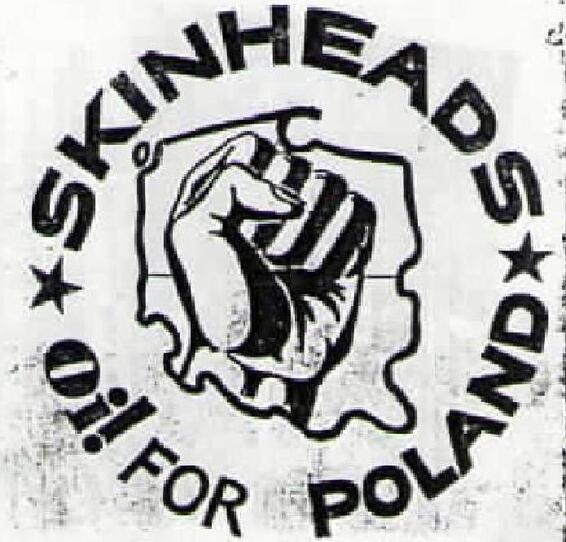
Trojan: I come from a small town on the southern outskirts of the Upper Silesian industrial hub. I spent my upbringing in a working-class neighbourhood. From our flat windows, we had a view of the mine gates where literally my entire family toiled. I became a punk in autumn 1981 – it was October when I headed to nearby Katowice to catch a gig by a band from Lodz called Brak. Their blend of aggressive music and political lyrics had me hooked. It has to be said that I had a penchant for politics from a young age. In the latter half of the 80s I became a skinhead, and in 1988 I co-edited the skinzine Fajna Gazeta. After 1993 I stepped away from the skinhead scene.
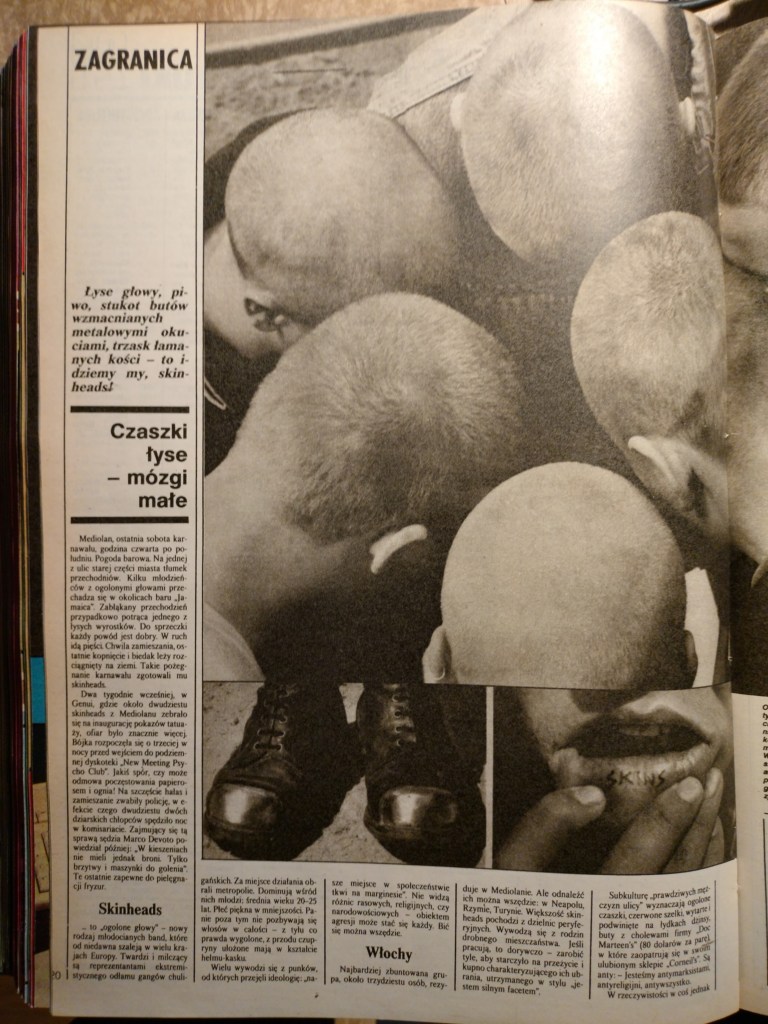
So, where and when did the first skinheads appear in Poland?
Apparently the first skins were sighted in the early 80s in the harbour town of Gdansk. Around the same time, the ‘Fascist Renewal Army’ was also operating in the area, though these ‘fascists’ were a completely distinct subculture. Skinheads later appeared in Warsaw too: Tyc and Pokrop were well-known early faces there. In Lublin, there was a fellow by the name of Partyzant. I remember attending the Jarocin Festival in 1984, still in my punk phase.[1] He tried to snatch my Crass badge off my jacket. I hardly even registered what was happening – he reached out in my direction and shouted something I didn’t understand. It was only later that I learned about the animosity between skins and punks, something that hadn’t even crossed my mind that day.
There’s this story, maybe just an urban legend, suggesting that the earliest Polish skins emerged around 1981 in Szczecin. The tale goes that they used to hang out at the Castle of the Pomeranian Dukes. The cabaret singer Artur Andrus found the story so amusing that he incorporated it into his song ‘Glanki i pacyfki’.[2]
I haven’t heard anything about skins from Szczecin, but it’s perfectly possible especially because in Poland, new trends often reached the port towns first. They were brought in by sailors, travellers, and people who had been temporarily working in Sweden. The ‘Tricity’ area along the Baltic coast, which includes Gdansk, Gdynia, and Sopot, was also well-situated to pick up influences from the outside.
There’s an ex-skin from the 90s doing research for a forthcoming book on Polish skins. He claimed to me in an online chat that the first skinheads appeared in Poland as early as 1979. Does this seem likely to you?
I don’t really know – it’s difficult to verify such claims. In the Polish media, the first mentions of skins came after the ‘summer of hate,’ i.e. after the 1981 riots following the notorious Southall gig. But as I said: in harbour towns, information came through informal channels – through sailors selling records, for instance. So it’s not impossible.

What was the ‘fascist’ subculture you just mentioned?
The ‘fascists’ were a pseudo-political subculture driven by extreme anti-communism and a complete rejection of society. Their activities mainly involved violence, mugging, theft, vandalism, and defacing walls with swastikas. They didn’t always succeed at this: I saw a swastika that was oriented clockwise vertically and counter-clockwise horizontally [laughter]. The “fascists” also tried to emulate the nazis depicted in movies, dressing in black railway uniforms and wearing German army helmets left over from World War 2. I remember one of these crews showing up at a concert in Katowice in the early 80s, possibly at a Maanam or Kat show, though I’m not entirely sure. [Maanam was a major Polish new wave band while Kat was a leading heavy metal group – MC].
What was your political evolution before and during your time as a skinhead?
My political journey began with an interest in communism, specifically its dissident branches. I was particularly drawn to Maoism and the Italian Autonomia Operaia [Workers’ Autonomy] movement, especially the Brigate Rosse. I also briefly explored Shliapnikov’s Workers’ Opposition, although I might have discovered it later, after my actual communist phase. Later on, I was an anarchist punk oscillating between syndicalism and nihilism. Then I became an Oi skinhead. During that time, I liked the vibe of British Oi from the Gary Bushell era: anti-political but patriotic and populist-workerist, and by virtue of that slightly left-leaning.
Eventually I became a nationalist skinhead. During that period I was fascinated with the pre-war Zadruga movement (which, together with the Legion of the Young, you could say was the Polish equivalent of National Bolshevism)[3] and with Strasserism. I was good mates with the lads from the national-communist skinhead band Sztorm 68. But this tendency never held much sway in Poland. In our country, the right is Catholic, conservative and pro-capitalist and the left, at least post-1989, is liberal and Europeanist.
You mentioned that a skinhead ripped a Crass patch from your jacket in 1984. Was that your first encounter with skins or had you seen them around before?
No, he didn’t manage to rip it off my jacket, although he tried. In the early 80s there was a guy nicknamed ‘Łysy’ [Baldy] who lived in the student dormitories in Katowice-Ligota. He had a shaved head, quite an aggressive demeanour and was said to be a racist. I’m not sure if he was supposed to be a skinhead or if it was just a coincidence, though. As time went on, I began to read about skins in the newspapers, and I’d spot guys with short hair and denim jackets hanging out at gigs. Initially, they mingled with the punks and didn’t appear as a separate group. By 1984, though, it was becoming evident that they were forming their own distinct subculture.
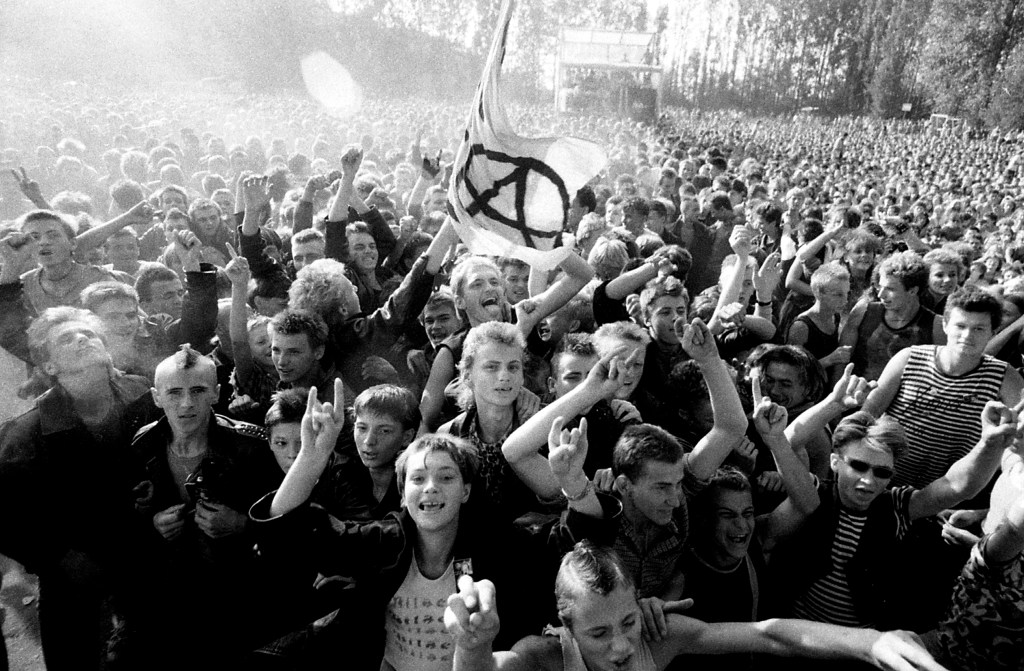
Skinheads in Poland gained notoriety for their tendency to disrupt punk and alternative concerts. When did these mass brawls between skins and punks start?
The first major brawl took place at the Jarocin Festival in 1985. The skins had arrived from Wroclaw to stir things up a bit.
Were you there?
I was indeed at that concert, but I found myself in a massive crowd at some distance from where the brawl was happening. At the time, I wasn’t entirely sure what was going on. Later on, I had a chance to see more detailed footage of the incident, thanks to my hippie friend Jurek P, who was filming a VHS movie about Jarocin.
The video footage, although somewhat distant, captures a group of about 20-30 lads approaching the stage – but instead of joining the pogo, they’re aggressively pushing the punks away. They start chanting “WKS – SS!” and clapping their hands in the manner of football fans [WKS stands for Military Sports Club, the main football club in Wroclaw]. Then the punks also close ranks in response. The two groups confront each other, exchanging shouts. Suddenly the first blows are thrown and a full-blown brawl erupts.
Interestingly, I recall a bloke with a mohican on the side of the skinheads and another fellow with a shaved head fighting alongside the punks.
Did the punks usually come out on the short end or did they sometimes have the upper hand?
It varied, but generally speaking, the skins had the upper hand. Punks weren’t pacifists in Poland – they knew how to stir up trouble too. But they were less organised, less determined, and less efficient in their actions. The skins may have been fewer in number, but they tended to be a bit older than the punks on average. Plus, they knew each other well and had a strong sense of solidarity – they stuck together.
Additionally there was the surprise factor: at first the punks didn’t understand why the skins were attacking them. I’ve got this fuzzy memory of a festival of the Gdansk Alternative Scene at Sopot pier. Most of the skins couldn’t afford to get in, so they hung around outside the fence. I saw a bunch of skins on the other side, challenging the punks in the enclosure to come out and have a go. But the punks just kept their heads down, not making a peep. They looked like a bunch of sheep, penned in and surrounded by a pack of wolves…
Militant punk crews like PBB (Punk Brigade Banditen) from Wroclaw didn’t emerge until the 90s, and that’s when the battles started to become somewhat more evenly matched. But even then, the combat value of the skins was generally higher.
As a punk, were you appalled by the skinheads’ organised attacks or were you fascinated by their strength and comradeship?
The former didn’t diminish the latter. I grew up in a working-class neighbourhood where physical strength, courage, solidarity and the ability to hold your own in a fight were highly regarded. It was difficult not to be impressed by them. But my initial response was to try to organise some form of self-defence among punks – and, most importantly, to find a way to defuse conflicts. As Sham 69 fan, I still held on to the naive belief that “if the kids are united, they will never be divided”
Can you tell us a little bit about the following years’ events at the Jarocin Festival, which you attended as a skinhead?
As a skin, I attended Jarocin twice. My memories of those events are just a series of fragmentary images… We, the skins, were drinking vodka in the market square of Jarocin. The crew from Sosnowiec wanted to bash Owsiak and his fans. Owsiak, a former hippie and now a contributor to public radio and the weekly magazine Naprzełaj, symbolised what we saw as the ‘commercialisation’ of counterculture, turning rebellion into harmless entertainment. When the anti-regime opposition launched a ‘Free all political prisoners’ campaign, he staged the surrealist happening ‘Free the elephant’. So we showed up shouting, “Bloody kill the elephant!” [laughter]
But for the other skins, the main enemy was, of course, the punks. A small group of skins were lurking in the arcades of Jarocin town hall, while the punks, who were far more numerous, were roaming around the hall. An open brawl was out of the question due to the police presence. Later on, though, there was a minor altercation with the boys in blue. A punk and a skin were about to engage in a one-on-one fight when the coppers stepped in and arrested them both. I believe it was Płetwa from Sosnowiec who managed to open the doors of the police van, allowing both of them to escape. So now the cops were after him, and chaos ensued. We all scattered in different directions. Szerman, who had experience in riots, quickly passed me Płetwa’s denim jacket so that Płetwa could disappear into the crowd more easily.
The last time I went to Jarocin was in ’88, only with my mate Długi at that point. Overall, by ’88, Jarocin was rather dismal: few mates there, zero fun. In 1989, I couldn’t be bothered to go anymore, although most of my crew still did – for “reserve training exercises”, as Szczygieł called it.
I presume you became a skin in 1986 or 87?
In February 1986, when I attended the Convention of Cynical Youth in Gdynia – another alternative music festival – I was still a punk. So my transition must have occurred later that year or in 1987. But it was a drawn-out process anyway, not an overnight conversion from Saul to Paul. For a certain period, I was a punk who mainly hung out with skinheads, which was a common thing at the time. But then I ended up identifying with skins completely. I published a one-off zine titled Oi!, which was just four photocopied DIN A5 pages containing an interview with the German Oi band Vandalen and nothing else. The point of the publication was to propagate the slogan “punks and skins, unite and win”. But the Fajna Gazeta zine a year later was already a pure skinhead zine.
The unity slogan hadn’t caught on?
No chance. The skins hadn’t split from the punks only to unite with them now. There were a few folks who bought the ‘unity’ slogan, but they were in the minority. I remember this one gig where I was trying to play peacemaker between friends from rival subcultures, and at some point, Majcher had had enough. He says, “Alright, mate, you keep dragging me away from these people. Let’s sort it like this: I can have a go at your friends if you can have a go at mine”. [laughter]
Now, when it comes to Polish punks, they weren’t too thrilled about Oi. I remember this punk zine once described Oi as a “mixture of pseudo-socialist slogans and typically right-wing brutality”.
Did you do the Vandalen interview yourself or translate an existing one?
Nah, I did it myself, by mail.
Why a West German band? Anti-German attitudes have always been quite strong in Poland. And later, as a nationalist skin, I presume anti-Germanness became one of your fundamental stances.
Well, exactly – at the time, I wasn’t a nationalist yet. What really mattered to me was the band’s anti-political message.
How did you overcome the language barrier? Weren’t they teaching only Russian in Polish schools at the time?
Let’s not go overboard. In communist Poland, we had English and other Western languages taught in high schools. We learned enough to be able to correspond with a dictionary in hand – which, by the way, taught me more than English at school.
So, English songs about the Polish situation like ‘Solidarity’ by Angelic Upstarts and ‘Poland’ by Skrewdriver were understood by Polish skins?
We could work out the overall meaning, yes.
The original version of ‘Solidarity’ [published only on the Upstarts’ Lost & Found compilation] is credited as a ‘Polish folk song’. I recall hearing about a Polish version called ‘To jest strajk’ from an ex a while back, but I’ve never been able to track it down.
Well, your search is over. The original is an authentic strike song from 1980 called ‘Boże nasz’.
Nice one! Now, from about 1985 onward, large numbers of ex-punks became skins. I heard a few times that Polish punks became skinheads partly because punk had become “commercialised”. It’s difficult to imagine what commercialisation might entail in a country like the Polish People’s Republic, where there was no market operating on a profit basis?
That’s not entirely accurate. In the Polish People’s Republic in the 80s there was a thriving ‘shadow economy’ – I remember getting my hands on my first Sex Pistols cassette, which was, of course, a bootleg, in a market in Katowice around 1980. But it’s true that commercialisation in the strict sense of the word only occurred in the 90s, when zine and cassette publishers, t-shirt labels, etc became real enterprises and serious money was pouring through the so-called rock scene markets.
The latter half of the 80s, on the other hand, saw the massification of punk. Punk rock was increasingly heard on state radio, with shows such as Marek Wiernik’s Cały Ten Rock programme and Tomek Rylko’s broadcasts on Rozgłośnia Harcerska. Punk bands weren’t performing only in student venues, but also at housing estate clubs and provincial community centres – sometimes for pay. There were these things called pogotheques, basically punk disco nights. Punk didn’t shock anymore. All over the country, punk crews began to spring up like mushrooms – but these younger crews were less familiar with the music and customs. Many were so-called fair-weather or holiday punks. All of this led to resentment among the older crews, prompting them to emphasise their distinctiveness by adopting the skinhead style.
Was the ‘commercialisation’ of punk also the reason why you became a skin?
There were several factors at play. First, there was this ‘commercialisation’ – or let’s say normalisation – of punk, which I thought was losing its edge and becoming more of a fashion statement rather than a real movement. It had become a way of having fun, increasingly blending into the so-called ‘alternative’ scene. Second, on an intellectual level, I started feeling disillusioned with the anarchism I used to identify with. I began to see its utopianism in terms of any kind of constructive solutions – it was, after all, difficult to imagine punks as members of anarcho-syndicalist workers’ collectives. Third, I was fascinated by the energy and fighting spirit of the skins. And fourth, perhaps most importantly, there were social factors at play. In the course of one year – one summer, in fact – almost all in my crew had transitioned into being skins.
In your early days as an anti-political skin, did you have any trouble with the more politicised elements on the scene?
Not really. The scene was small and any politicisation was very superficial. There was some teasing and taunting, like with Struś, a well-known skinhead from Lodz who I first met in 1983 when he was still a punk. He once showed up at a gig wearing a homemade T-shirt featuring a coat of arms: one half had the Polish white eagle, and the other half had a swastika. I used to rib him about that all the time.
The first serious brawl between the ‘nationalists’ from Kraków and Opole and the apolitical Oi skins from Sosnowiec and Katowice only occurred in 1990 at a concert in Sosnowiec, called ‘Oi for the Fatherland – Second Strike’. But even there, the immediate cause wasn’t really politics; it was more about someone having their jacket nicked… Then the Oi skins suddenly disappeared from the scene, only to be reborn in the latter half of the 90s with bands like Skankan and zines like Ska Fever and Skinhead Sosnowiec.
In one interview, Bogdan from the band BTM talked about his efforts around 1984 to emulate the original ’69 skinhead style. He even managed to track down a pair of bus driver trousers that resembled Sta Prest. Was such interest in the origins and creativity in capturing the look the exception?
I wasn’t particularly interested in clothes or appearance during that time, so I may not be the best person to comment on this. I do remember that Bogdan wasn’t the only one aiming for authenticity in their style. He was definitely in the minority, though. Keep in mind that access to visuals of British skinheads was quite limited, and original gear like Dr. Martens, Lonsdale, or Fred Perry was simply out of reach.
So what were you lot wearing in the 80s?
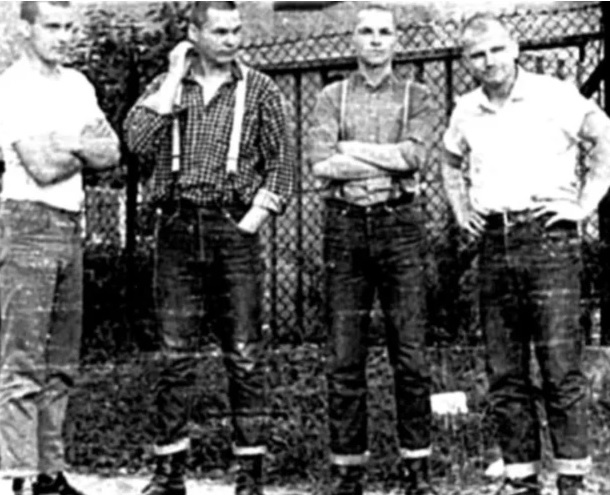
In the 80s, Polish skins typically sported denim jackets, braces, and boots, with a preference for rumuny [Romanian combat boots originally made for Ceausescu’s Securitate police units but imported to Poland for workers] and jeans with turn-ups. Lace colours, like white or red, were supposed to have meanings, but everyone was saying something different so I just stuck with black laces. Crucially, skinheads in Poland during that time didn’t shave their heads; they just kept their hair short and tidy. As we moved into the 90s, pseudo-American flight jackets with orange lining (known as bombery, flyersy, or fleki in Poland) became popular. At first, it was green jackets but as neo-nazism became the dominant trend, black ones became more common. Add to this the customary high-waisted jeans, preferably Levi’s 501s, or alternatively camouflage combats. Plus t-shirts, less often polos, and even less often shirts (preferably checked ones).
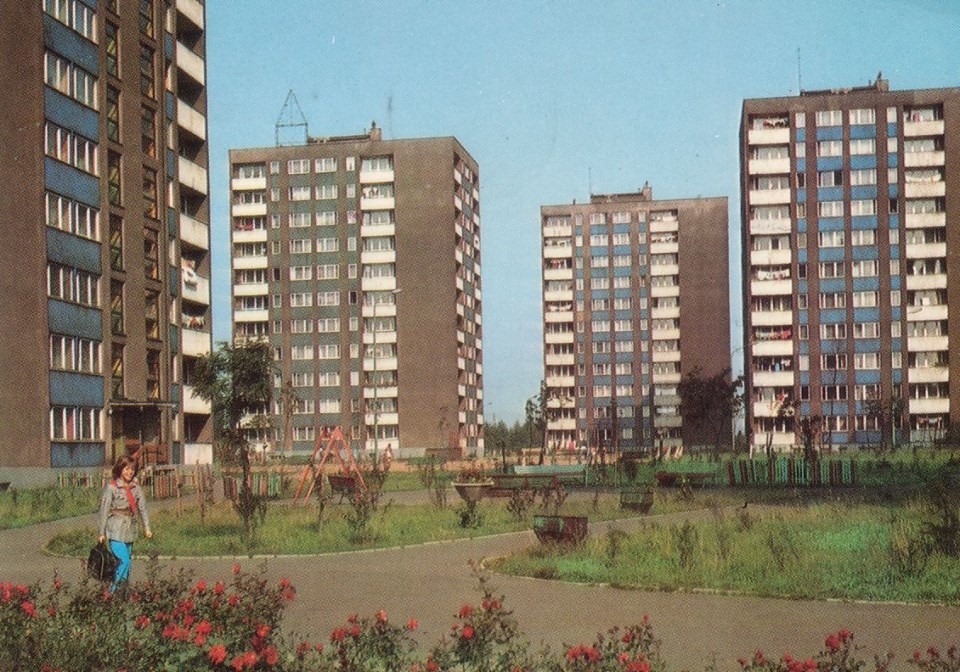
The Sosnowiec crew, to which I was affiliated, generally tried not to stand out too much visually, perhaps for practical reasons given the crew’s hooligan lifestyle. You could say we had a more ‘casual’ style. Anyway, everyone dressed differently. Pastor from Sosnowiec, for example, looked like a traditional punk. And my jacket, de facto a fireman’s jacket, had been dyed brown since wearing uniforms as unauthorised individuals was against the law.
Tell us more about the Sosnowiec crew.
Well, not all of the notorious ‘Sosnowiec skins’ were skinheads, and not all of them were from Sosnowiec [laughs]. I wasn’t from Sosnowiec for starters, and Dyzio and Długi were from Katowice. What’s more, Pastor was a punk and Małpa was a ska and reggae fan, but not a skinhead. There were no strict rules – the crew was mainly about having fun, causing trouble, hooliganism. Drugs weren’t a part of our scene, at most some occasional weed. Hard drugs were a no-go because we could see the degeneration of drug addicts right in front of us. As one of the lads used to say, “our motto is the three P’s: piwo [beer], panienki [girls], and the third P, I forget” [laughs].
Contrary to the stereotype of ‘dumb, boneheaded skins’. our crew had some thoughtful individuals. Szczygieł, for example, was a great drawer and generally a thinking bloke. He published an art zine called Manana, using it as a platform to promote his invented art movement, “manyanism” derived from the Spanish word for tomorrow, mañana. He described it as “futurism broken down into small parts” [i.e. the idea of futurism being reduced in scale, moving from grand historical concepts to smaller, more immediate concerns relating only to the following day].
The crew included members like Majcher, the Apacz and Jaszczur brothers, Płetwa, Śruba, Mrówa, Gruby Rycho, the inseparable Cegła and Generał, and others whose names have faded from memory. It was a tight-knit group. These guys would share their last slice of bread and the last drop of vodka with you if they recognised you as one of their own. In fights, they stood behind you like a wall – I learned this firsthand when I had trouble with some local gypsies. But when it came to people outside their own crew, let’s not sugarcoat it, they could be unpleasant. And they were tough. I could go on with stories, but let me share one episode: they once disrupted a gig at a student club in a basement by spraying tear gas into the crowd. The entire audience fled the venue, but they remained because they had become immune to the effects of tear gas.
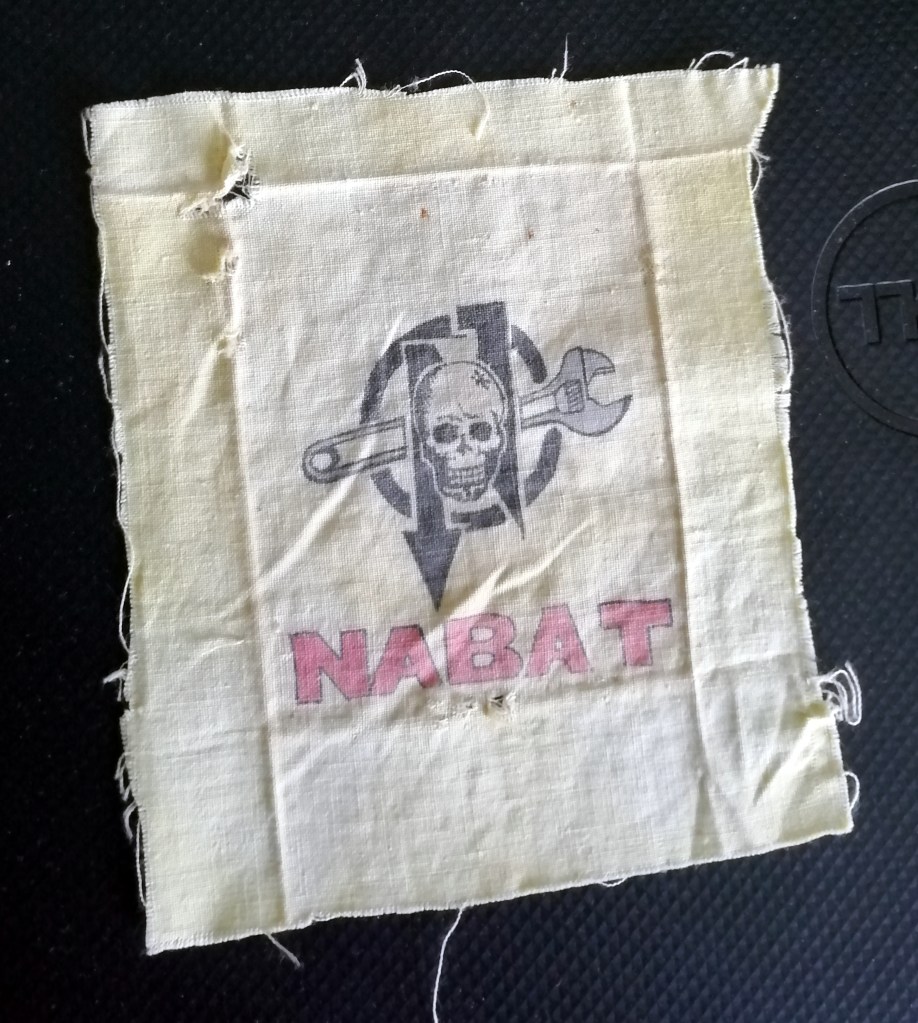
You showed me your Nabat patch from that period. Did you make it yourself?
A mate made it for me when I asked. I can’t quite remember when, but I used to wear it on a camouflage military jacket rather than my denim one, so this must have been before 1987. Nabat’s popularity was such that the skins from Raciborz nearby had their own Polish-language version of ‘Laida Bologna,’ which they chanted in the streets (with lyrics that told the story of a Raciborz skinhead – completely unrelated to the original song).
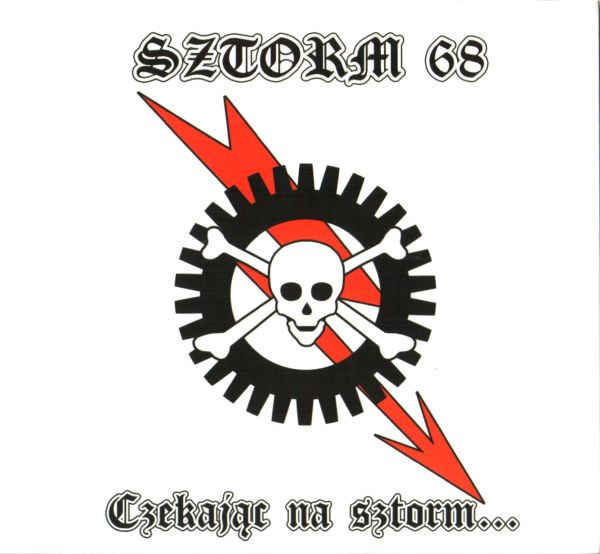
Oh, here’s an interesting tidbit: the Nabat logo later served as inspiration for the logo of the band Sztorm 68 from Kraków. When they were gearing up to release their debut tape and brainstorming the cover art, I floated the idea of a plain white eagle without the crown [the emblem of the Polish People’s Republic], set against a backdrop of a Celtic cross in its pagan form. Kelian, the singer, vehemently protested: “No eagles, no crosses! Only hardline national-workerist vibes!” [laughs] So, what they ended up with was a skull with crossbones on a backdrop of a gearwheel, with a lightning bolt striking across it.
We will certainly return to that band later on.
CLICK FOR PART 2: OI MUSIC, ZINES AND METALHEADS

[1] In the 80s, the Jarocin Festival was the biggest alternative music festival in the Eastern Bloc countries. From 1980–94 it took place annually in the west-central Polish town of Jarocin. ↵
[2] In a magazine interview, Andrus explained: “I was told that the first skinhead group in Poland used to meet at the Castle of the Pomeranian Dukes in Szczecin. I was quite surprised by their choice of hangout. I envisioned them leaving their typical skinhead behaviour outside the castle and strolling through the museum halls with protective slipcovers over their boots, guided by an elderly lady whose directives they dutifully followed”. ↵
[3] Zadruga: a Polish nationalist and neo-pagan movement, launched in 1937 by Jan Stachniuk. Legion of the Young (Legion Młodych): a radical youth league founded in 1930 by young Josef Pilsudski loyalists. It espoused an ideology of state (not ethnic) nationalism of an anti-capitalist, anti-clerical and anti-democratic character. It defined its enemies as “KKK” (the Polish initials for Comintern, church and capital) and espoused the ideal of a ‘state built upon organised labour’. ↵
 Creases Like Knives