From Bar Italia, we walk south to Old Compton Street and turn right, then take the next right into Dean Street.
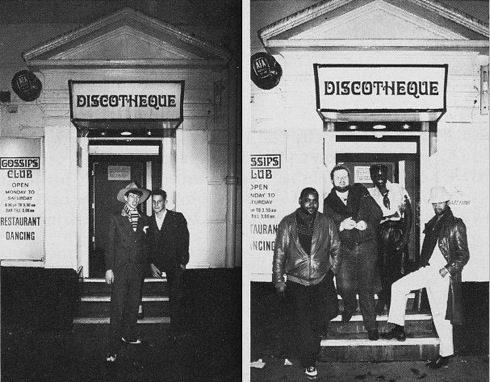
Gossips circa 1979
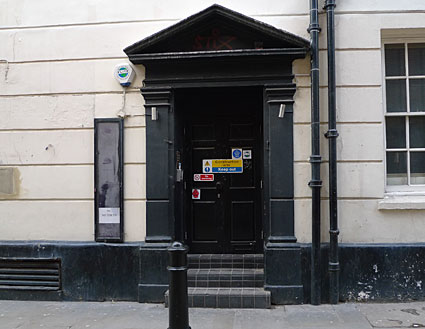
Gossips, 69 Dean Street, Soho.
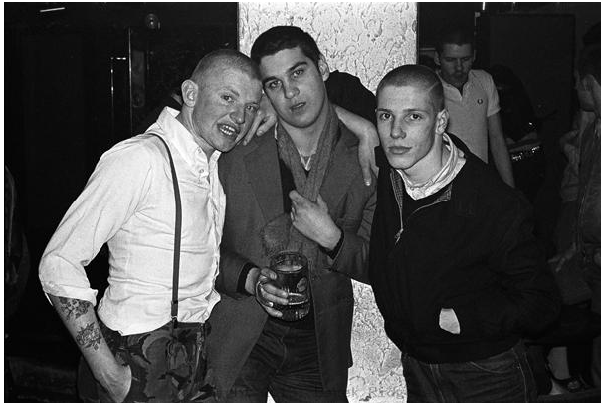
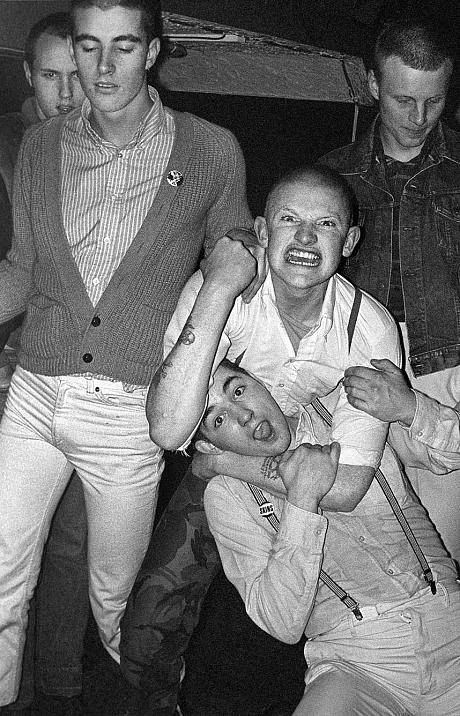
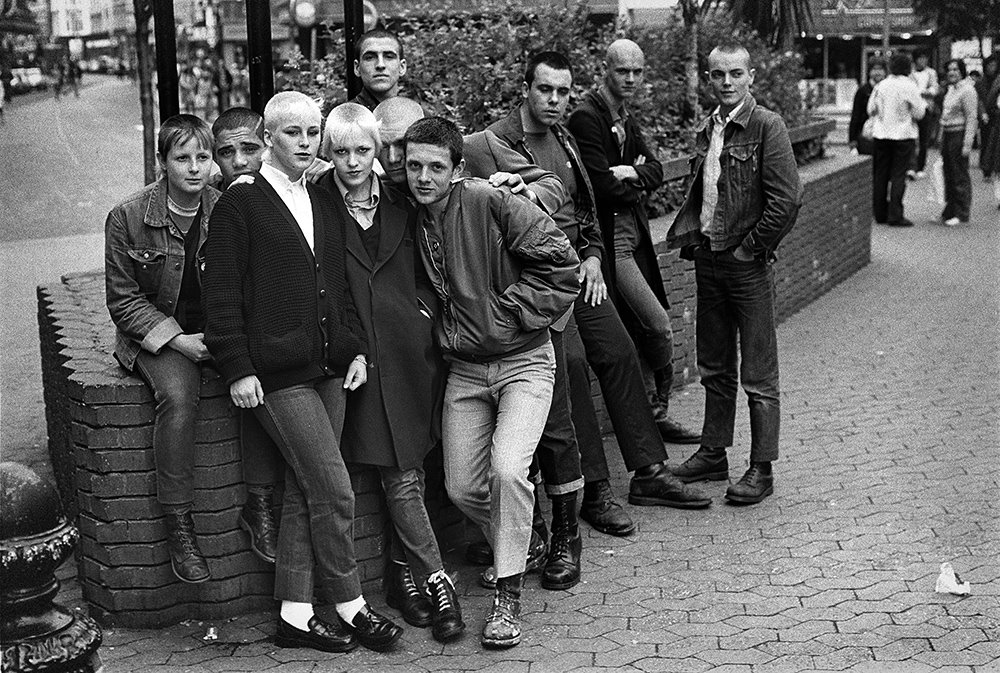
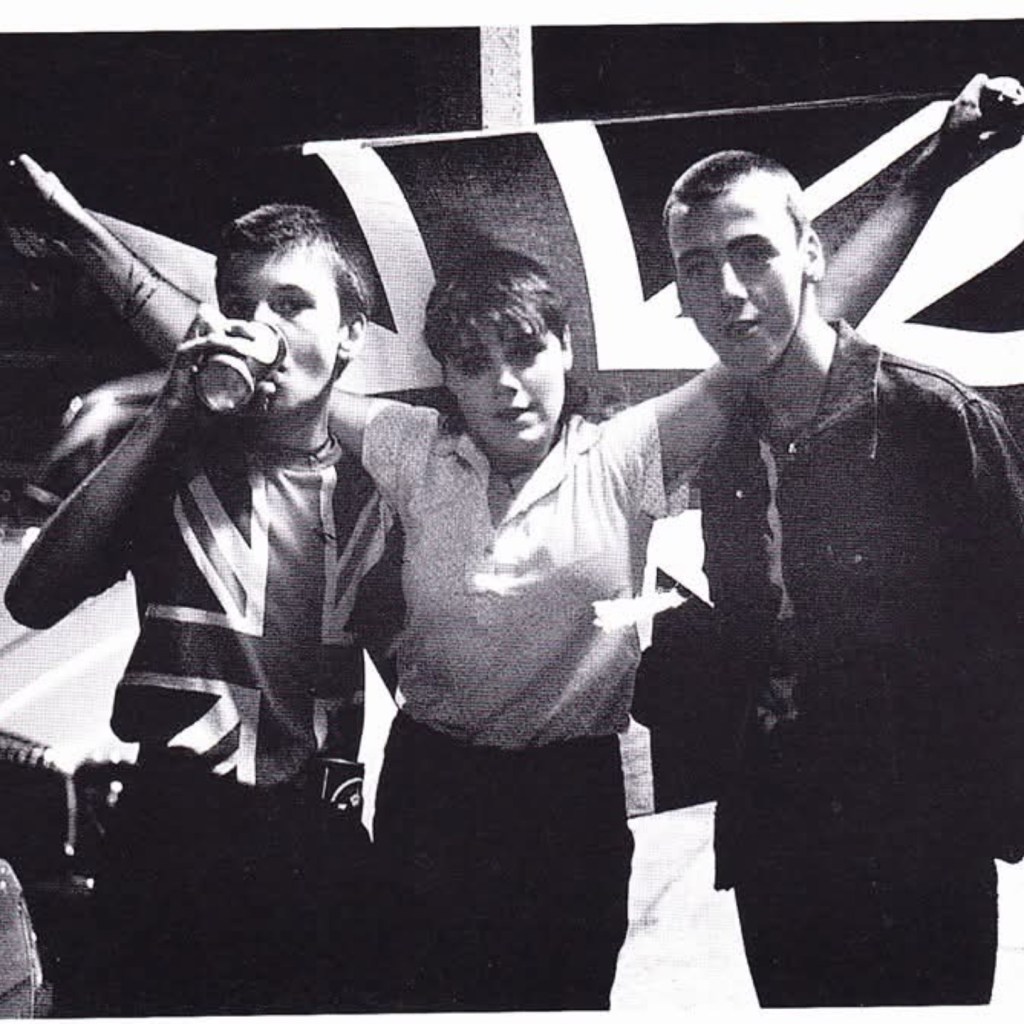
The exact opening date of this legendary Soho nightclub is a mystery, but it hit its stride in 1979 as the home of Gaz’s Rockin’ Blues on Thursdays – London’s longest-running one-nighter. Hosted by Gary Mayall, son of blues musician John Mayall and grown up a little peanut in the late ‘60s, the club served up a heady cocktail of ska, blue beat, and rhythm and blues. Unsurprisingly, it quickly became a skinhead haunt – a fact immortalised in Derek Ridgers’s Skinheads 1979–84 photo book.
Gossips 1979. Photo by Derek Ridgers
By 1982, Gossips had also become a venue for punk and skinhead gigs. A transitional year, 1982 saw regular skinhead and punk bands increasingly sharing the bill with early RAC acts. Among them was the British Movement outfit The Ovaltinees, who made their way onto the Gossips stage. In the 40 Minutes documentary episode ‘Skinheads’ from 1982, featuring Combat 84, one scene captures Chubby, Deptford John, and other South London skins hanging out at Gossips, dancing along as the Acton punk band The Satellites play their song ‘Nightmare’. The band would release the track as a single the next year.
A small, intimate basement club with dim lights and the tiniest of stages, Gossips also also earned its place in history as the birthplace of goth, hosting the Batcave nights from 1982 to 1985. Although Gaz’s Rockin’ Blues moved out in 1995, Gossips remained a haunt for punks, skins, and rock ’n’ rollers well into the 2000s, when it was hosting the monthly Club for Losers on Fridays. As Soho gentrified, the club finally closed in 2007 when the lease ran out. I seem to recall for a while afterwards it was briefly repurposed as a brothel, then some ‘networking club’, before shutting its doors for good.
Gaz’s Rockin’ Blues also found an audience among the skinhead revivalists who gathered in Carnaby Street in the early ’90s, and astonishingly it still continues today. Since November 1995 it has been held every Thursday from 10 pm at the St Moritz on Wardour Street, once again featuring live bands each week. The St Moritz actually gives a fairly authentic sense of what Gossips was like – the same kind of dingy Soho basement club, with a near-identical vibe. The main difference is that the St Moritz always stinks of piss, no mean feat given there’s only a single toilet cubicle for all, guaranteeing permanently long queues.
From here we walk south to Shaftesbury Avenue and turn right. Just off here at 96 Dean Street stood the Sound & Vision, an unmistakably 1980s pub whose walls were covered with television screens constantly playing music videos. It was never a skinhead pub as such, but around 1984 it was sometimes used as a meeting point before heading elsewhere in the West End. Nearby at 97 Wardour Street, The Intrepid Fox, a historic pub dating back to 1784, leaned more toward the punk crowd but was occasionally used by skins. The Intrepid Fox closed in 2006 when sold to property developers and now houses Old Town 97, a standard tourist trap / drunken restaurant in Chinatown. The Sound & Vision was demolished during the construction of Crossrail, a project that will mainly benefit yuppies in high-paid central jobs, especially in the City, the West End, and Canary Wharf.
We head west along Old Compton Street until we get to Rupert Street.
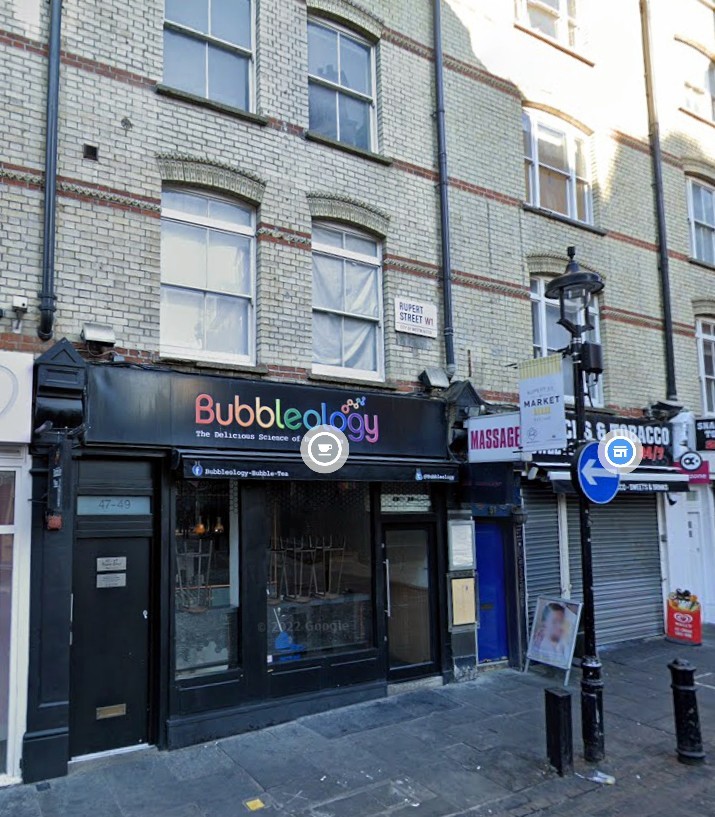
Nicky Crane’s flat, 47 Rupert St, Soho.
This is where Nicky Crane’s Soho pad was located – two doors down from The White Horse, a pub I quite like, and two floors above what was then a greasy spoon and is now a bubble tea cafe. Despite extensive gentrification and repeated attempts to clean up Soho, Rupert Street remains a seedy stretch even today, still home to some of the quarter’s last ‘massage parlours’.
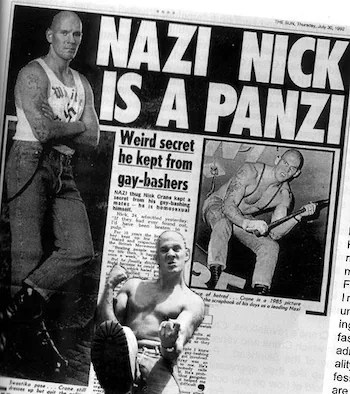
It is also barely a minute’s walk from Old Compton Street, with all its gay pubs and clubs. Why Crane chose to set up camp here, of all places, and what he was doing working as a security steward in gay venues and at gay pride marches never, of course, occurred to any of his Blood & Honour comrades, despite repeated exposés in Searchlight going back to at least 1985. Crane’s Rupert Street bedsit was also the setting for his televised ‘coming-out’ interview. This footage, broadcast as part of Channel Four’s Out programme on 29 July 1992, prompted Ian Stuart to claim that he had been “fooled the same as everybody else” and lament that he felt “betrayed”.
Crane had arranged to meet his old mate John G Byrne – a skinhead, though not a political one – at nearby Berwick Street Market on 8 January 1993, a street you may want to stop over on, with its cluster of great record shops. Crane never showed. The former postcard nazi, reformed and repentant at the last minute, had died the previous day of AIDS-related complications.
The question remains: why do ultra-macho movements that are officially hostile to homosexuals, like nazism, attract so many gay men?
Naturally, in any large group of people a certain percentage will be gay, regardless of ideology. Yet in the early 1930s the connection was so strong that, in street confrontations, communist militants baited nazi street fighters with derisory songs about rampant brownshirt homosexuality and chants such as “SA, trousers down!” – a fact that neither side likes to dwell on today. Soviet propaganda under Stalin even portrayed same-sex attraction as a sign of fascist influence. Somewhat closer to home, the strong presence of gay men in the ranks of Britain’s National Front, including among its leading members, was not exactly one of its best-kept secrets. Other historical examples abound. Germany’s most prominent neo-nazi leaders of the 80s and 90s, respectively, were Michael Kühnen and Bela Althans – both gay. Doug Pierce of neofolk pioneers Death in June turned the connection into an entire concept, meditating on it in numerous songs and using flags with the SS death’s head on rainbow colours as stage backdrops. As for Nicky Crane himself, he and some of his comrades are said to have organised well-attended gay skinhead nights at the London Apprentice pub in Isleworth near Richmond.
Is it the simple fact that fascist movements are overwhelmingly male, which leaves them prone to homoerotic dynamics? The lure of ritualised male bonding? The hypermasculine ideology?
Is it overcompensation for a perceived defect? Or the old truth that we often most hate in others what we despise in ourselves?
Music: Bronski Beat – ‘Why’
47 Rupert Streettoday
We may want to stop off at the excellent record shops on Berwick Street, such as Sounds of the Universe and Reckless Records, though the Jamaican music store Daddy Kool has been gone since 2003. Otherwise, from 47 Rupert Street we head south to the end of the street, turn left onto Coventry Street, and continue straight on through Swiss Court, which brings us directly into Leicester Square.
Leicester Square, West End.
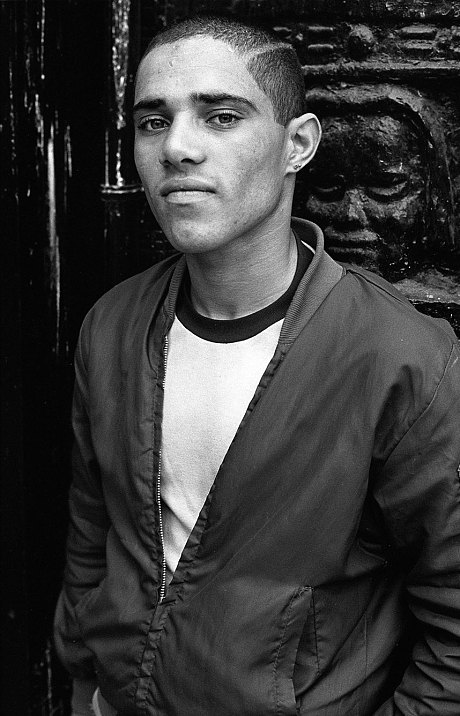
A gathering point for the down-and-out through the ages, this is also where the ‘gutter punks’ of the skinhead scene congregated in the ’80s. Glue- and Tuinal-addled and staying in squats, some of these kids were rent boys and small-time criminals, their lives a spiral of homelessness, violence and self-destruction. They were variously feared, admired, despised or simply avoided by other skins.
Symond from Wycombe remembers first encountering this world:
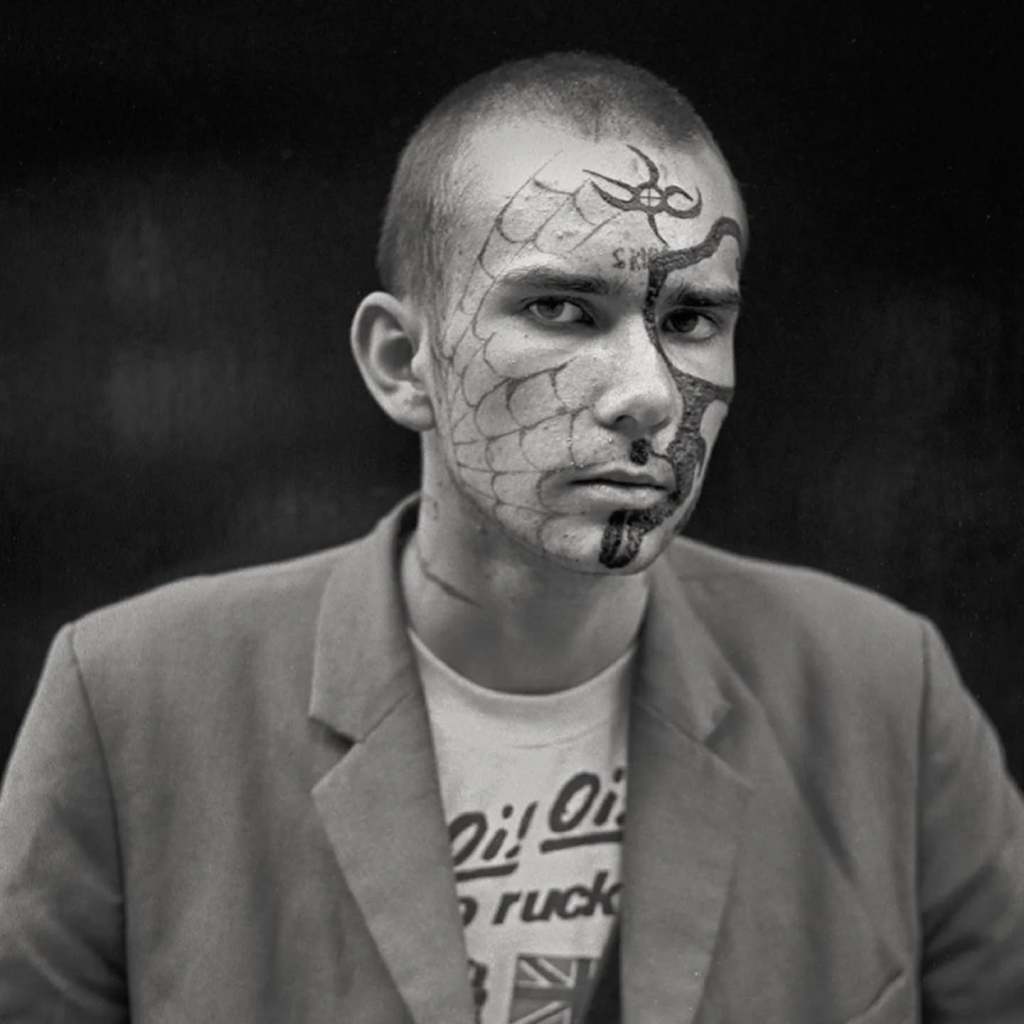
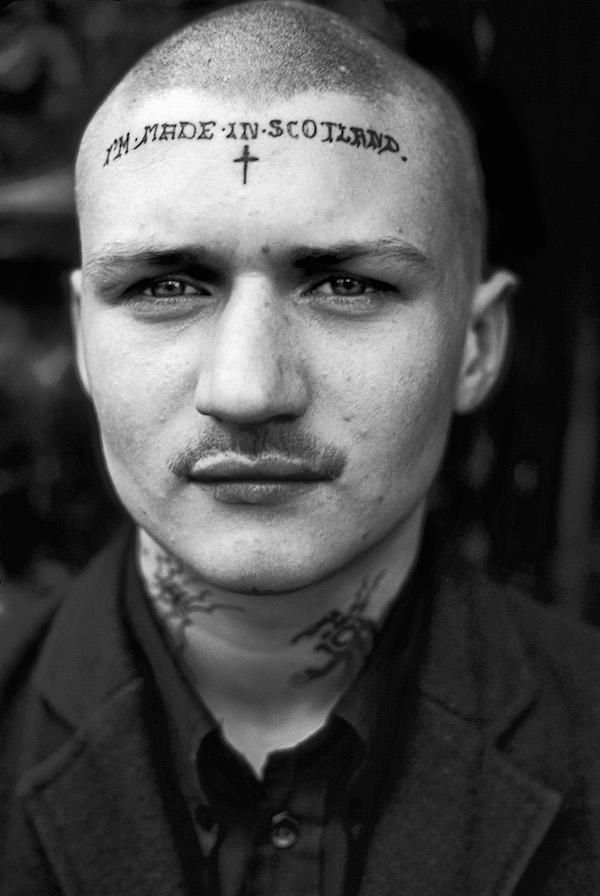
Around ’80–’83, Trafalgar Square, Soho, Leicester Square were big skinhead hangouts on a Saturday. Being from the west of London, we always headed straight to Carnaby Street, then down to Soho, Trafalgar and Leicester Square. It’s the first time I started meeting skinheads with face tattoos. Back then, face tattoos used to make people nervous, and in the early ’80s it was solely a real hardcore skinhead thing. Most of them were inked at Rick’s Tattoos at the Elephant and Castle [in Walworth Road]. He was a gay bloke who tattooed a lot of London skins. It was a bit of a hangout place in itself.
But beneath the surface, there was a darker side to the scene:
I remember looking for a pub and looking in one, and I saw a skinhead with a cobweb on his neck, so I thought, great, this pub serves skinheads. We walk in and buy a beer. As I’m standing, I see a pile of magazines on the bar. I thought it must be Bulldog or National Front News, which was common anywhere large groups of skinheads congregated. Then I looked closer and saw it was Gay News. Then I realised we had been circled by men. We were 15 years old, and we ran out of the pub in fear and shock.
Many runaways came to London escaping abuse. They would land at Euston or King’s Cross and be targeted almost immediately by the sex trade. London was full of squats back then. As a kid, most are very naive, and you would be attracted to other skinheads or punks, thinking that’s cool or safe. But you were walking into a very nasty trap. The extremist groups is common knowledge, but the sex trade was a whole lot worse. There was an overlap with both things. What we looked at as being hyper hard-nut, cool skinhead was actually severe self-abuse and societal abuse. Kids would be fed barbiturates, become addicted and become prostitutes. Skinhead was a fetish image that these sex trolls liked. It was horrific and very terrifying for young people. I became aware of it at a very young age.
What angers me even today is how these kids, escaping domestic abuse, found their way into horrific abuse. The media would call them thugs and fascists, when in reality they were teenage victims. I kept a very wide berth of some of them, and luckily for me, I was always very streetwise.
Leicester Square 1981. Photoby Derek Ridgers
Others, while aware of the same scene, kept their distance. I asked Hounslow Rob of A Sense of Stylewhat he thought of them at the time:
As I didn’t really know any of them personally, I didn’t have that strong an opinion about them. At that time, probably a certain amount of disdain and mild annoyance regarding their drug taking and glue sniffing and how that image reflected on the rest of us… particularly as it was so blatant and in such public view. In later years and in hindsight, I realised that most of those kids came from very difficult backgrounds. Many had been adopted or come from broken homes, had been abused, and had ended up homeless. It’s not that surprising that turning to drugs seemed an attractive thing to do, as it would at least ease some of the stress of everyday life. I suppose it’s easy to judge someone else’s behaviour from a more settled and safer position, where you don’t have to face the daily struggles that many of those West End kids did. The fact that so many died young is proof of that, I think.
I should add, though, that I’m referring to the hard core who tended to be in the West End on a daily basis. Other skinheads would sometimes hang around up there, but not necessarily take drugs or sniff glue. They’d just go there to hang around and meet others. I knew a couple of people that would fall into that category. There was definitely a distinction’.
Derek Ridgers’s Skinheads photo book gives a great deal of space to the Leicester Square kids, though they were hardly representative of the skinhead scene as a whole. Perhaps it was simply that they were the most visible and easily accessible to an outsider like him. Perhaps, too, there was a slightly exploitative angle to these pictures. Many of the Leicester Square lot are now dead, while the odd survivor can still be found asking for spare change outside a London tube station, recognisable solely by their faded skinhead tattoos. For the most part, the lives of these people have been tragic, and I have mixed feelings when I see their pictures turning up on gig flyers, record sleeves, and book covers, recycled as tokens of authenticity by people whose lives are radically different. Then again, maybe it’s nice that they’ve been immortalised and mean something to somebody.
Music: 4 Skins – ‘Johnny Go Home’ Peter & the Wolf – ‘Glue Sniffer’ The Pogues – ‘The Old Main Drag’
From Leicester Square, we make our way just a couple of minutes south to Trafalgar Square.
Trafalgar Square, West End.
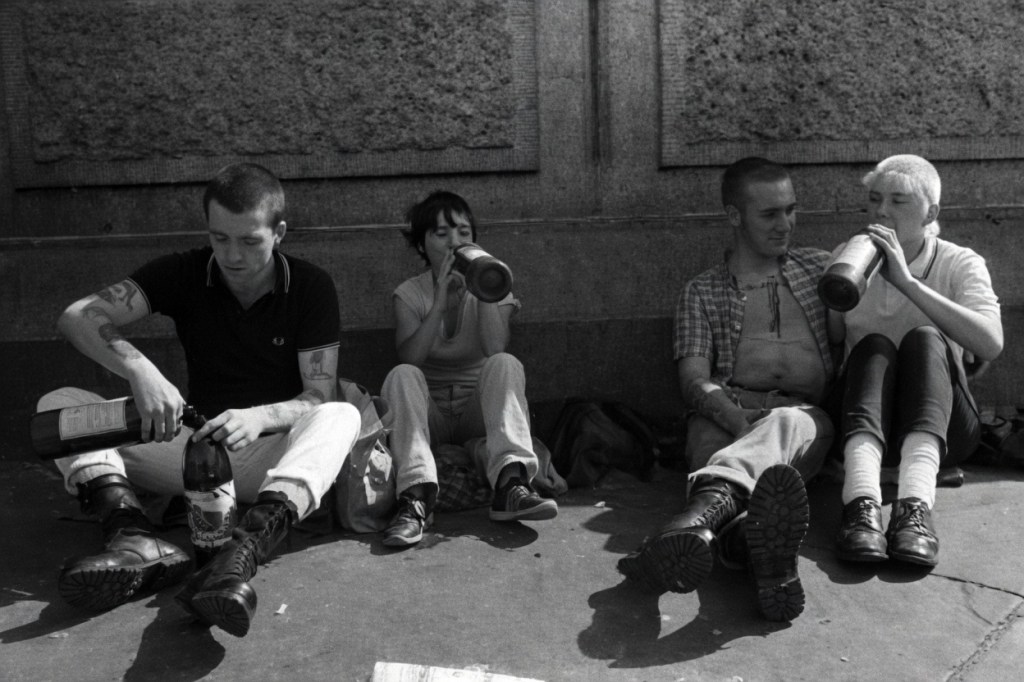
If Leicester Square was the hotspot for some of the more troubled cases, skinheads could just as reliably be found congregating in Trafalgar Square at weekends, while punks gravitated towards the King’s Road in West London. On New Year’s Eve, Trafalgar Square seemed to draw half of London in an informal gathering: there was singing, cheering, drinking, and a general street-party atmosphere, punctuated by the occasional punch-up. Among those celebrating into the new year, flocks of skins were a constant presence. Paul Burnley, in the first part of his Skinhead Diaries that I reviewed HERE, describes attending on the last evening of 1983, when he was 15:
Symond in Trafalgar Square on New Year’s Eve 1980
New Years’ Eve is another traditional skinhead milestone I’ve embraced. I’m glad to escape the house and head for Trafalgar Square again this year. Here among the thousands of revellers waiting to hear Big Ben chime us into oblivion, there’s always the presence of an enclave of London skins and the guarantee of a swig or two of cider … It’s freezing cold but the alcohol dulls the sensation… ‘Happy new year’, folk roar in unison and for a few moments, it seems the nation is united in hope and inebriated glory. Those who had gazed at us with suspicion earlier that evening are now embracing us like old friends, as the famous clock does its thing. For that moment in time all prejudices and preconceptions are put aside to greet our fellow man an woman and wish them well for the coming year.
Symond remembers his first New Years’ Eve in Trafalgar Square, also aged 15, in somewhat less harmonious terms: someone emerged from the crowd and, shouting “I fucking hate skinheads”, whacked him square in the face. A happier memory for him comes from July 1981, when the Square filled with crowds and celebration as people gathered to watch the wedding of the ‘people’s princess’, Diana Spencer, and Charles Windsor on screens and join in the atmosphere. It was an intensely patriotic few days, somehow completely out of synch with the youth riots flaring up across the nation that month. Some three weeks earlier, in west London, the Southall disaster had brought the first wave of Oi to a halt, at least for the time being.
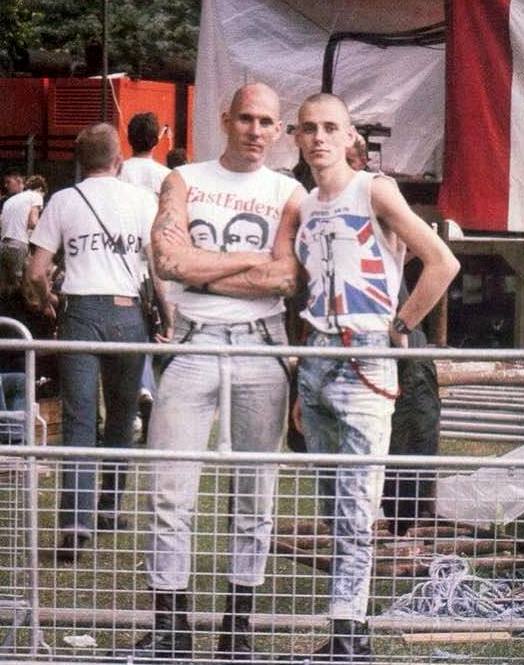
Soho, 28 July 1981. Photo by Gavin Watson
Symond recalls:
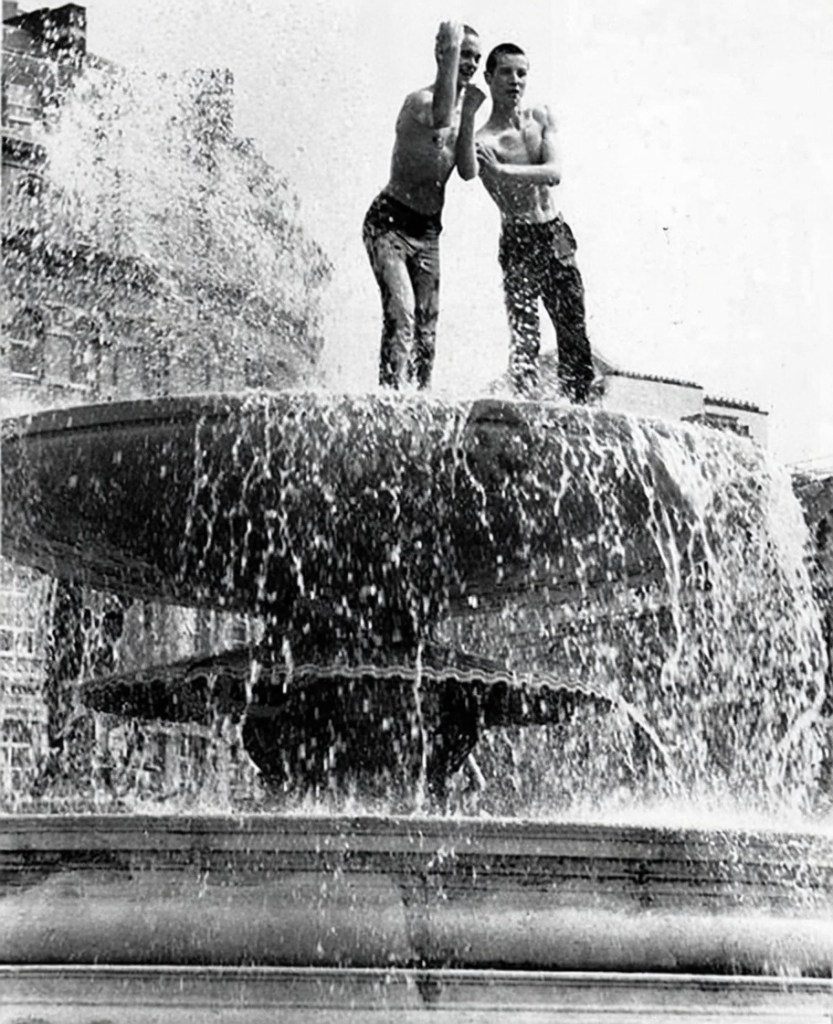
This picture, taken by Gavin Watson in Soho on 28 July 1981, was the night before the royal wedding of Lady Diana Spencer and Prince Charles. My mates and I partied around the West End all night, the next day splashed about in the Trafalgar Square fountains, and soaked in what felt like a huge celebration of British culture – skinheads drinking cider, streets full of Union Jacks, and a country proud of its heritage. I was brought up to believe the Queen was almost a goddess, the royal family the glue of everything good in Britain, and seeing Lady Diana pass by in her carriage the following day was a moment of pure pride. Yet Prince Andrew has since let every single one of them down.
Looking back, I think the whole country was clinging to a culture and history we felt slipping away: the Blitz, Dunkirk, North Atlantic convoys, the great escape, men from our estates who had served, suffragette great-grandmothers, trench nurses, the smell of furniture factories, and the working men’s clubs – this was our England. That wedding and the Falklands War were among the last great episodes of that world we grew up in.
That night in Soho and the wedding the next day remain some of the happiest memories I have of London. I was also there decades later, at Hyde Park Corner, watching Diana’s coffin pass – without a doubt the saddest day I ever saw in the city. And yet, those two days together capture the joy, pride, and heartbreak of the Britain I grew up believing in.
Trafalgar Square, 29 July 1981. Photo by Richard Young
Through the ages, Trafalgar Square has also served as a focal point of street politics. Most political demonstrations in central London end here, with speeches from leading figures and rival factions distributing leaflets among the crowd. On 30 April 1978, a march of some 100,000 people set off from the square, heading all the way to the East End for a Rock Against Racism free concert in Victoria Park, featuring The Clash, X-Ray Spex, Jimmy Pursey and others.
November 1986 saw two competing marches taking place in central London on Remembrance Day: the annual one by the National Front, and one by Anti-Fascist Action, which planned to lay a wreath at the Cenotaph ‘in memory of the victims of fascist violence’. At the end of the AFA march, rumours spread that NF marchers were targeting the nearby anti-apartheid picket in Trafalgar Square. And so, a section of the crowd marched off to Trafalgar Square, where they clashed with large numbers of National Front supporters. Reports suggest that a couple of anti-fascists were stabbed.
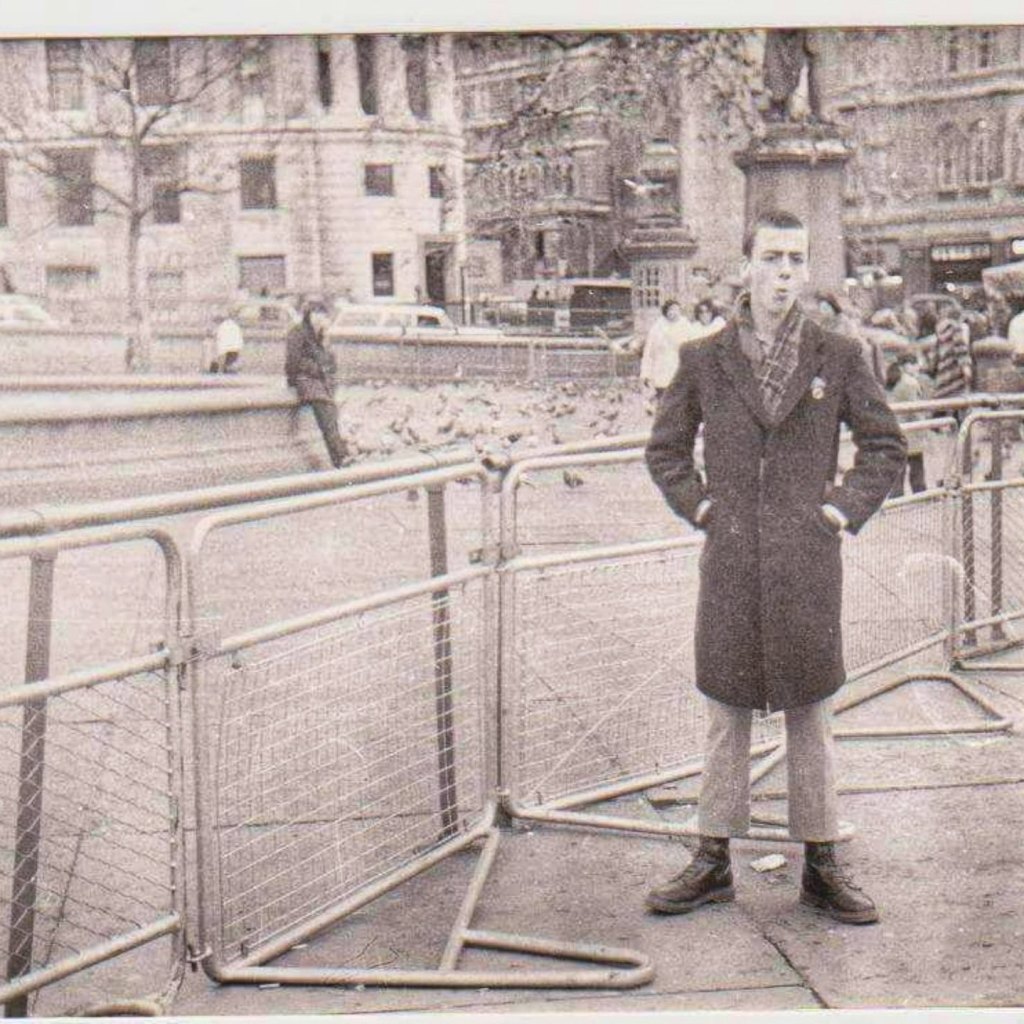
Hanging out in Trafalgar Square, 1982. Photo by Homer Sykes.
While the exact details of the confrontation remain unclear, the semi-fictionalised account in Max Schaefer’s novel Children of the Sun sees the anti-fascists ultimately get the better of their opponents. Not unreasonably for the period, Schaefer depicts the bulk of the NF supporters as a mixed bag of casuals and skins:
So after a few more pints it’s down Regent Street again and on to Haymarket, walking fast on a new determined wind fuelled by beer and this group, one big gang of booted skins and Headhunters in, well, Timberland moccasins, mainly, or trainers: not much help with kicking but they don’t seem worried which you can understand given their reputation.
Much the same picture emerges from the AFA side:
Some reds are yelling back, ‘Fascist scum!’ or whatever; a few stand on the railings making come-hither signs. They’re low-budget versions of the Headhunters, mainly, with the usual few commie skins.
Music: Edward Elgar – ‘Pomp and Circumstance’ The Clash – ‘Something About England’ (while Elgar’s tune glorifies empire and elite ceremony, this track does a great job at exposing the human cost behind those traditions). Blitz – ‘Nation On Fire’
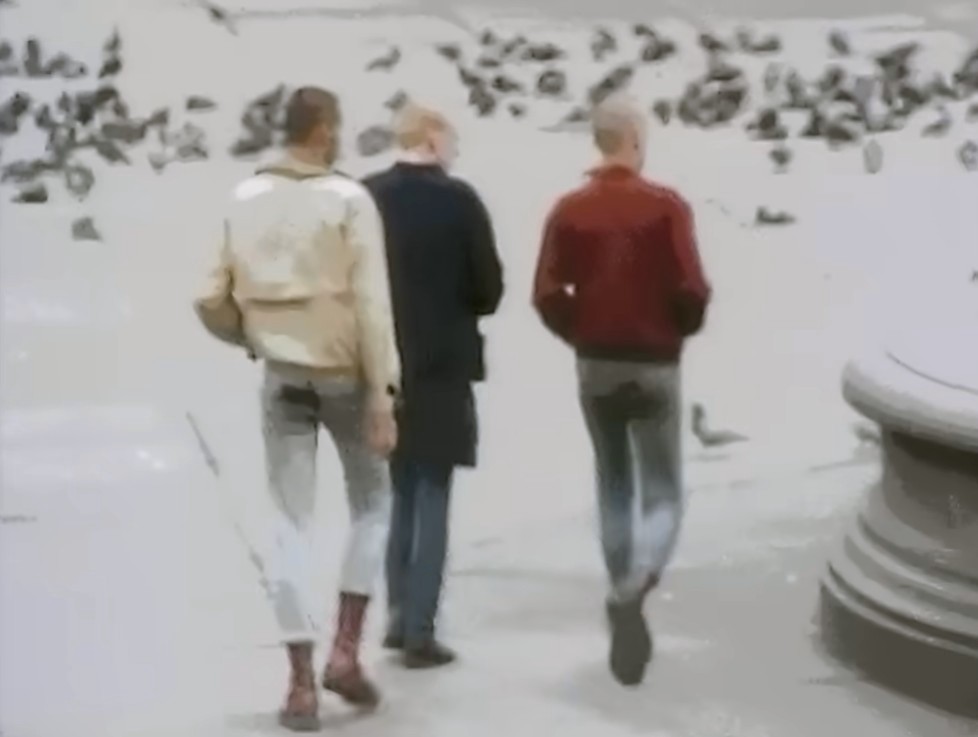
Skins in Trafalgar Square, Pet Shop Boys video for ‘West End Girls’(1985)by Andrew Morahan and David Watson
We leave Trafalgar Square by heading south toward the river and joining the Victoria Embankment. We then walk east along the Embankment for a short distance until reaching Villiers Street, which slopes up to the left toward the Strand. Just beneath the railway arches here you’ll find Heaven.
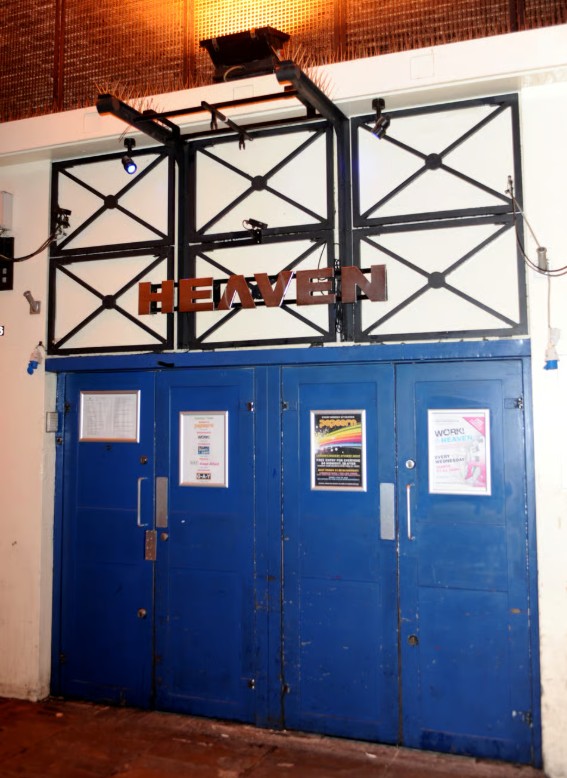
Heaven, 11 the Arches Villiers Street, Charing Cross.
This still-operating famous gay venue, which also hosts regular rock and indie gigs, was one of the places where Nicky Crane worked as a bouncer in the mid-1980s. The ‘anti-fascist’ magazine Searchlight outed him as early as April 1985:
Since arriving home from the Isle of Weight [where he had been imprisoned], Wayne has returned to his old stomping ground of south and east London. On Thursday nights he can be found at the Heaven disco at Charing Cross.
This was within a year of Crane first having sex with a man. Searchlight was then regularly studied by the far right as a matter of course – including by Ian Stuart, who purchased his monthly copy from the left-wing Housemans bookshop off Kings Cross.
According to Ian Stuart, Nicky Crane assured him that he was working at gay venues simply because that was where the security firm had sent him. That may very well have been how it all started for Crane… Stuart, pragmatically, ‘believed’ him.
A few words of warning about Searchlight, however, since this is the second time I mention it. The people behind the publication enjoy close working relationships with the right wing of the Labour Party, the wider ‘anti-extremism’ and security establishment, and the Israel lobby group Community Security Trust. Like its offshoot Hope Not Hate, Searchlight ultimately descends from what was known as ‘Jewish anti-fascism’ in post-war Britain. This was a curiously selective ‘anti-fascism’: the 43 Group opposed the likes of Oswald Mosley at home, yet in its literature happily cheered on Zionist terrorist militias like the far-right Irgun in Palestine. In fact, archival sources show that in 1948 the 43 Group’s whole executive formally affiliated with Irgun. A number of 43 Group members even travelled to the Middle East to volunteer in Israel’s ‘war of independence’, which saw the first large-scale ethnic cleansing of Palestinians, the Nakba.
In the ’80s and ’90s, Searchlight was known to plant agent provocateurs in the British far right, who would propose antisemitic acts and terrorist plots that the magazine then ‘uncovered’. More recently, the network around Searchlight and Hope Not Hate played a key role in the ‘antisemitism’ smear campaign against Jeremy Corbyn’s supporters. Not unreasonably, the organisation is regarded by some as a softer British version of Anti-Defamation League in the US – working tirelessly to find antisemitism everywhere and manufacturing it where there isn’t any.
Music: The Afflicted – ‘Be Aware’ Frankie Goes To Hollywood – ‘Relax’
Nobody knew: Nicky Crane and boyfriend Derek in Glastonbury, 1986
From here, we walk down Villiers Street towards the river. The road slopes steeply downhill and passes beneath the railway bridge. We continue straight ahead for a minute or so until the street opens out onto Victoria Embankment, directly opposite Embankment station and the river.
VictoriaEmbankment, Westminster.
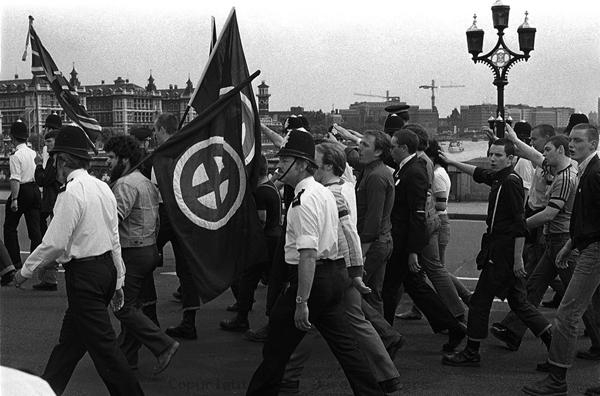
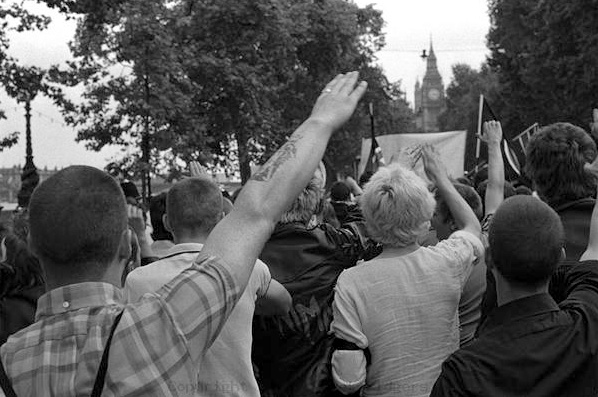
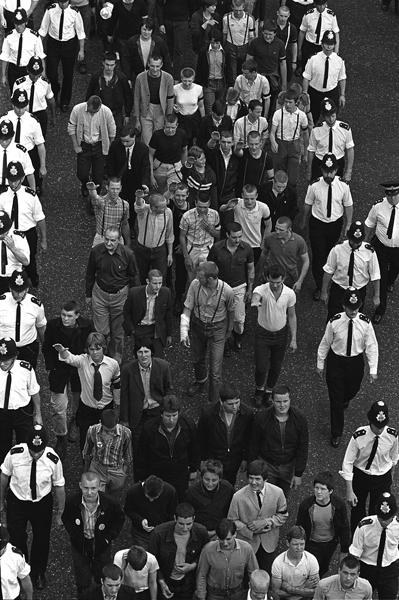
The London Embankment is a roughly 1.5-mile stretch along the Thames, running from Westminster to Chelsea. Its modern form dates from the 1860s–70s, when it was built as part of London’s major sewer works. In 1979, Derek Ridgers photographed a British Movement march along the Embankment. While the BM was a hardline neo-nazi outfit and much smaller than the more populist National Front – which at the time occupied something of a halfway house between right-wing Toryism and British fascism – it began attracting skinhead revivalists from around 1977 onwards, as the pictures attest.
By 1978 skinheads were reappearing in large numbers. What’s interesting, though, is that even a year or two earlier some of the earliest revivalists – including Hodges, Panther, and Gary Hitchcock, who later all ended up in the 4 Skins in one role or another – had already been drawn, at least for a short time, into the British Movement’s orbit. Hodges himself said as much in Janet Street-Porter’s London Weekend Show report on skinheads, broadcast in 1979, recalling that he and a few mates had been members the previous year, but no longer were.
Clearly visible in Ridgers’s photos are also a couple of punks – including the one at the centre, half covered by the ‘Roman salute’. Perhaps ironically, he’s sporting an anarchy logo on the back of his leather jacket:
Victoria Embankment, 1979. Photos by Derek Ridgers
An acquaintance who grew up in the north-east London suburb of Chingford in the late 1970s once told me about a few punks she knew from school. They turned up at both Anti-Nazi League marches and National Front demonstrations. What interested them was the chance of riots and aggro with the police, not the politics – which side they chose on any given occasion was largely incidental.
It stands to reason they weren’t the only ones. But why did some of the early skinhead revivalists get involved with the small and radical BM? Inner-city pubs and football terraces would have been obvious points of contact for BM recruiters looking for hands-on lads. Against a backdrop of social tensions and competition for scarce resources in certain parts of London, the promise of punch-ups – combined with the BM’s deliberately shocking symbols, slogans, and leaflets – would have had a certain appeal for those looking for a way to express defiance. Many drifted in and out, drawn more by the action, the camaraderie, and the sense of a new kind of skinhead identity than by the politics itself.
Symond says similar things about the appeal of the NF:
When I became a skinhead in ’78, the NF was at its peak. At that time, it was the height of rebellion. NF skins were like a nationwide firm. The NF used a lot of tactics, all based on fear: fear of communism, fear of the IRA, fear of the nuclear bomb, fear of non-white migrants from the Commonwealth. This bred a feeling that you needed a gang, you needed a backup and mob. But in reality, many of the NF skins came from all-white areas; they had never personally been attacked by a black gang, but racism became high fashion, a badge and a Celtic cross. Very, very few took that any further than being rude to an Indian shopkeeper or saying how they hated the reds.
Hounslow Rob confirms:
It should be remembered that the support for the far right by many younger skinheads back then only went as far as wearing a couple of badges. Some may have attended the occasional meeting or march but I think for the most part it was just a trend to say you were NF or BM or whatever… or to think that claiming that allegiance was part of being a skinhead. Most wouldn’t have been old enough to vote. That’s not to downplay those connections, and of course some kids went on to become active in extremist political groups, but many weren’t actively involved in racist behaviour, and many would’ve stopped even claiming to be NF once they grew their hair and stopped being skinheads.
What’s curious about the earlier revivalists drawn into the British Movement orbit is how many of them were Irish, given the far right’s hostility towards Irish republicanism, which often extended to the Irish more broadly. “We’re all London Irish”, Gary Hitchcock said in a 1980 Sounds interview with him, Tony Cummings and Terry Madden about the early skinhead revival circa ’77. “Yeah, don’t put me down as a racialist, I’m a republican”, Madden added (this was after their stints in the BM).
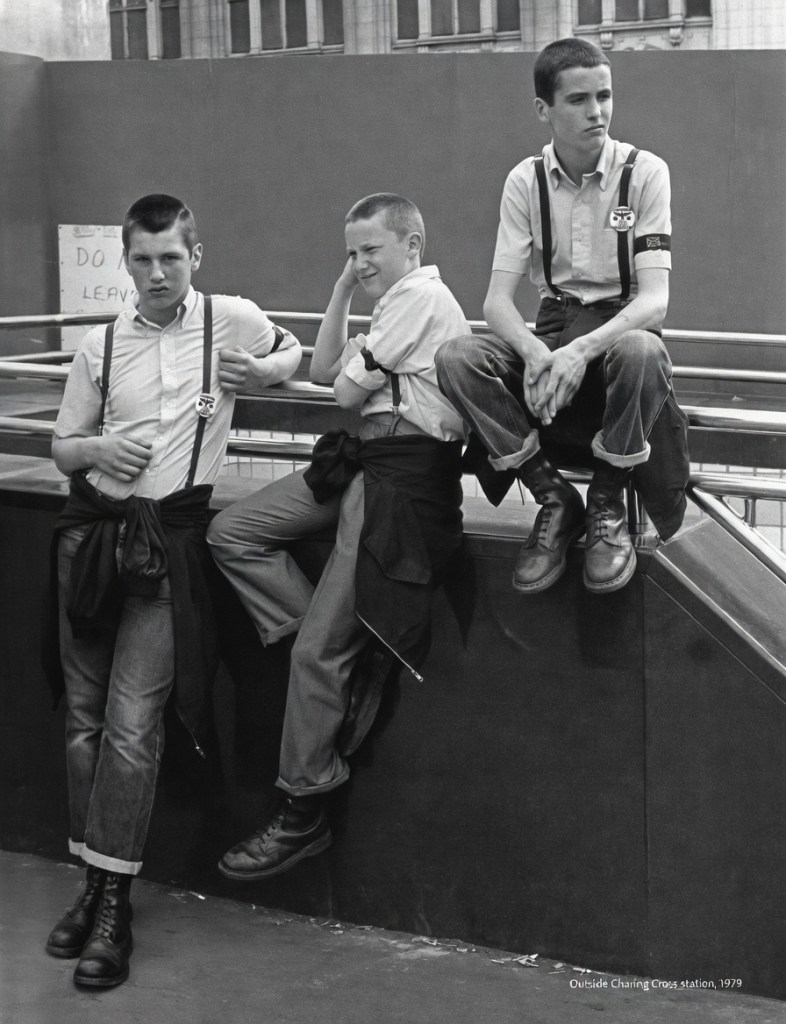
Skinssporting BM insignia at nearby Charing Cross station, 1979. Photo by Derek Ridgers
Rob recalls:
I do remember skinheads from my area who were born in London, but who had Irish parents and an Irish background and obviously Irish-sounding names, who did become involved with right-wing groups in the late ‘70s and early ‘80s… most often the NF, as that organisation was particularly active in Hounslow during that period. The fact that the area had a very high percentage of immigrants from India may have had some sort of contribution, I suppose, as did distancing themselves from their own families’ fairly recent history of being newcomers. I suppose only the individuals themselves could really explain their motives and reasons.
Although I’m certainly no authority on the manifestos or aims of any of the right-wing groups from that time, I do remember reading about internal division within the BM regarding support for Irish reunification. There was apparently an element which saw Sinn Fein and their like as fellow nationalists, and as such they were supportive of their cause. I would imagine that those from an Irish background involved in the BM would have been influential in promoting that stance… As regards the NF, I don’t recall hearing or reading about any such support for Irish reunification in that organisation. It was also noticeable that the NF had a much higher profile at anti-IRA demonstrations, whereas the BM didn’t seem to have a noticeable presence at counter-demonstrations when ‘Troops Out’ or similar Irish nationalist or republican groups marched.
Although this is possible, I could not find any information on such a faction within the BM. While the organisation’s leader from 1975 onward, Michael McLaughlin, was the son of an Irish republican (and communist Spanish Civil War veteran), the BM’s rhetoric and actions were consistently loyalist. In its literature, the BM referred to groups like the Provisional IRA generically as ‘Marxists’ and ‘subversives’, it held an anti-IRA march in Liverpool in 1974, and in the 1970s its members were jailed for gun-running to loyalist paramilitaries in Northern Ireland. It seems plausible, though, that the NF placed greater emphasis on the issue, given its generally more populist approach. In any case, the earliest BM skinheads shared one feature with their croptop counterparts in Red Action: a surprisingly high concentration of Irish roots.
Music: The Members – ‘Fear On The Streets’ Skrewdriver – ‘Streetfight’ (1978) Crisis – ‘White Youth’
We continue along the Enbankment and, just before reaching Waterloo Bridge, turn left into Savoy Street. At the end of this short alley, our next stop comes into view across the Strand.
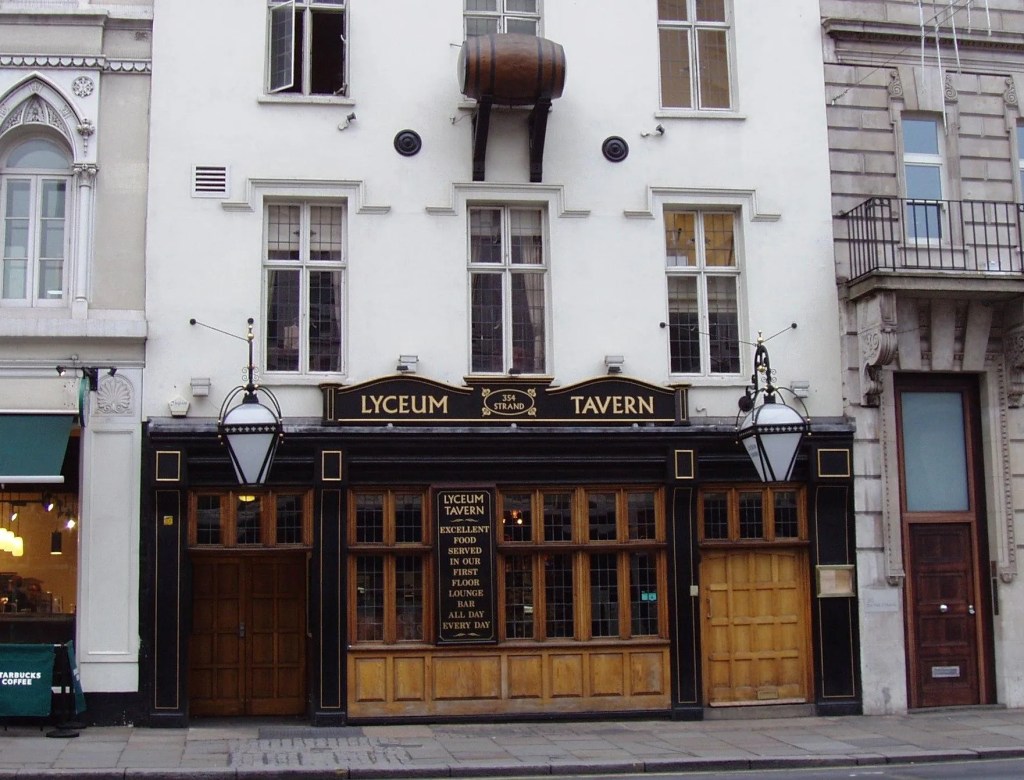
Lyceum Tavern, 354 Strand.
The Lyceum Tavern’s connection to skinhead history is limited. Still, I have it on good authority that, during the original skinhead period around 1969, skins from various parts of London, like Kilburn, often stopped here for a few pints whenever they ventured into the West End. This was despite the traditional boozer’s rather draconian rules, which include a ban on swearing. More recently, a ban on mobile phones has been added to the list, so if you want to experience what it was like when people truly ‘lived in the moment’, this is the place to go.
It is also the kind of pub with individual booths, allowing small groups to hide away from fellow drinkers – perfect for secret conspiracies, minor betrayals, or simply avoiding your in-laws – or you can choose to overlook the Strand from the upstairs bar. Apparently, this is where Bram Stoker wrote Dracula while, from 1879 to 1898, living in a room upstairs and managing the adjacent Lyceum Theatre, of which the Tavern forms the rear building.
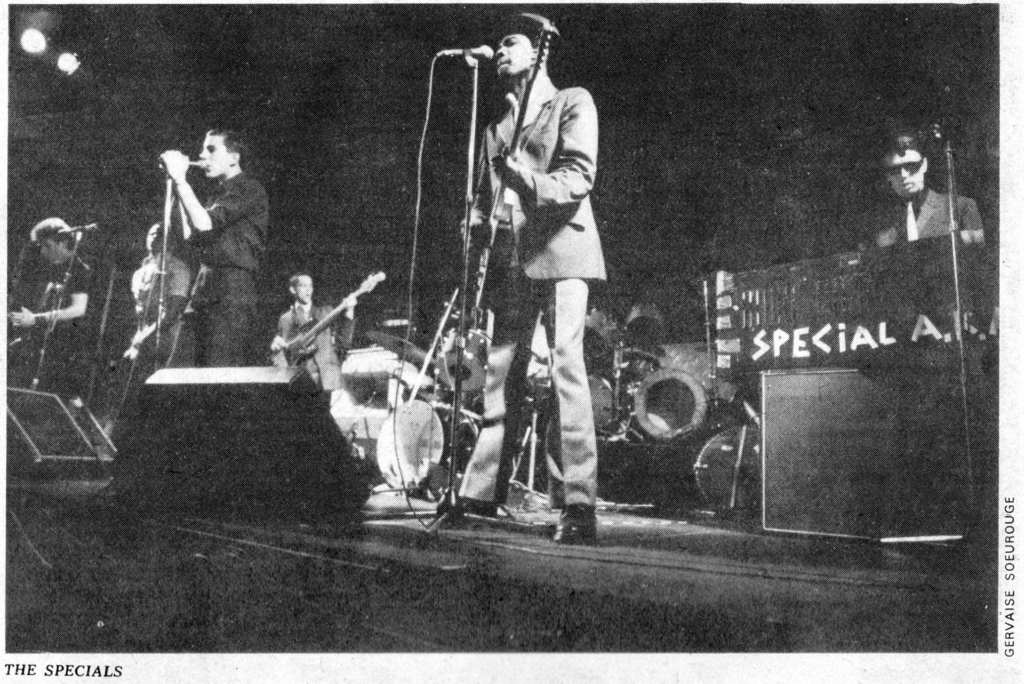
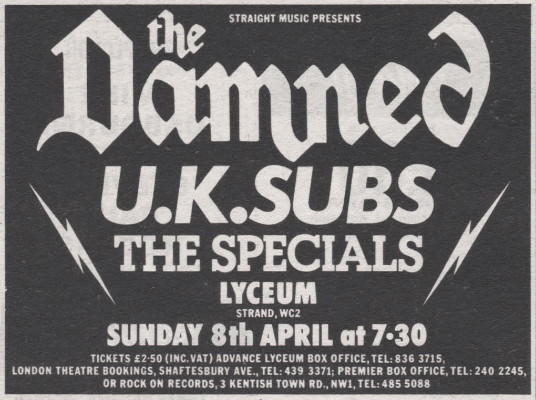
The Lyceum Theatre itself, at 21 Wellington Street, with origins dating back to 1765, has long doubled as a concert venue. The Specials played there several times in 1979. On 25 November, they appeared as part of the 2 Tone Tour. Parts of the performance, including the amazing ‘Skinhead Symphony’ medley, were later released on the Too Much Too Young 7-inch EP that came with the More Specials album. They returned for another gig on 2 December, which was recorded in its entirety and has since circulated on bootlegs.
Also worth noting are a few punk bills at the Lyceum, such as Angelic Upstarts on 6 August 1978 (with Adam and the Ants and The Monochrome Set), and the first date of the legendary ‘Apocalypse Now’ tour on 24 May 1981, featuring Discharge, The Exploited, Anti-Pasti, Chron Gen and Anti-Nowhere League. Though the latter was arguably the height of what would later be dubbed ‘UK 82’ rather than Oi, it’s safe to assume that a few croptops were in attendance.
Current status: Both the Lyceum and the Lyceum Tavern are open.
Music: King Horror (Laurel Aitken) – ‘Dracula Prince of Darkness’ Special AKA– ‘Skinhead Symphony’ Angelic Upstarts – ‘Student Power’ The Exploited – ‘UK 82’ Desmond Dekker – ‘ Dracula’

 Creases Like Knives