This article is part of the London Skinhead History Walk series.
Leaving the 100 Club, we could simply turn right, then take the first left onto Wardour Street. But if you’re up for a short detour, let’s take a five-minute walk north to New Cavendish Street. Here we find the Cavendish Campus of the University of Westminster, once known as:

Central London Polytechnic, 115 New Cavendish Street.
1978 saw the return of skinheads en masse, while punk became politicised. Much of this politicisation was driven by the Rock Against Racism (RAR) campaign, but also, by proxy, by the Socialist Workers’ Party (SWP) and its Anti-Nazi League (ANL) front, which set out to pull punk decisively to the left. The SWP, a Trotskyist organisation founded by Tony Cliff, had from its inception fostered a culture of permanent urgency. The revolution was always just around the corner. All it took was perhaps a few dozen more street demonstrations – a task the party’s rank and file pursued breathlessly, then as now. By the late 1970s, amid a deepening socio-political crisis and the alarming rise of the National Front, the party’s cadre convinced themselves that only two outcomes were possible: either fascism, or a seizure of power by the revolutionary vanguard (that is, the SWP itself, not the 57 other varieties).
Rock Against Racism, which had been set up independently and did not formally answer to the SWP, yet involved plenty of SWP cadre and worked closely with the ANL, was seen as a vehicle to reach the youth before the NF did. For a time, the party organ Socialist Worker became something of a ‘punk paper’, reviewing gigs and releases while pushing RAR with slogans such as ‘Nazis are no fun’. A certain Gary Bushell was among its staff at that point.
As for the skinheads, although some leaned left and others didn’t care for politics at all, many – especially in London – gravitated towards the NF, whether out of a taste for provocation against lefty teachers and students or in response to a range of social grievances.
Early 1978, after the Sex Pistols broke up and left a punk-shaped gap to be filled with actual content, was the heyday of RAR. Given the growth of the NF’s street fascism, RAR figured it was high time that punk dropped the swastika shock tactics and dissociated itself from any hints of racism. Sham 69, who had built their profile on the back of a sizeable skinhead following the previous year – the ‘Sham Army’ – now seemed keen to clarify where they stood on the racist attitudes of some sections of their audience. They agreed to play RAR gigs.
One such event took place on 24 February 1978, when Sham were billed at the Central London Polytechnic alongside Misty in Roots, a Southall-based rasta band. Apart from Skrewdriver, Sham were then the group most associated with National Front and British Movement followers. With sizeable contingents of both Sham and Misty fans turning up, the evening had all the makings of a tense social experiment.

Accounts of what happened vary, but the overall picture is one of narrowly avoided disaster, and therefore a triumph in the organisers’ books. Some 30 British Movement supporters did show up, all still in their teens and dismayed at Sham agreeing to play for RAR. A chair was hurled at Misty, a minor scuffle broke out in front of the stage, and a few stiff right arms went up. That the situation was contained before it escalated owed much to the fact that the BM lads found themselves facing not the expected ‘lefty students’, but a combination of Southall heavies connected to Misty in Roots and some old-school trade union muscle handling security that night: the Royal Group of Docks shop stewards.
Photographer Syd Shelton later said that he took the photograph below of Sham 69 playing the Polytechnic show – with Tony James of Generation X on bass – just after the would-be troublemakers had been kicked out.

The night ended on a harmonious note, with Misty in Roots and Jimmy Pursey jamming together on ‘Israelites’ – a moment enjoyed by the skins who remained in the venue, some of whom were broadly supportive of RAR. The Misty and Sham encounter could have gone horribly wrong, and you’ve got to respect the people who had the nerve to stage it. Today, the SWP and its various anti-racist front groups wouldn’t touch folks with a reputation like the Sham Army’s with a barge pole. In 1978, however, RAR saw that following precisely as its target audience.
As photographer and RAR co-founder Red Saunders, who described the atmosphere that night as “extraordinary”, put it:
There I am on stage doing a bit of compéring, for lack of a better word, just shouting at the audience who were Sieg-Heiling. People were going, ‘Why have we let them in?’ I was going, ‘This is what we’re about. This is the fucking real world, mate. This is Rock Against Racism. Here’s the white working class and here’s a reggae band and we’ve brought them all together.
(Daniel Rachel, The Walls Come Tumbling down, p. 51)
But while serious bovver was avoided at the Polytechnic gig, Sham’s decision to play it was what ruptured their relationship with British Movement supporters, triggering an escalating sequence of far-right shows of strength. Immediately after the show, Jimmy Pursey began receiving threats. These did not stop him from wearing an RAR badge while performing ‘Angels With Dirty Faces’ on Top of the Pops on 11 May that year – but as the death threats mounted, they did prevent Sham from appearing at the RAR carnival at Brockwell Park in September. It all built up towards Sham’s infamous ‘last stand’ at the Rainbow in July 1979, which effectively ended the band’s career.

Was Pursey at fault for turning his back on the skinheads who had given him his start, even slagging them off to the press, as some of them later claimed? Not really. Pursey never dissociated himself from his audience. On the contrary, he continued talking to NF and BM supporters, convinced that he might somehow change their minds. His real transgression was that he rejected racism and said so publicly. This was something the BM and NF were not prepared to tolerate. And so, Sham became one of the first targets of their strategy of escalation.
In July that year, Sham released ‘If The Kids Are United’, and it’s worth reflecting on the full extent of the song’s idealism. For Pursey, it meant something quite different from how it’s often understood today. It did not mean ‘the kids except the nazis’, or ‘the kids except the commies’, or ‘the kids except the extremists’. It meant all the kids, without qualification, regardless of politics or subculture.
Could that ever have worked? Well. It didn’t.

Music:
Misty in Roots – ‘Six One Penny’
Sham 69 – ‘If the Kids Are United’
Desmond Dekker – ‘Israelites’
From here, we walk back along Cleveland Street to Oxford Street, then turn right and take the first left onto Wardour Street. About five minutes in, we reach the site where the legendary Marquee Club stood in the ’70s.
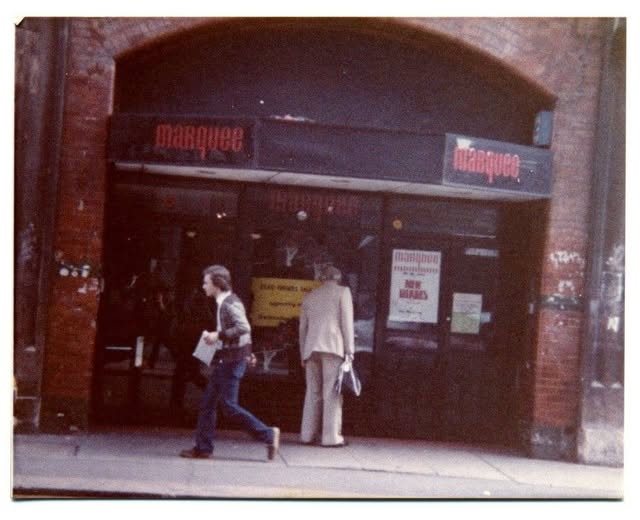
Marquee, 90 Wardour Street, Soho.
Originally a jazz, skiffle, and blues venue, the Marquee moved from 165 Oxford Street to its iconic location at 90 Wardour Street in 1964. During the mod period, it was an important venue for live rhythm and blues and later hosted bands such as the Rolling Stones, Led Zeppelin, and Jimi Hendrix. The venue teemed with A&R representatives, talent spotters, and record company executives, and in the early ‘70s, bands performing there included The Faces and Status Quo.
Even before punk really took off, in February 1976, an East London band called Cock Sparrer – then living and rehearsing at The Roding Hotel and Pub in East Ham – secured something of a residency at the prestigious club, though usually as a support act. Far from punk at the time, they were a working-class rock ‘n’ roll outfit straddling street glam and blues-drenched pub rock – styles that would later feed into Oi as well. Tracks like ‘Platinum Blonde’ or ‘I Need a Witness’ from their 1978 Decca debut probably capture their sound of that period far more accurately than the punk-flavoured ‘Running Riot’. Musically they were not a million miles from London’s unsung heroes of prole rock ‘n’ roll, the Heavy Metal Kids, who had also been regulars at the Marquee since 1973. As late as 1977, the venue was still more likely to bill Cock Sparrer alongside blues-based hard rock outfits such as 29th & Dearborn rather than have them share stages with punk bands.
In 1977, the Marquee opened its doors to punk proper – the wraparound-sunglasses-and-safety-pin variety – though it never pretended to be a true punk venue. Interviewed that summer by Bavarian filmmakers for their documentary Punk in London, long-haired Marquee manager Jackie Barrie admitted he was only interested in the money punk bands brought in, adding that he’d rather listen to the Eagles at home.

On 25 May 1977, Blackpool punk band Skrewdriver, freshly relocated to London with a contract from Chiswick Records in hand, kicked off a string of dates at the Marquee on the strength of their anti-drug debut single, ‘You’re So Dumb’, released just a week earlier. In hindsight, the bands they shared the bill with that night – The Police and Wayne County – were probably less natural companions than, say, Chelsea, with whom they played on the night of an England vs Scotland match to a crowd of pissed-up football lads. History has since supplied the punchline that the Marquee’s booking policy lacked.
Current status: In 1988, the Wardour Street site was sold for redevelopment, and the Marquee Club was forced to move again, this time to a larger venue in the former Cambridge Circus Cinematograph Theatre at 105 Charing Cross Road. Today, the Wardour Street site is occupied by the Meza, a Spanish tapas restaurant, and the Floridita, a Cuban-themed bar and restaurant with a cigar room, along with a few flats. Only the entrance remains from the otherwise demolished building that once hosted the Marquee – a lonely witness to the days when the site’s greatest hits were amplified, not marinated.
Music:
Heavy Metal Kids – ‘Hangin’ On’
Cock Sparrer – ‘Platinum Blonde’
Skrewdriver – ‘You’re So Dumb’
Chelsea – ‘Urban Kids’
Sham 69 – ‘Rip Off’
Slaughter and the Dogs – ‘Run Joey Small’

Here’s a selection of dates at the Marquee on Wardour Street:
| 18 Aug 1973 | Heavy Metal Kids |
| 29 Dec 1973 | Heavy Metal Kids |
| 15 Feb; 17 Feb; 5 Apr; 29 Apr; 29 May; 5 Jul; 16 Aug; 6 Sep; 5 Nov; 31 Dec 1974 | Heavy Metal Kids |
| 31 Dec 1975 | Heavy Metal Kids |
| 19 Feb 1976 | Cock Sparrer |
| 4 May 1976 | Cock Sparrer |
| 14 Oct 1976 | Cock Sparrer with Steve Gibbons Band |
| 20 Mar 1977 | Heavy Metal Kids |
| 25 May 1977 | Skrewdriver, The Police, Wayne County and the Electric Chairs |
| 4 Jun 1977 | Skrewdriver, Chelsea, the Police |
| 15 Jun 1977 | Skrewdriver, Fury |
| 18 Jun 1977 | Skrewdriver, Cortinas, Johnny Moped |
| 5 Jul 1977 | The Damned, Models, Skrewdriver |
| 6 Jul; 22 Sep; 23 Sep 1977 | Heavy Metal Kids |
| 2 Oct 1977 | Cock Sparrer with Grand Hotel |
| 9 Oct 1977 | Cock Sparrer with 29th and Dearborn and Grand Hotel |
| 21 Oct 1977 | Sham 69, Killjoys |
| 9 Jan 1978 | Slaughter and the Dogs |
| 30 Mar 1978 | Slaughter and the Dogs |
| 28 Jan 1979 | Pursey’s Package (Jimmy Pursey, Angelic Upstarts, Invaders) |
| 10 Dec 1979 | Slaughter and the Dogs |
| 15 Feb 1982 | Long Tall Shorty (farewell gig) |
| 17 Feb 1982 | Angelic Upstarts |
From here, it’s just a short walk to the former site of the Vortex.

The Vortex, 203 Wardour Street, Soho.
An oft-repeated myth about this legendary Soho punk club – formerly the Crackers Discotheque and opened to the punk public in July 1977 – is that it opened when the Roxy club in nearby Covent Garden ‘closed down’. This is not quite true. What actually happened was that, amid persistent concerns over unpaid rent and the threat of eviction, Roxy managers Barry Jones, Susan Carrington and Andy Czezowski were forced out in May 1977 and replaced by a new management, which continued to book punk gigs for another year. Czezowski left Covent Garden for Soho to open the Vortex with Terry Draper, only to be ousted by him within a week. Draper partnered up with the shady ex-soldier John Miller instead.
By then, the punk scene was changing. If the Roxy was a poseur’s paradise, the Vortex was its opposite. Punk nights routinely drew far more punters than the venue was licensed to hold, creating a crowded, volatile atmosphere. The Vortex – variously described as a ‘dump’ and a ‘sewer’ – was basically an ongoing study in how many people you could cram into a room before someone lost a tooth. In his account of the era, England’s Dreaming, Jon Savage described the atmosphere as follows:
Punk meant violence: that was the equation. When the Vortex, the ‘new Roxy’, finally opened in July [1977], it was marked by the amphetamine aggression typical of that summer… Punk was now tearing itself apart. The year 1978 was marked by a high level of violence, directed both internally and externally. Theatrical violence became actual violence…
Too much so for some, as Paul Weller’s lyrics for ‘A’ Bomb in Wardour Street by The Jam attest:
Where the streets are paved with blood
With cataclysmic overtones
Fear and hate linger in the air
A strictly no-go deadly zone
I don’t know what I’m doing here
‘Cause it’s not my scene at all
There’s an ‘A’ bomb in Wardour Street
They’ve called in the Army, they’ve called in the police too
I’m stranded on the Vortex floor
My head’s been kicked in and blood’s started to pour
Through the haze I can see my girl
Fifteen geezers got her pinned to the door
I try to reach her but fall back to the floor …
It’s Dr Marten’s apocalypse

As the song’s final line suggests, the Vortex also became a popular hangout for skinhead revivalists. Sham 69 and Menace played their fair share of gigs at the club, attracting steadily growing numbers of neo-croptops. But the gap between the original culture Weller had known while growing up as a little suedehead and this new breed was considerable.
Still a month from the release of their debut EP I Don’t Wanna, on 23 September 1977, Sham were to play on the rooftop of the Vortex Cafe on nearby 22 Hanway Street to mark its opening (the venue now hosts the 7M Private Members Club). It was managed by the Vortex chancers and poised to become a 24-hour punk cafe complete with record shop. By the time Sham made it up there, it wasn’t entirely clear which roof was the right one, so they ended up playing on someone else’s. Their set was cut short – not by rioting this time, but by the police, who arrived and arrested Pursey. A little bit of the footage can be seen HERE.

Skrewdriver made their Vortex debut on 2 August 1977, playing alongside Generation X and Penetration. They returned a week later to perform with Slaughter and the Dogs and Siouxsie and the Banshees. Importantly for the band’s recorded legacy, that second appearance was filmed, alongside Slaughter and Siouxsie, by veteran modette Janet Street-Porter for the Year of Punk TV documentary. Skrewdriver are seen performing ‘Antisocial’, and the accompanying interview footage (shot the day before in Notting Hill) helps explain why they never quite broke into London’s fashionable punk scene, but soon drew a skinhead following instead. Rather than offering acidic social commentary like Johnny Rotten, or calling for political upheaval like Joe Strummer, Ian Stuart – a ‘thicko from up north’, as he later described the way Skrewdriver were perceived – wide-eyedly recounted punch-ups between punks and teds.
Before their next show at the Vortex, a fateful transformation occurred: like Slade before them, Skrewdriver ‘went skinhead’, claiming their niche in a crowded marketplace and gaining themselves an instant fanbase. Their gig on 18 October 1977 at the Vortex was arguably the most important in their career: it was Skrewdriver’s first live appearance as a skin combo. According to Gary Bushell:
No-one took Skrewdriver seriously as a punk band, but Stuart was shrewd enough to realise that the skin revival was the next big thing and jumped on it. He canvassed skins at a Sham gig at the Roxy telling them Skrewdriver weren’t like Sham, that they were real skins. The word spread and at Skrewdriver Mark 2’s gig at the Vortex there was a mass turn-out of skins.
(interviewed in Toby Mott: Skinhead – An Archive)
The evening began innocently enough. Chelsea, West Ham and Arsenal skins all turned up but, rather than fighting, danced to old Trojan records spun before the bands hit the stage. Gary Hitchcock, future manager of the 4-Skins, later recalled in Sounds:
We never knew there were so many skinheads around and they were all geezers. No one looked under 25, and they played all the skinhead reggae stuff that we hadn’t heard for years. It was great… Skrewdriver were the first real skinhead band.
After sets by punk bands The Mutations, Menace and The Tickets, Skrewdriver roadie Suggs – yes, that Suggs – took up a position beside the stage. When Ian Stuart & Co launched into their opening song, all hell broke loose. “Stuart told them that he wouldn’t slag off their violence like Sham had started to do”, Bushell recalls, “Unfortunately they took him at his word”. Skinheads began smashing everything in sight and were soon embroiled in wild brawls with security stewards and bar staff. The Vortex bouncers – mostly ex-army types and casual mercenaries with a taste for ruthless violence – were in their element. By around 10.30 pm, police and ambulances had arrived to collect the injured and those who’d caused them.


The show was intended to be the first date of a 26-date tour, partly as an opening act for Canadian blues-rocker Pat Travers (listen to his 1977 track ‘Life in London’, which is littered with references to the city’s punk explosion). Chiswick Records had bought Skrewdriver onto that bill, who were swiftly dropped. Representatives of the Sammy Hagar Band were also in attendance. A support slot on an upcoming Sammy Hagar tour had already been under discussion, but the idea was abandoned on contact with reality. Skrewdriver were banned from the Vortex, the Roxy and the 100 Club to boot. The same sanction extended to skinheads in general, because collective punishment is always a fair policy.
By March or April 1978, Skrewdriver had grown out their crops and once again presented themselves in punk gear. Stuart wrote rueful letters to the music press declaring that they were “no longer a skinhead band”, and that the image had been “wrong to begin with”… Much later, in the ’80s, the Vortex experience allegedly inspired the reformed Skrewdriver’s song ‘If There’s a Riot’, in which Stuart, somewhat at odds with his earlier recantations, proclaimed defiantly:
You’ll find yourself banned from everywhere
You’ll find the criticism real hard to bear
Keep a strong will, hold your head up high
Make sure skinheads never die

Accounts of why the Vortex closed as a punk club vary. Some claim its notorious reputation forced it to call it quits. Others suggest that the club simply failed to achieve the commercial success needed to keep it afloat, let alone expand. According to the Punk77 site, John Miller moved on to found a mercenary outfit offering ‘counterterrorism’ operations and the staging of military coups. In any case, matters did not improve under new management. A Vortex ‘fanzine’ never made it beyond its first issue, and the last gig took place in April 1978, after which the club and cafe went out with a whimper. The venue at 203 Wardour Street was converted into a trendy nightclub and bar called Dirty Harry’s – presumably with slightly better health and safety.

Current status: Today the venue hosts a Simmons bar, a franchise that specialises in creating a ‘disco club vibe’. Below, there’s the Nova, an exclusive club with ‘VIP’ tables. The ghosts of punk may linger, but they’re condemned to dance to commercial house and R&B.

Music:
Slaughter and the Dogs – ‘Cranked Up Really High’
The Jam – ‘A’ Bomb in Wardour Street’
Sham 69 – ‘We Gotta Fight’
Toots and the Maytals – ‘Pressure Drop’
Skrewdriver – ‘Antisocial’
Pat Travers – ‘Life in London’
Menace – ‘I Need Nothing’
Here’s a small selection of gigs at the Vortex:
| 2 August 1977 | Skrewdriver, Generation X, Penetration, Johnny Curious & The Strangers |
| 9 August 1977 | Slaughter and the Dogs, Mean Street, The Flicks, Fruit Eating Bears. Plus Skrewdriver and Siouxsie and the Banshees (unadvertised and filmed for London Weekend Television) |
| 29 August 1977 | Chelsea, Neo, Swank |
| 30 August 1977 | 999, Art Attacks, Now, The Flies |
| 13 September 1977 | Sham 69, Doctors of Madness, The Jolt, Masterswitch |
| 23 September 1977 | Sham 69 (Vortex Cafe), The Models, Mean Street, Neo, The Outsiders |
| 4 October 1977 | Sham 69, Wire, Solid Waste, Bazooka Joe |
| 18 October 1977 | Skrewdriver, The Tickets, Menace, The Mutations |
| 25 October 1977 | Sham 69, Rikki & The Last Days of Earth, The Crabs, The Terminals, The Primates |
| 8 November 1977 | The Rezillos, Menace, Bazoomies, Tanya Hyde & The Tormentors |
| 14 November 1977 | Slaughter and the Dogs, Spizz 77, Raped, Metal Urbain |
| 15 November 1977 | The Lurkers, Art Attacks, The Doll, Bizarros |
| 3 January 1978 | Sham 69, The Crabs, The Mirrors, The Jerks |
| 30 January 1978 | Menace, The Police, Muvvers Pride |
| 28 February 1978 | Menace |
| 7 March 1978 | Menace |
| 14 March 1978 | Menace, Eater, Blitzkrieg Bop |
| 21 March 1978 | Menace |
| 28 March 1978 | Menace |
For our next location, we don’t need to walk anywhere.

Wardour Street, Soho.
This photo was taken on Wardour Street, more or less where the Vortex had stood four years earlier. It was December 1981, and The Face had sent a reporter and a photographer onto the streets of London to capture the thriving second-generation punk scene.
What’s all this got to do with skinhead history? For a start, another image from the same shoot later appeared on the Punk and Disorderly compilation released in March 1982, which, alongside chaos-punk fare like Disorder and G.B.H, also featured northern ‘skunk’ bands Blitz and Red Alert. Second, the twink with the mohican on the far left is Andy Nunn – originally bassist of Essex punks Rigor Mortis, later of Brutal Attack, and later still, occassionally, of Skrewdriver. Not long after the photo was taken, Brutal Attack, today Britain’s longest-running bonehead band, entered a phase of trading as a ‘nationalist punk band’ – or nazi punk band, take your pick – cutting their teeth at venues such as the 100 Club.
The photo was part of an article made up of pictures and brief interviews with punks on the King’s Road, in Kensington Market, Carnaby Street, and so on. Although the kids wear what are now instantly recognisable punk uniforms, some refuse being ‘put in a box’: “I wouldn’t class myself as a punk, I’m just an individual. I don’t like being put into categories”, says one. You’ve got to laugh, but there’s nothing especially surprising here. Individualism is always self-deception, even when dressed up in more ‘sophisticated’ forms that this…
Others offer bleak forecasts of their own futures: “In 20 years I’ll be dead”, says one. But in reality, the mohicaned girl on the right was spotted on Facebook only a few years ago, still sporting a mohican, bless her.
Music:
Rigor Mortis – ‘Pissing It Up’ (1982 demo)
If you started our walking tour at John Simons’s in Marylebone this morning, it should be around midday by now, and you’ll be hungry. You could stop for pub food at the Green Man in 57 Berwick St, a short-lived skinhead watering hole in the late ’80s. But we’re now closer to Bar Italia, where grabbing a pizza might be the better option. Bar Italia has little to do with skinheads, strictly speaking, but I couldn’t very well skip Bar Italia without betraying my adopted Italian loyalties.

Bar Italia, 22 Frith Street, Soho.
Opened in 1949 by Lou and Caterina Polledri, immigrants from Naples, the café was the first in London to feature a real Gaggia espresso machine and serve proper Italian coffee. What began as a social hub for post‑war Italian immigrants soon became a magnet for the era’s stars, musicians, bohemians, and figures from Soho’s criminal underworld.
As an all‑night café located just a few houses down from Ronnie Scott’s Jazz Club at 47 Frith Street, it was only natural that, in the 1960s, mods began turning up on nocturnal visits for coffee when the effects of their purple hearts and dexies had started to wear off. Before long, shiny Vespas were a familiar sight parked outside on weekends.
Both traditions – the mod gatherings and the bleary post-club congregations at Bar Italia – continue to this day. The latter are, of course, immortalised in Pulp’s famous tune from 1995, while for the mods and scooterists, bank holiday scooter runs still regularly start here. From 2002 to 2017, there was even a Bar Italia Scooter Club.
On a rainy London Sunday afternoon, Bar Italia was also the last London establishment I visited before moving to… Italy. That Dalton tune in the mini-playlist below was on my headphones constantly during those final weeks.
Music:
Ronnie Scott: ‘All The Things You Are’
Luca Battisti – ‘Dieci ragazze’
Squire – ‘It’s A Mod Mod World’ (incidentally, the band was named after the shop we discussed in Part 1)
Underground Arrows – ‘The Beat Of Life’
Statuto – ‘Rabbia e stile’
Smodati – ‘Sabato’
Dalton – ‘Caffè’
Pulp – ‘Bar Italia’
COMING SOON: PART 5 – EAST SOHO AND BEYOND

Text: Matt Crombieboy
 Creases Like Knives