We’re starting our walking tour in Marylebone, a neighbourhood north of Oxford Street with Georgian and Regency architecture. For our purposes, only two things need to be said about these grounds. First, there was once a short-lived ‘suedehead Oi band’ named after the neighbourhood, the Marylebone Martyrs, who formed in 1982, released a rough demo tape through ‘Crophead’ zine, and split in 1984. They didn’t hail from Marylebone, though – nobody except the rich live here. The Marylebone Martyrs were from South London.
Second, in 2011, English Ivy pioneer John Simons relocated his shop to this neighbourhood. It’s still alive and kicking – the first stop on our tour.

John Simons, 46 Chiltern Street, Marleybone.
John Simons has stood at the crossroads of British subculture and menswear, channelling the lean lines of Ivy League style into the wardrobes of mods, skinheads and suedeheads. It was he who in the ‘60s brought the Ivy look – “Savile Row for everyone”, as he put it – to England, and he who named the Barracuta G9 jacket the ‘Harrington’. In an interview, he said, “We were never a skinhead shop, but skinhead was kind of born of our shop”. While this is a slight exaggeration, The Ivy Shop in Richmond and The Squire Shop in Soho, both run by him, influenced ‘the look’ considerably. The styles he sells today remain largely unchanged: mid-century American fashion, brogues, loafers, rain macs, Harringtons, selvedge denim – the lot. They don’t come cheap, but it’s John Simons.
Here’s a sad episode from my life. Back in 2017, I visited the shop and fell for a bottle green tonic Harrington he’d made in collaboration with Burberry. It cost £230 – more than I could really afford at the time. I left a £50 deposit so he’d put the jacket aside. But I wasn’t earning much, and somehow there was never any money spare. Months went by. I sent an email asking for patience. A year passed. In the end, I was simply too embarrassed to pipe up and tell John Simons I couldn’t actually afford his jacket, or ask if he might convert my deposit into credit. Any other shopkeeper – but not John Simons, progenitor of ‘the look’, namer of the Harrington. I let it slip and never went back to the shop.
So, now you all know my embarrassing John Simons story.

Current status: Open
Music: Chet Baker – ‘But Not For Me’ (one of John Simons’s faves)
To the east of Marylebone lies Fitzrovia, where we held our first – and so far only – public event, Suedeheads, Sorts and Smoothies, back in 2018. It took place at The Wheatsheaf, a bohemian pub frequented by George Orwell, Dylan Thomas, and fellow BBC staff during the war. But that’s not our destination. Instead, we head south along Baker Street and turn right onto Oxford Street until we reach Marble Arch, the Speaker’s Corner end of Hyde Park. In doing so, we move from the sharpest historic expression of the look – John Simon’s shop – straight to one of its drabbest:
Speaker Corner, Marble Arch.
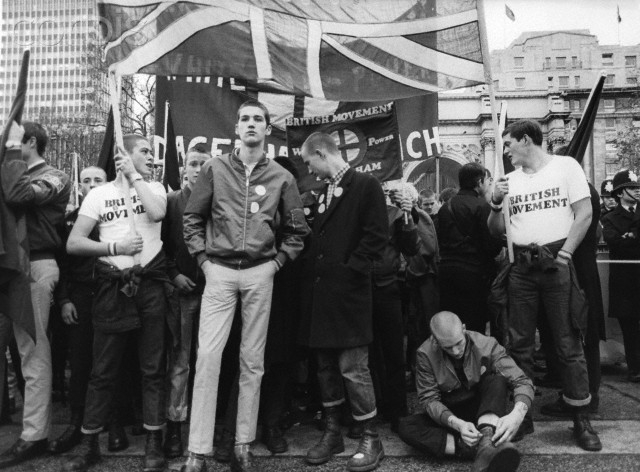
On 24 November 1980, Marble Arch marked the final stop of a 500-strong march by the burgeoning British Movement, which had set out from Paddington earlier that day. Photographs show white supremacists from as far as the US, punks sporting Sid Vicious-style swastika tees and Discharge logos on their leather jackets, and, above all, a large contingent of very young skinheads. Along the route, the BM marchers ran into a counter-protest by the Anti-Nazi League, sparking clashes that left 73 people arrested on both sides.
Footage of the demonstration also appeared in a 1980 Thames Television TV Eye investigation into skins and the British Movement – followed, rather spuriously, by snippets from a live performance by Cockney Rejects at the Bridge House, presented as a sample of the “loud and violent” music supposedly favoured by BM supporters. The band were none too pleased.
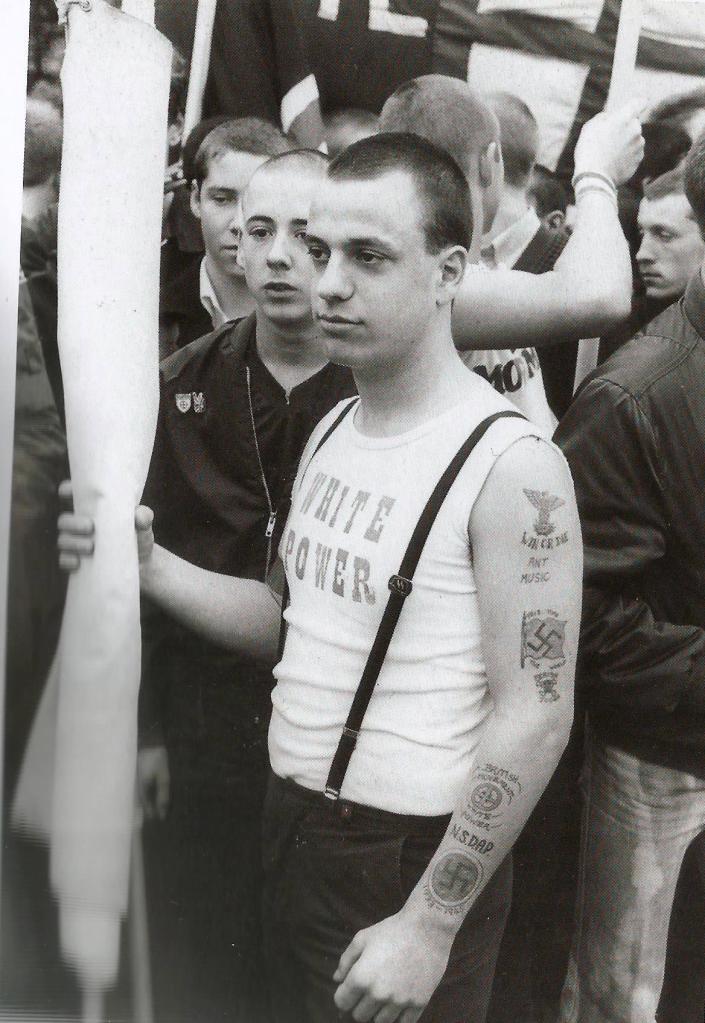


For better or worse, the demonstration produced an ‘iconic’ image, printed on countless tacky t-shirts alongside slogans like ‘Skinhead – A Way of Life’. Rather than embodying any of the more redeeming traits one might associate with the skinhead cult – pride, honour, tidiness – the bloke in question looks like he’s nodding off on smack.
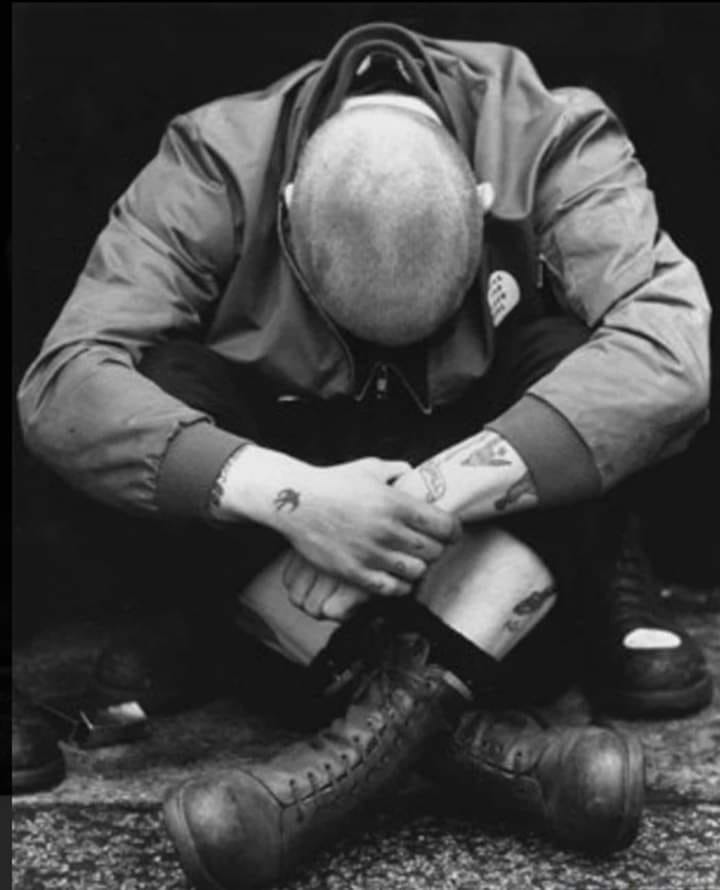
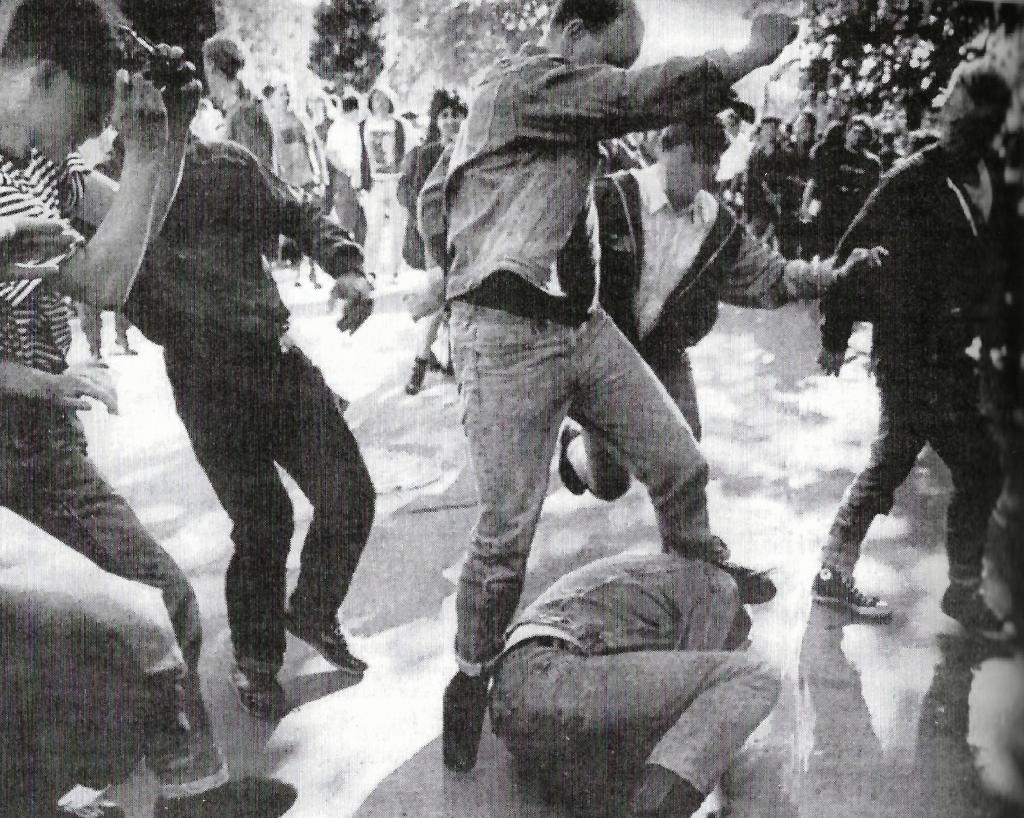
Nine years later, on 27 May 1989, Hyde Park’s Speakers’ Corner became the ill-fated redirection point for The Main Event Chapter 2 – a Blood & Honour concert featuring Skrewdriver, Brutal Attack, Sudden Impact, No Remorse, Squadron, Vengeance and Bunker 84, initially scheduled for Camden Town Hall, but later moved to the Red Lion pub in Gravesend. The redirection point was changed at the last minute, but not everyone got the memo. As a result, small clusters of bewildered B&H supporters arriving at Speakers’ Corner found themselves greeted by around 300 Anti-Fascist Action militants. Some would-be concert goers ended up in hospital instead – it was a rough lesson in the perils of poor communication.
Music:
Cockney Rejects – ‘Fighting in the Streets’
Skrewdriver – ‘The Showdown’
The Oppressed – ‘The AFA Song’
From Speaker’s Corner, we stroll south through the park until we reach the Parade Ground near Hyde Park Corner.
Hyde Park Parade Ground.
On 5 July 1969, between 250,000 and 400,000 people gathered here for the Rolling Stones’ free concert – their first in two years, taking place just two days after Brian Jones’s death. Among the crowd were members of London’s hippie counterculture, young would-be ’Hells Angels’ – and skinheads.
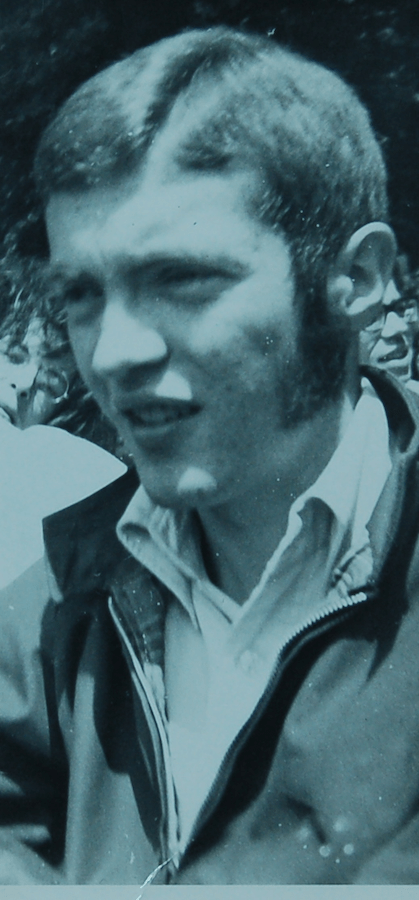
This is how Bryan Biggs from Liverpool remembers the atmosphere:
“I swear Paul McCartney strolled past me in the crowd, and two men conspicuous in grey suits and metallic painted faces were surely an early version of controversial art duo Gilbert & George. A theatre group nearby delivered stirring anti-imperialist agit prop to a group of indifferent peanuts (skinheads)”.
John Hastings from Bristol recalls the skins as being rather more lively:
“We passed a gang of several hundred skinheads out for trouble with the Hell’s Angels. Having run the gauntlet – ‘bloody hippy bastards’ and hearing the distant chimes of the Stones kicking off, we made for home”.
Paul Thompson, South-East London skinhead from 1968–70 and previously a Blackpool mod (we will meet him quite a few times on our route), went to watch the band rather than cause trouble. Why the Stones? I didn’t have them down as a skinhead favourite. Paul tells me:
“It was free and they were famous. They weren’t particularly a skinhead thing, but it was an occasion, that’s all. But don’t forget, I was a wannabe mod aged 14 when their first album came out in 1964. I heard it when my friend next door’s mates came round and played it. I enjoyed their take on R&B, and I guess I hoped I would hear some residue of that at the Hyde Park gig. I didn’t, and that was disappointing… The Stones, to me, sounded as though they hadn’t bothered to tune their instruments properly”.
His judgement is borne out by the bootleg live album Hyde Park 1969… There’s also a film documentary, The Stones in the Park, where at 21:55 you can briefly see a couple of skinheads fishing in the Serpentine lake in Hyde Park. You’ll probably spot more skins if you sit through the whole thing.
Perhaps surprisingly, a skinhead interviewed by a TV team at Hyde Park (in the clip below) thought the hippies were “not that bad” – he considered the ’Hells Angels’ to be the real problem.
Music:
Rolling Stones – ‘I’m Yours, She’s Mine’ (from Hyde Park 1969 bootleg album)
From Hyde Park Corner, we head east along Piccadilly until we reach number 144.
‘Hippidilly’ squat, 144 Piccadilly.
In September 1969, the London Street Commune took over the derelict multi-million pound mansion located here and declared it their home. The LSC was a loose network of hippies – or ‘freaks’, as they called themselves – misfits, the homeless, anarchists, drop-outs, prostitutes, and even a bunch of rather weedy-looking young greasers posturing as the London chapter of the Hells Angels. The gutter press sensationalised the matter instantly, inciting their readers against the squatters. One day a group of skinheads decided to pay them a visit – though arguably, their real target weren’t the freaks, but their main rivals, the ‘Hells Angels’.
Accounts of what happened then differ. According to Chris Faiers’s hippy memoir Eel Pie Dharma, the skins were merely standing outside the squat, “howling” behind a police line. The hippies bombarded them with “rubber balls, most of which had been pumped full of water from hypodermic syringes”. British Pathé footage, on the other hand, shows a bunch of skins and other football lads milling about outside 144 Piccadilly, not doing very much at all.
According to other reports, the skinheads arrived under cover of darkness and laid siege to the building, taking pot-shots at the squatters with air-guns. That, allegedly, was when hundreds of incongruous water-filled carpet boules started raining down upon their cropped heads, bringing the skirmish to an abrupt and soggy conclusion. In any case, 144 Piccadilly was cleared by the police after only six days. The freaks moved to a new building over in Endell Street, near Covent Garden. Apparently, they had another encounter with skins there, though not much is known about it.
Sooner or later, we will dedicate an article in its own right to the ‘Hippidilly’ skinhead siege as we’ve collected quite a bit of material.
Current status: The mansion at 144 Piccadilly still stands.
Music: Rolling Stones – ‘Street Fighting Man’
From here, we continue east toward Piccadilly Circus.
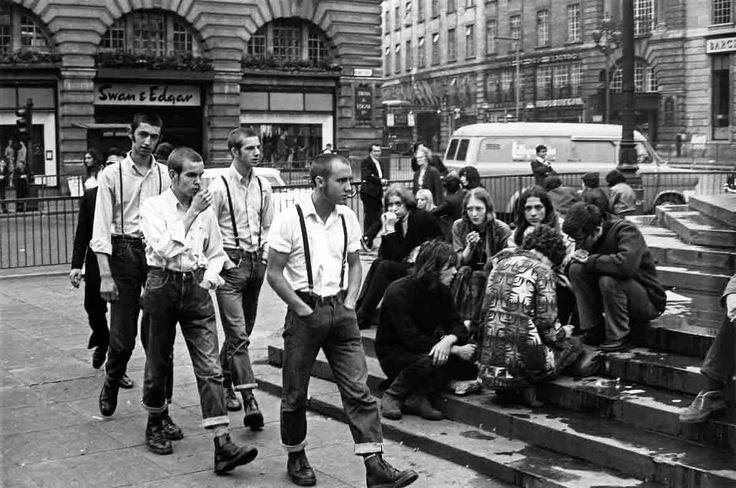
Shaftesbury Memorial Fountain, Piccadilly Circus.
They say a picture is worth a thousand words, and in this instance it couldn’t be more accurate. The ‘Eros Fountain’ became the setting for one of the most iconic images of the 1969 skinhead generation, capturing, more sharply than any essay, the contrast between hippie and skinhead attitudes. At the time, Piccadilly Circus was a magnet for freaks, drop-outs, and druggies – partly thanks to the 24-hour Boots pharmacy at 44–46 Regent Street and the underground public toilets, which offered both convenience and a touch of subterranean glamour.
It is often claimed that the photograph shows skins en route to attack the 144 Squat, but in fact it was taken in October 1969, after the squat had already been cleared. Gerry Rayner, one of the skins pictured, told me around 2015:
I don’t know anything about an attack by skinheads. There was a lot of bullshit printed about that photo. Papers and magazines would write stories about skinheads and put that photo in the story, so it looked like us telling them what violence we got up to… I was 17 years old when that was taken so my parents got pretty mad when they read these things. But they knew I didn’t get involved in that sort of thing. We just loved the clothes and music, youth clubs and football.
So, what’s the actual background to the picture?
It was taken on a Sunday morning and we four came from Borehamwood in Hertfordshire. There are more photos from that day and other days in Borehamwood and at Spurs football stadium, and on the 107 bus from Borehamwood to Enfield, and in the train from Enfield to White Hart Lane. About six years ago I had the pleasure of looking at all the photos of all the Borehamwood skinheads that Terence Spencer [RIP] took of us.
Gerry reckoned that Terence Spencer’s daughter, Cara, has around 200 of these pictures, but my attempts to get in touch with her via terencespencerphotoarchive.net came to nothing. You might want to try your luck yourself.
Music: Symarip – Skinhead Moonstomp
Plus a real nugget about freak encounters with croptops in Piccadilly Circus from the late Peter Wyngarde. Hear it for yourself:
Heading east along Shaftesbury Avenue, we now enter Soho. The original skinhead era was mostly manor-based, and Soho was less important as a meeting point. Even so, skinheads frequented Soho just enough for Led Zeppelin’s Jimmy Page to start complaining about them to Melody Maker in March 1969: “Jimmy was really down on the situation at home … his ultra-long hair was getting him in trouble in London’s West End, where skinheads in suspenders and boots called him rude names” (Stephen Davis, Hammer of the Gods: The Led Zeppelin Saga, p. 76). During the second wave of skinheads, Soho became more crucial. This was partly a legacy of punk with its Soho-based music venues.
Austin’s, 27 Shaftesbury Avenue, Soho.

Austin’s was a big menswear shop, opening just after World War II and running through the ’50s to the ’70s. Founded by Lou Austen, a jazz saxophonist who travelled regularly to the US to source the latest US Ivy League clothing and sportswear, the shop sold suits, jackets, trousers, and shirts, including Arrow and Enro brands. As such, it was a magnet for mods and musicians like Charlie Watts, Eric Clapton, and Georgie Fame. The interior was described as “dowdy by today’s standards”, with dark wood, rows of suits on rails, and glass-topped display cases.
In pre-skinhead days, Austin’s mattered because it was where John Simons, future brains behind the legendary Ivy Shop and Squire Shop, got his first taste of the trade as a window dresser. “For me, looking into that window was like going to the Tate”, he later recalled. For a while, Simons’s evenings were spent digging through the extensive range of American menswear before catching the 38 bus from Piccadilly Circus back to Hackney. Austin’s wasn’t just a shop – it set the template for a certain London look that would outlast the mods and echo into the skinhead scene.
Current status: Alas, 25 Shaftesbury Avenue now houses a McDonald’s.
Music: Gerry Mulligan Quartet – ‘Walkin’ Shoes’
From 27 Shaftesbury Avenue, we take a few steps west along Shaftesbury Avenue and turn right into Great Windmill Street. At the end of the street, we find 52 Brewer Street on the left, right at the corner.
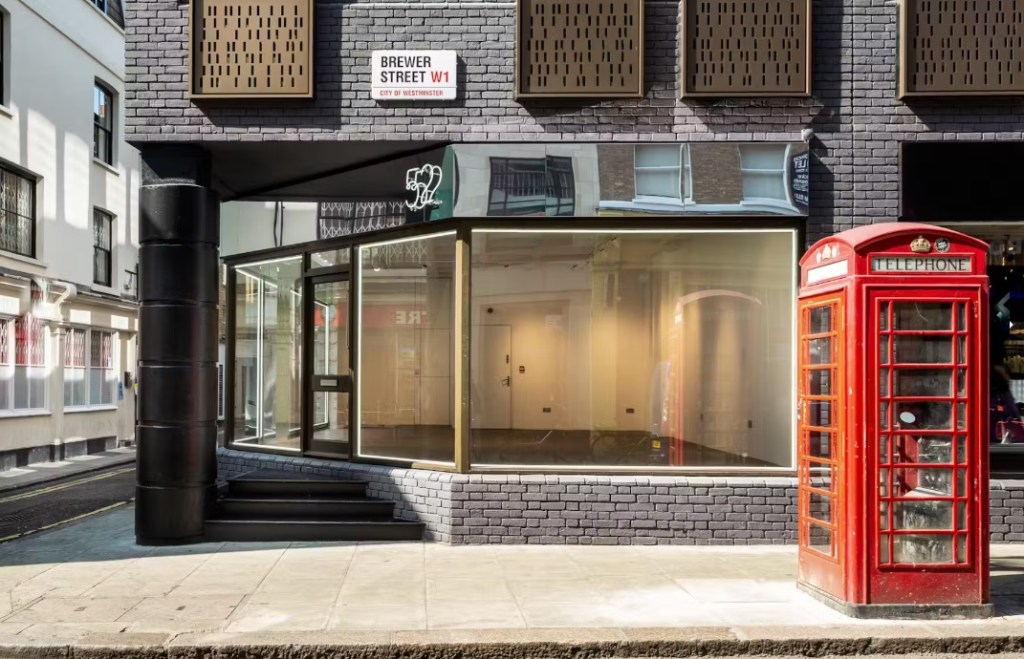
The Squire Shop, 52 Brewer Street, Soho.
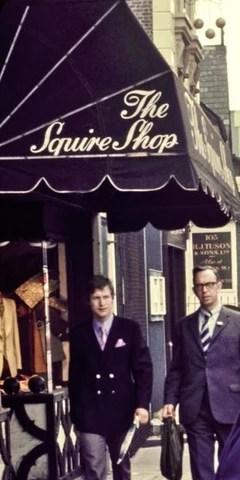
In 1967, John Simons moved from Kings Road, Chelsea, to Soho. Alongside The Ivy Shop in Richmond, this became one of his key stores during the original skinhead era. The venue, originally an old butcher shop, retained many of its original features, including tiled walls and wooden benches. After extensive refurbishment, the butcher’s tables took centre stage, serving as a display for the shop’s iconic shoe collection – a feature fondly remembered by customers to this day (and probably by a few retired butchers too).
Besides brogues, smooths, button-down shirts, rain macs, and the full range of Ivy League staples, Simons also sold Baracuta G9 jackets – which he christened ‘Harringtons’ – and some skinhead mobs would outfit themselves entirely in Harringtons from The Squire. Even then, Baracuta jackets didn’t come cheap. But it was the late ‘60s, and in an era of full employment much of the clientele could simply walk into a job – and those too young had their own creative ways of ‘acquiring’ a jacket.
Apart from Blackmans in Brick Lane, The Squire was the main destination where original skinheads bought their footwear. While Blackmans was the place for Dr Martens, the three models at The Squire most popular among skins were Royals (smooths), American longwing brogues, and Bass Weejuns.
What does Paul Thompson, the original South-East London skinhead we met earlier in Hyde Park, remember of the shop?
Very little. I can remember a basket of coloured socks on a table top, all neatly rolled. A bloke I knew vaguely in Lewisham had an American sports shirt he bought there – sky blue with yellow window-pane check and sleeves baggier than Ben Sherman or any of the cheap copies. So I went there and bought a similar shirt, but with the colours reversed, and we were the only two blokes in the Lewisham area to wear them. We thought we were so cool.
Then I can recall my first wage packet, it must have been in 1970: I went back there and bought a pair of tassel loafers, which looked a little like Bass Weejuns. I must have been there a couple more times because I had a pair of brown or burgundy smooth wing-tips”.
What was Simons’ attitude towards him? I recall someone saying he wasn’t actually too keen on skinheads.
To me it was just a shop. I didn’t pick up on any atmosphere. He always strikes me as being the sort of bloke not to turn away a paying customer. I’m sure he would have preferred a different clientele, but the vogue for American clobber amongst the well-heeled had passed, and the arty, more carefully-constructed hippy-influenced gear was being worn by them. So having skinheads actually kept it going – or so I would guess.
Simons ran the shop in Brewer Street until the early 1970s. By then, the original skinhead era had come to an end in London, and he moved on to pastures greener.
Current status: 52 Brewer Street is now a short-term retail space, rented out to frequently rotating pop-up stores at around £1,440 per day. In recent years, it has hosted pop-ups by brands such as Wrangler, Scuffers, and Represent.
Music: Ella Fitzgerald – ‘I’m Old Fashioned’ (another John Simons favourite)
From here, we walk north to CARNABY STREET (click HERE)

Text: Matt Crombieboy
 Creases Like Knives