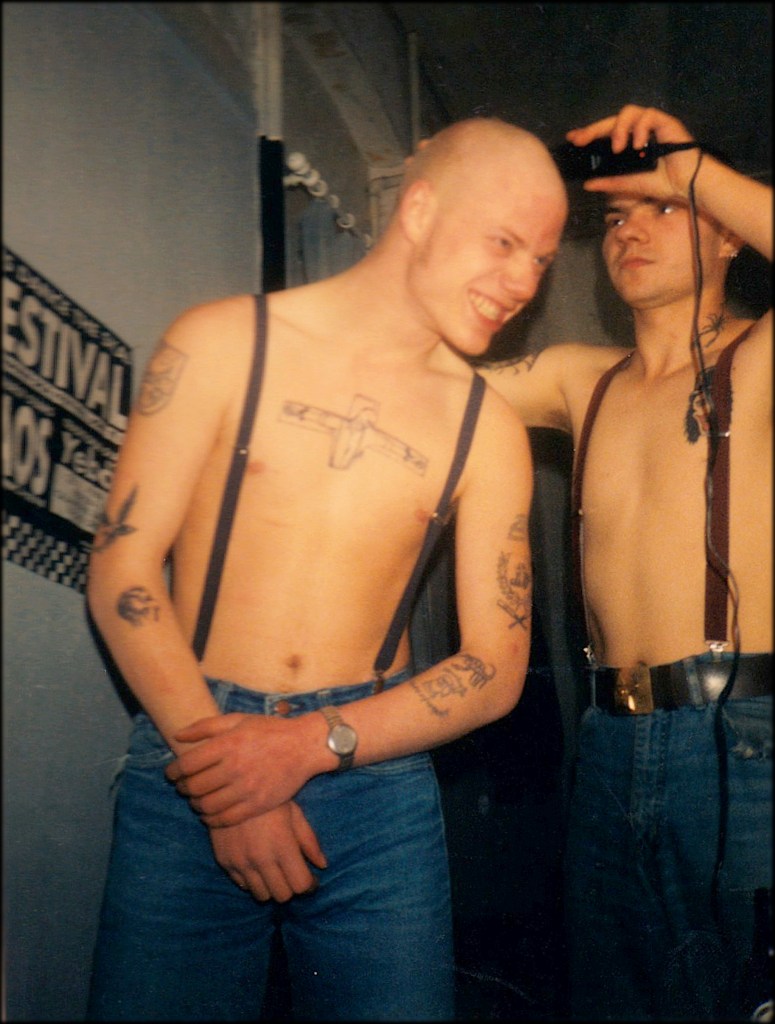
From your point of view, were the Berlin redskins a purely West Berlin thing or did you feel part of an international movement? Were you aware of the Basque redskins and bands like Kortatu, for example?
As I said before, being based in West Berlin was not conducive to friendship with people from other cities. Until at least late ‘89 we hardly knew any anti-racist skins outside our little island. We had some contact with the Oi band Vandalen from Hildesheim, who also visited us in Berlin. As far as I remember their crew was like 5-8 people strong, but they weren’t redskins. The only redskins apart from our group in Germany at that time, at least of noteworthy size, were the lads from Frankfurt who later formed the band Stage Bottles. We were close friends, and that lasted for a long time with some of them. I think we first got in touch with each other in about 1987-88.
We had no contacts outside Germany. Of course we knew the bands. I had the chance to see Kortatu live twice. But to find out about skins from other cities, let alone countries, you had to go actually go there or read zines. The world was bigger back then – or at least the distances seemed greater. To make matters worse, financially it was almost impossible for us to travel. Look, nowadays I fly to Greece at least twice a year, and I’ve never paid more than 100 Euros for a return flight – once I only paid 32 Euro return. Back then, that would have barely paid the taxi to the airport. There was no internet and only three TV channels.
In short, most of the information that we had was first-hand. It might have been possible to get more infos from British soldiers, but I grew up in Kreuzberg, which was in the American sector. The Brits were stationed in Spandau, which was on the other side of town, and chances of finding a redskin among stationed soldiers would have been almost nil anyway.
Did British bands like Redskins provide some kind of blueprint?
No, they didn’t really play a role, at least not as far as political orientation or fashion. Or else we would have joined the Trotskyist League of Germany… and besides, you couldn’t buy bright red Harringtons anywhere in Berlin.

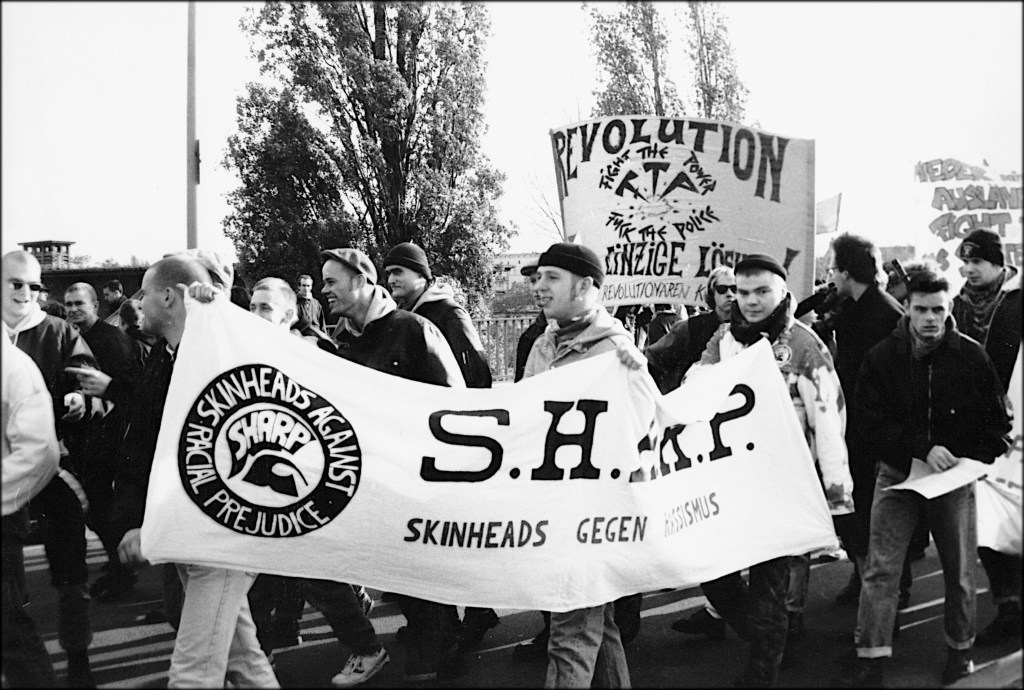
In pictures from your redskin days you’re wearing MA-1 flight jackets, Lonsdale hoodies and a fair bit of camo gear – the skinhead fashion of the time. Quite different from Britain, where in the 80s anti-racist skins made a point of dressing ‘traditional’ and sharp to distinguish themselves from ‘boneheads’ – I mean the scene around zines like Spy Kids. To some extent the same was true for German SHARPs in the 90s, especially after George Marshall’s ‘skinhead bible’ came out. Did these sartorial concerns not play any role in Berlin redskin circles?
The clothes were never really an issue – you wore what you could get hold of. I think I only had one Ben Sherman shirt at the time. To us, ‘smart’ meant a polo shirt, a Fred Perry V-neck and a pair of 501s – but clothes were never that important. You see, we didn’t particularly want to distinguish ourselves from boneheads, we wanted to beat them until there were none left. Visual dissociation was irrelevant – they were abusing our cult, and we wanted them to stop. We thought they shouldn’t dress like skins at all. But even if they had dressed differently, they were still nazis and therefore our enemies and a target to be dealt with. The whole fashion show – who has the better outfit, who looks more ‘original skinhead’ and so on – only started in the early 90s and played no role for us.
Unusually even for redskins, you were members of the Red Guards, which – if I’m not mistaken – was the youth league of the Communist Party of Germany/Marxist-Leninist (KPD/ML), a pro-Albania ‘anti-revisionist’ group. From what I know, the KPD/ML distinguished itself for embracing German patriotism and speaking out against long-haired deadbeats. Did this make the party particularly attractive for skinheads?
Haha – no, that’s not quite accurate! The Red Guards are the youth league of the ‘Communist Party of Germany’ (KPD). But there were two of those. And because everybody who owned a copy of the Communist Manifesto and an acoustic guitar wanted to have their own Communist Party, there were also the KPD/WB (West Berlin), the KPD/ML (Marxist-Leninist), the KPD/AO (Organisational Structure), the MLPD (Marxist-Leninist Party of Germany), the BWK (League of West German Communists) and the WBK (West Berlin Communist). And these are just the ones off the top of my head. Because West Berlin didn’t have a KPD without a suffix at the time, we simply set up the Red Guards as the ‘youth league of the KPD’, but without a KPD attached. We were an independent youth organisation set up by three skinheads. To a degree, I allowed myself be talked into this since they needed at least three people to form a political group.
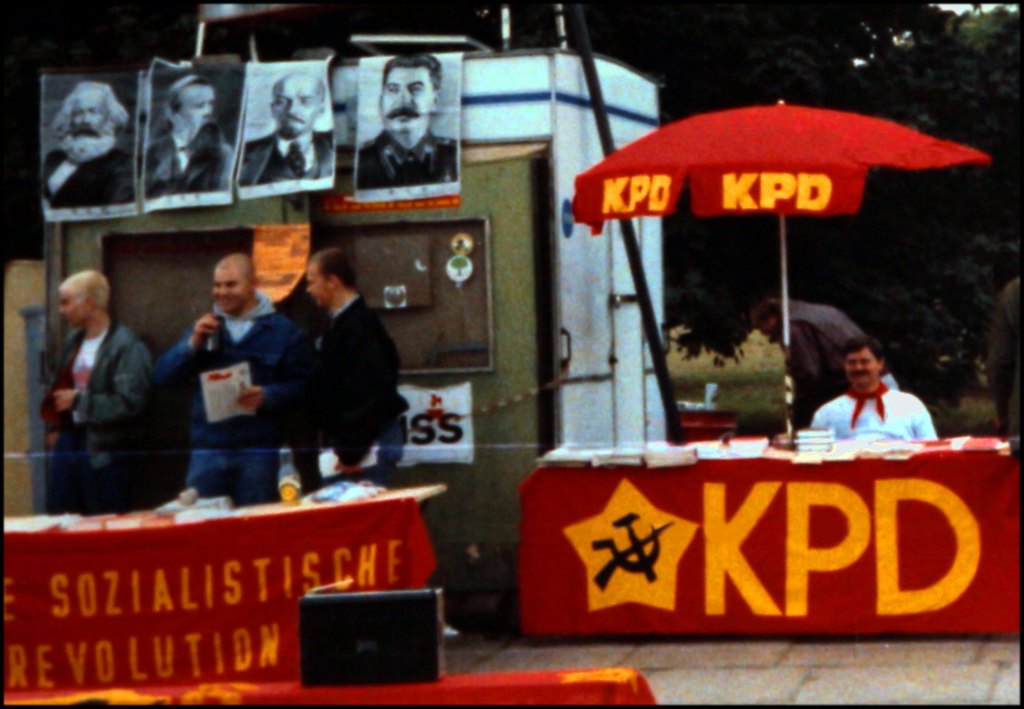
So, we weren’t just members, we actually founded the Red Guards in the first place, and we weren’t directly linked to any party. We had meetings with one of the two KPDs a few times, and I’m sure they would have liked to co-opt us. But nope, we wanted to stay an independent group. This particular KPD had its headquarters in Dortmund, had maybe 20-30 members and no youth organisation – and that’s the way it remained.
And because I’m a hoarder, I still own the programme of the Red Guards that we worked out in lengthy discussions over several nights. It took us so long because I really wanted to consider peasants in our programme, which forced us to address all the relevant peasant matters. I was smirking on the inside the whole time. They had talked me into doing this, so now they had to persevere with the peasant question. Needless to say, there was only one peasant in West Berlin, a guy who lived on the western outskirts… But I compelled everyone to discuss his interests and problems in detail before I agreed to the programme.
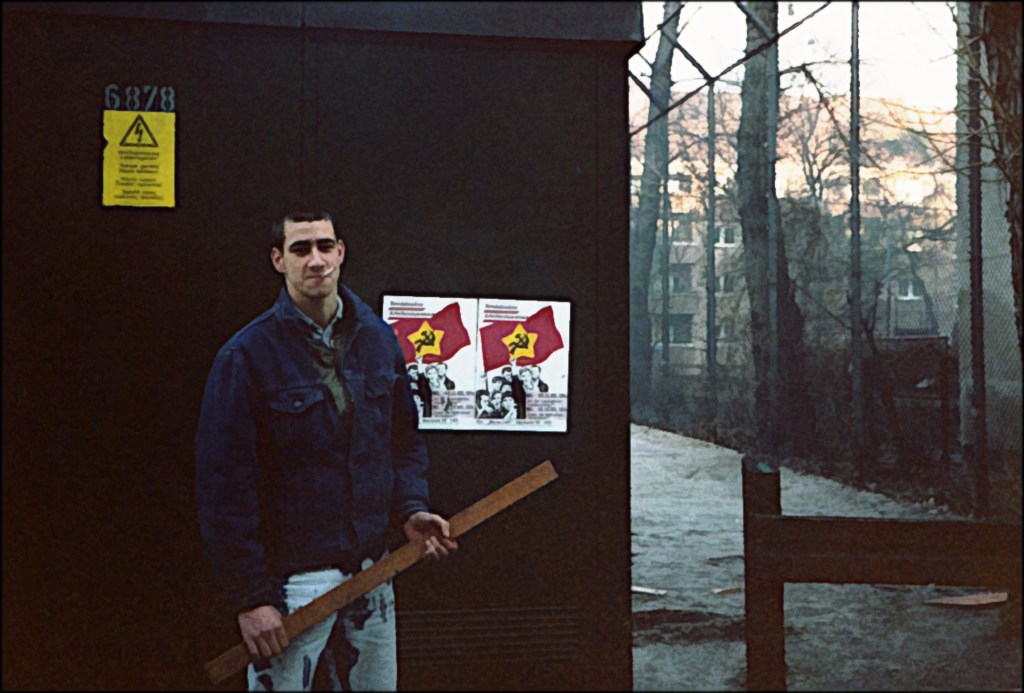
Why set up a pro-Albania, Hoxhaist group – what interested you about this orientation as opposed to other Communist tendencies?
Albania had the advantage that there was no information like there was about other countries, so naturally there were fewer verifiable criticisms. For us, it was something like the land of milk and honey where workers were living and working in a self-determined fashion. Unfortunately, when I read Ever Hoxha’s book Memoirs from My Meetings with Stalin, the facade of my ‘paradise’ began to crumble.
For me, it was less a question of what positions the party conveyed and more a matter of selecting, rejecting and formulating my own positions unhindered. Actually, I was in the process of learning and finding my way around, and for this such sectarian groups were good. Groups that would split as soon as another ego had become too big to continue subordinating itself to the alpha ego. That made the whole thing not just ridiculous but also non-binding. It was ideal for us at the time to try things out and position ourselves.
What were your political activities?
Our activities were freely chosen by us, of course. In the beginning, we were basically a group of communist skins, and often I couldn’t have told you whether we were acting as the ‘Red Guards’ or simply as redskins… But due to the overlap of core personnel, we knew each other really well and could rely on each other, which allowed for quite a few risky exploits. Once, six of us attacked a nazi do that was taking place in the clubhouse of a church, and before the 50 or so nazis realised what had hit them we were gone. Geniuses that we were, though, we then jumped on a bus that went straight back past that same party. This prompted a hail of beer bottles being pelted at the bus, and a heroic bus driver had to help us escape…
But it never happened that we left someone behind. We would’t have done that – we either ran or fought, all of us. Often our actions weren’t chosen according to what was feasible in terms of numbers, but according to the perceived necessity of anti-fascist struggle and our appetite for fighting. To be quite honest, we often got into fights with nazis just because we liked fighting – political conviction came second. But it was a good thing that it didn’t hit the wrong people, and that they weren’t victims but perpetrators. They were nazis organised in parties or loose groups, attacking immigrants and people of divergent viewpoints. We were doing to them what they were doing to others. But the difference was that in order not to become victims, they only had to stop being victimisers, whereas their victims couldn’t help being non-German.

But apparently you also had trouble with Trotskyists. Was that because you were skinheads or because you were Stalinists?
The reason was that the Trotskyist League of Germany (TLD) has a screw loose, which I’ll prove to you by showing you an article about Berlin redskins from one of their pamphlets [click HERE to read our translation of the article – Editor]. The TLD is more like a sect than a political party. Much like Mormons, its members are dispatched into various countries in small groups in order to ‘build the party’ there. But only for short periods of time, because the fascist seizure of power is imminent – so they have to be rapidly circulated around the world in changing combinations. This also means that a TLD member has no social ties whatsoever, which is deliberate. This way, the leadership has atomised individuals at its disposal that it can manoeuvre about as it wishes. Not unlike Scientology or the Mormons.
Fortunately those nutcases were well known, and they isolated themselves through their behaviour. Whenever they tried to incite people against us at demonstrations, they were offered a beating and chased away. Olaf the old Trotskyist is still getting ice pick comments and emails with pictures of ice picks from me today.
I assume you turned your back on Hoxhaite ‘anti-revisionism’ at some point. Did you still remain a communist or Marxist?
Over time, the ‘man of steel’, Stalin, disappeared from my pantheon of ‘classical Marxists’, and a little later Lenin did too. Not just because of their deeds, but because of their intentions. For me it became increasingly obvious that they were less concerned with the liberation of the oppressed than with their own rule, which is unforgivable from a socialist point of view. You can argue about the means, but there’s no argument about the ends to which they were used. I could forgive Kronstadt if it had served the construction of a socialist state, but it’s unacceptable because it only served the power of a party elite.
Whereas Marx is lucky enough to be judged not by his deeds, but by his theories and analyses. And Marx is brilliant in his analyses. When he speaks of class antagonism, that’s his description of the opposing interests of capital and the proletariat in a nutshell – or in modern terms, the opposing interests of employer and employee. No matter how you name or rename the buyers and sellers of labour power, the opposing interests are still the same. This will continue as long as there is capitalism. Or take his theory of the ‘concentration of capital’, which over 150 years ago described a development that we’ve observed globally since the end of the Second World War, resulting in corporations like Nestle. So, no matter what kind of arsehole Marx may have been as a person, that doesn’t change anything about his theory.

Returning to your skinhead life: when and why did you leave Skintonic?
I think after issue 4, but it was a gradual process. I wrote less and less, which was partly due to politics and partly due to my bar jobs. When you’re working behind the bar four or five times a week, you don’t feel like writing an article with your hangover. Then the Berlin Wall came down, and I moved in with my then-girlfriend. The world was changing, my little world was changing too, and my interest in writing was waning. Later on, I wrote a few more articles under the ‘Red Pirate’ moniker, but as a guest writer rather than a member of the editorial team.
I also started working with Klaus Farin [a youth subcultures author and archivist] a little while later, which earned me gigs as a DJ and then as a public speaker. Some TV appearances too, all of them well rewarded. A new platform from which I could counter the prevailing notion that ‘skinhead equals nazi’ had opened up for me. This also opened up a new frontier in the struggle against nazi skins that we hadn’t expected. A growing number of right-wingers wanted to switch sides, and we were trying to get them on side by offering an alternative. In this way, we got rid of more nazis than ever before.
What happened with Skintonic after you left?
Ulrich Sandhaus aka Filthy McNasty and his girlfriend Trudchen took over Skintonic from Hermann. I was already out by then, and Hermann didn’t have the energy to keep it going either, so these two continued from issue 6 onwards. Then they split up privately and then also editorially. Trudchen dropped out and started doing the Oi! Reka zine. At first, the two zines were bitter enemies railing against each other in their pages. Then they made up again, and shortly after they merged and became Skin Up.
But by then, the zine had long degenerated into Uli’s vehicle to feed his urge for self-promotion. Uli, who had only became a skin at 30, wrote with great arrogance and superiority about other skins, but when it came to ‘important’ players in the scene he was sucking up like there was no tomorrow. When I founded RASH in Germany, he wrote that I was carrying a bird’s nest on my head, by which he meant my new flattop haircut. The next time I bumped into him, I had to give him a ‘slap on the wrist’ for that. It was the same as with the internet today: he thought he could write what he wanted without consequences. Well, he was wrong…
When they stopped the Skin Up they also disappeared from the skinhead scene, although Trudchen has recently resurfaced. Uli is still missing. At first, I got along with them fine, but around ‘93-‘94 that changed, and I wanted nothing more to do with them.

One thing that strikes me about the redskins of the 80s, whether with bands like Redskins or Kortatu or you Berlin lot: the focus was on what you were for. For socialism, for a better society, for the Sandinista movement, for the Basque country and so on. With RASH, on the other hand, everything always seems to revolve around nazis and ‘boneheads’… To be honest, I find this obsession with nazis and reduction of politics to anti-fascism rather paltry. As a former redskin who later co-founded RASH Germany, though, what are your thoughts on this?
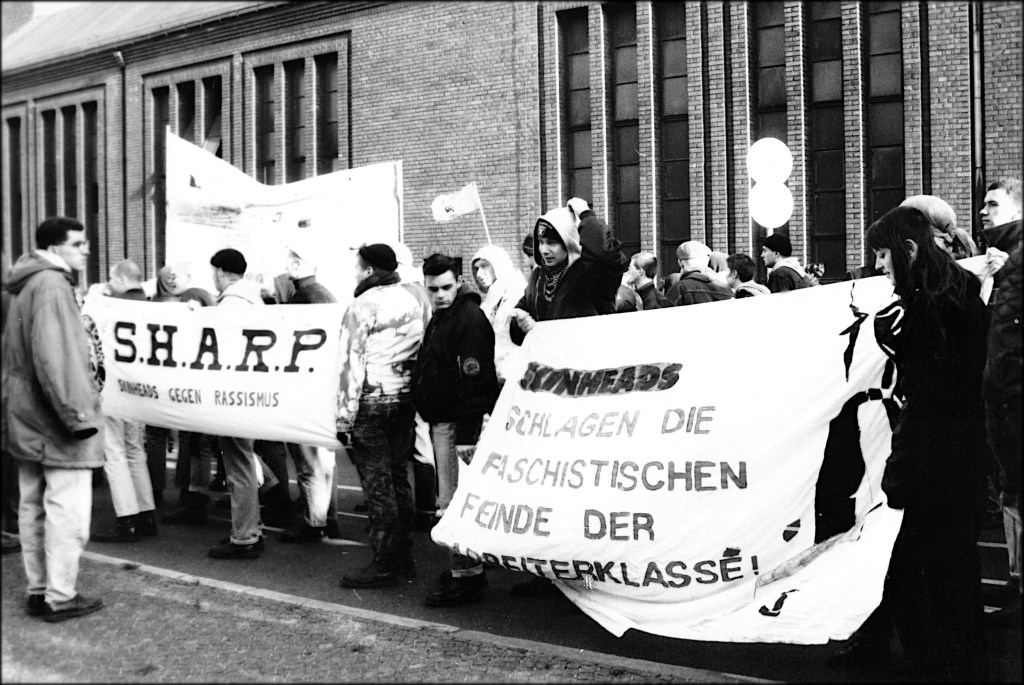
RASH came into being because the anti-racist consensus of SHARP was not enough for some skins. It was intended as an association of skinheads whose leftist self-conception went beyond being purely ‘anti’. So it’s absurd if people confine themselves to something that SHARP is already doing anyway. In my view, the task of RASH is to show what role racism plays in the capitalist system, why anti-fascism is inseparable from anti-capitalism, what alternatives there are to capitalism, and that capitalism can only be overcome through revolution. If RASH only duplicates what SHARP is doing, then RASH should ask itself what the point of its existence is.
So when did you hang up your boots?
Sometime in 1995, on an underground train – the anti-immigrant pogroms of Rostock and elsewhere were still looming large on people’s minds – I saw a Turkish grandmother pulling her granddaughter close and eyeing me fearfully. To give off this impression was the last thing I wanted, and I grew a flattop as a result. Frightening old women and small children was just too much and indefensible, because their fear was plain to see, and it was obvious that I had caused it with my appearance… When that happened, it was natural for me to take a step back and continue to live my life as a punk rocker. Still connected to the skinhead cult at heart, of course – after all, those had been the most formative years of my life.
Let’s turn to the most important subject: music. Firstly, what were you into in your early, apolitical skinhead days – mainly the classic British Oi and punk stuff, or more like Böhse Onkelz, Vortex, and whatever else German skins were listening to at the time?
I’ve never been a big fan of German-language music. Most of the time the lyrics are too trite, and the problem is that I understand them… Fehlfarben and But Alive are exceptions to this rule. My first punk record was a Christmas present from my great-grandmother: Nocturne by Siouxsie and the Banshees. I always think of my then 88-year-old great-grandmother going into the record shop and asking the saleswoman for ‘Suzie und die Banjees’.
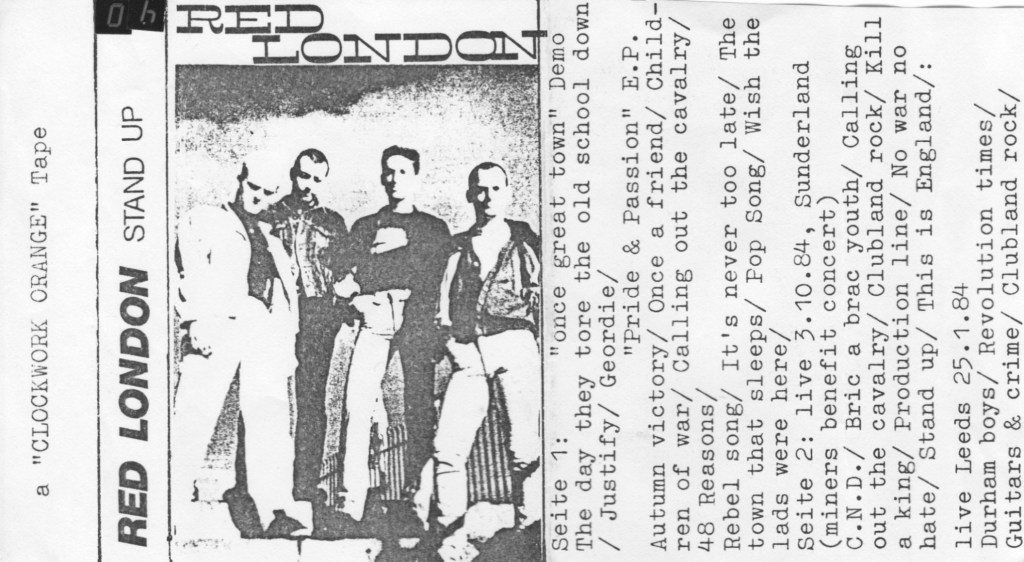
But to return to your question, yes, I was mainly listening to British classics like Cockney Rejects, Vice Squad, Stiff Little Fingers and Sham 69. Then I got into our local boys from Berlin, The Voice, and Red London shortly after. I was playing their first album, This Is England, and especially their 1987 demo non-stop. I had already discovered and loved Madness and 2 Tone when I was 12, but now I got into all the old skinhead reggae stuff too.
1987 Red London demo? You mean the Pride and the Passion EP?
Nah, there was a demo recorded on 8 August 1987 that had ‘Wish the lads Were Here’ and ‘Once a Friend’ on it. The demo is called Once Great Town and isn’t listed on Discogs. I think the vocals were done by Raish Carter, the drummer, so Red London are quite happy that it’s been forgotten [Carter later ended up in Skullhead – Editor]. But the tape is great.
And what were you listening to later, in your Skintonic and redskin days?
A lot of skinhead reggae, rocksteady, ska or whatever you want to call it. My greatest gig was Desmond Dekker live at a jazz club called Quasimodo near the Bahnhof Zoo station. That was in November 1987. Other than that: Kortatu, and of course Redskins, Burial, Newtown Neurotics, Attila, Billy Bragg and still Red London. I liked Mother’s Pride, I was their merchandise guy on the first tour. The 90s ska wave also caught my attention, but I only found some of it convincing. Operation Ivy was a milestone of course. Ska played with such intensity and speed and with great breaks – just awesome.
And of course, in the 90s you got good Oi bands again. Braindance were my faves – the first two singles are brilliant. Oxymoron were one of the better ones too. Unfortunately there were also bands like Another Man’s Poison. I thought they were pretty cool and organised a Berlin gig for them. My chin dropped when the guitarist opened his guitar case and revealed a huge celtic cross sticker on his instrument. His girlfriend also had a celtic cross dangling from the zip of her flight jacket – a real disappointment. I’ve rarely been so reluctant to hand a band the agreed fee…
And today?
Speaking of newer bands, The Interrupters were a revelation the first time I heard them. I’m a big fan of female vocals and, as I mentioned, also of Operation Ivy and Rancid – and The Interrupters are basically Rancid with female vocals. I also like Autonomads, Scum of Toytown and Inner Terrestrials at the moment.
I’ve also discovered some bands that I hadn’t really taken any notice of for decades. New Model Army are musically and lyrically way ahead, and I think Chumbawamba are great to: “You think you’re god’s gift, you’re a liar, I wouldn’t piss on you if you were on fire” delivered by those angelic voices, brilliant. It’s political pop in a good way – nice to listen to and reaches people who’d never go anywhere near Crass. After all, Redskins were also a very poppy band in their late phase, with horns and all that… and they also reached more people than the rama-lama punk combos could.
Did I mention that I’m still a big Red London fan? The latest album, Symphony for the Skins, is their best since This is England.
To what extent are you still, or again, involved with the skinhead world?
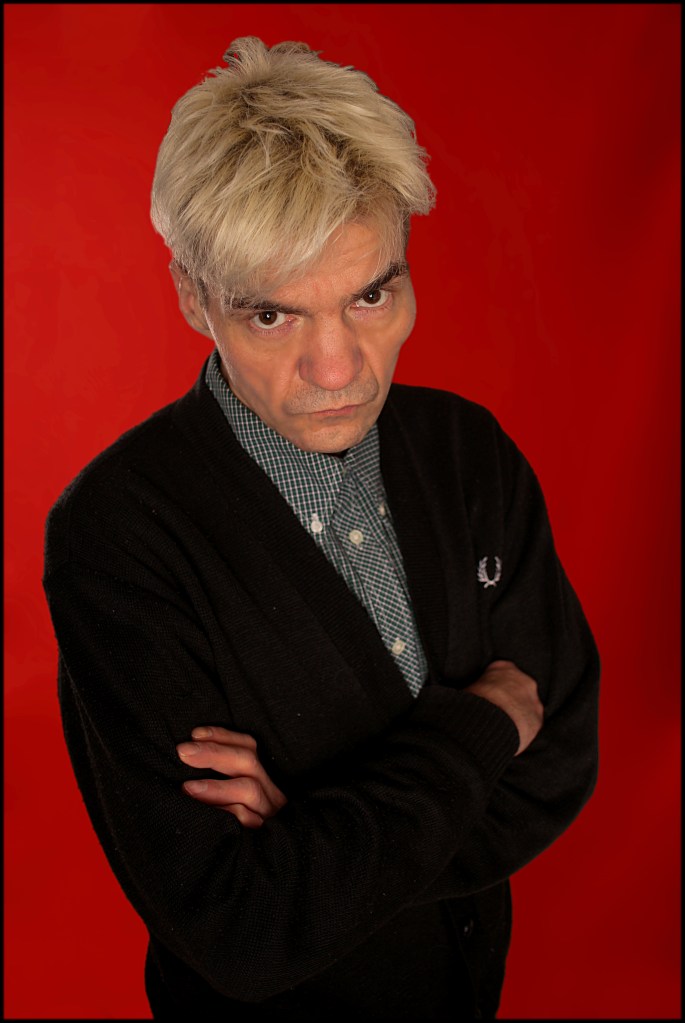
I’m 52 now, and I’ve outgrown the stage where I felt it necessary to define myself through groups. Not that that’s a bad thing or that I’m better than others, it’s just the way I am. I’m just Ugly – a product of my life’s experiences.
If you want to see a collection of documents, flyers, posters, zines and other stuff from my life, have a look at ‘UGLY’s Archiv’ at www.facebook.com/UGLYWestBERLIN.
Last year when the Covid lockdown began I started doing a zine again. It’s called Rauditum, and I’m doing it together with a skinhead who’s 25 years younger than me.: https://www.facebook.com/rauditumfanzine
 Creases Like Knives