
In a book on German youth gangs from 1991, Krieg in den Städten (War in the Cities), there are a few quotes from you in a sub-chapter about Berlin redskins. Apparently, when you were still a punk in about 1985, you almost got your head kicked in by a bunch of skinheads one day but then made friends with them instead?
That’s such long time ago. If memory serves me right, it was a chance encounter in an underground train station in Berlin. The initial aggressive vibe quickly wore off and then we got on just fine. I started hanging out only with skins for a while even though I was still a punk, and getting rid of my mohican was the next logical step. Skinhead also matched my self-image more closely at the time. I was doing an apprenticeship as a sheet metal worker and wasn’t particularly interested in politics. My focus was more on the next beer and the next girl.
What kind of skins were you hanging out with in the beginning?
Today I’d call them right-wing. They weren’t politically organised but clearly right-wing. However, politics rarely entered the conversation. We were talking about everyday stuff. At the time, I wasn’t interested in politics, but that all changed when organised right-wingers started showing up and politics became a more important part of the conversation. I met a redskin at that time, which was very fortunate for me, because then I had an alternative to my circle of confused right-wing friends.
West Berlin in the mid-80s must have been breeming with skinheads...
The scene at the time was huge but divided by neighbourhoods. The two districts with the strongest concentration of skinheads were Spandau in the west and Neukölln in the south. Those two were also the ones that hated each other the most. Plus there was a crew in Schöneberg based around Crellestraße [the local high street] that comprised skins and a few punks. These were the three best-known groups in West Berlin at the time. There was a smaller crew in Kreuzberg too, which I eventually joined. They were anti-fascist left-wing skins who didn’t consider themselves redskins, though.
But apart from the Kreuzberg one, all the crews were more or less right-wing. To some extent, they were organised in parties such as the Nationalist Front (NF) and the Free German Workers’ Party (FAP). The FAP was more strongly represented in the outer boroughs with detached houses and was led by neo-Nazis with side partings, whereas the NF consisted almost exclusively of skins and ex-skins.

Your statements in the aforementioned book give the impression that redskins didn’t like punks very much – that they saw them as ‘anti-social bums’. Quite different from the ‘punks & skins united’ slogans that became fashionable in the 90s…
If that’s the case, then the interview gives the wrong impression. We had no time for some parts of the punk scene, i.e. the ones who really were anti-social. But there were also the kind of punks that we hung out with, who were far more numerous. I mean, we hung out in punk bars in Kreuzberg. But we had no time for people who were just drinking and begging and who were completely filthy to boot. It’s them who we called ‘anti-social’ and ‘bums’ because that’s all they were. But solidarity with punks was important especially when we became more noticed as a distinct group, which meant that we were increasingly becoming a target for other skins. At first there were only three of us, and until the time that more skins joined us, solidarity with punks was important for our fighting strength and never questioned.
Any idea when redskins first appeared in West Berlin?
I reckon there were left-wing skins in Berlin from the beginning, but they tended to be scattered ones who were integrated into the punk scene. I think it was in ‘82 or ‘83 that I met a skinhead who called himself a redskin for the first time, and that guy was hanging out more in ‘new wave’ circles. The first crew dominated by left-wing skins was actually us. Or at least I’m not aware of any crew before us.
You did, however, send me a few issues of a West Berlin zine first called Kampfbereitschaft 84 (KB84) and then Reasons Why, which came out from 1983-85. Do you know who was behind it?
The guy who was doing the zine was called Rasta, but unfortunately I never met him. I have no idea where he is now. I knew people around 1986 who used to know him, but he seems to have vanished from the scene very soon. KB84/Reasons Why is where I later took my main inspiration for Skintonic from. For me, the fourth issue is one of the best zines ever. If you compare it to the first issue of 1983, you can see how he and his zine evolved over time.

Yeah, that’s true. The first issue is just a typical skinzine of its time. It even has a picture of Skrewdriver inside – though maybe he didn’t know about their politics at the time.
The first issue came out in early ’83, so I think he might have worked out Skrewdriver’s politics by then. But I think Rasta was only 18 or 19 when he started the zine, and he too went through a process, which I think is really evident in his zines from one issue to the next. In the beginning, he wasn’t really aware what a pile of shit the far-right skins were. It wasn’t until years later that the murder of Ramazan Avcı occurred. Maybe Rasta saw the whole thing more as an attitude, an act, and never imagined the extent and the consequences it could have. I can relate to that a bit. You’re young, you want to have fun, and you don’t think things through. Then you find yourself stuck with a circle of ‘friends’ that you don’t want, and that’s when you act.
It’s an interesting zine. One thing that has always struck me is that bands like Red London or Red Alert, who in Germany were more or less considered ‘redskin’ bands because of their names, were actually quite moderate. This much is evident from their interviews with KB84/Reasons Why too. There were only a few really left-wing skin bands from Britain: Redskins, Skin Deep, Burial and early Blaggers come to mind.
That’s true, but Red Alert and Red London now clearly consider themselves anti-fascist and therefore left-wing. On the other hand, hardly anyone knows how left-wing Skin Deep and Burial were, because their lyrics weren’t quite in the same vein the Redskins’ ones.
What were the leisure activities of West Berlin skinheads in your early period with the more right-wing and apolitical skins? I’m talking about gigs, bars, football…
Football was clearly an important topic, and there was no plurality of views there: for West Berlin skins, Hertha BSC was and remains the club to support. As for bars, there was always some run-of-the-mill corner tavern that tolerated us for a while – after all, a crew of 10-20 skins is a decent source of income. But at some point there was always some brawl, sometimes among ourselves, sometimes with other guests, and everyone got kicked out.
In the mid-80s, Oi and ska gigs were quite rare, but that improved towards the end of the 80s, which was mainly due to one venue, the Blockschock. We were good friends with the owners, and sometimes we helped out when they needed a hand, so we gained the necessary influence, so to speak.

I know of two Berlin Oi bands from the 80s: The Voice, who are also mentioned in Skintonic and KB 84, and Kraft durch Froide (KdF), who were rather nazi-like – or at least their drummer was. Do you have any personal memories of these bands and their followers?
Two completely different bands! You really can’t compare them musically or lyrically. KdF were an explicitly fascist band. The drummer, Andreas Pohl (“Pole”), was the head of the Nationalist Front in Berlin and later its national chairman, and Zille the vocalist was his shadow – though even a shadow has more brains than Zille does. They named themselves after “Kraft durch Freude” (Strength Through Joy), the organisation that organised leisure activities for workers in Nazi Germany, not unlike the Free German Trade Union Federation later did in East Germany.
KdF songs covered all the usual ground that practically all right-wing bands sing about: soldier crap, the communist peril and red terror, and the servants of the Jewish world conspiracy presently in power. The band’s following consisted of boneheads in camouflage gear and 18-eye DMs: skins who lived up to the media image of skinheads, i.e. ‘fat, feeble-minded monsters with swastika armbands’.
One weekend in the mid-80s, three of us went to a party, and it turned out that the other guests were KdF and their entourage. Luckily we saw them early enough, and they didn’t see us, so we managed a hasty retreat without hassle – but it almost ended badly. Our chances would have been roughly that of a chicken at KFC…
As for The Voice, they weren’t organised in anything apart from trade unions, and musically they were much more diverse than KdF. On their first single, for instance, they covered ‘54-46 Was My Number’. At that time, there were six of them, and later there were only three who recorded both albums. Their lyrics were quite typical for an Oi band, maybe even a bit too typical – too British.
The Voice were actually on the bill for last year’s Skinhead Reunion Brighton, but I think the event had to be cancelled ‘cos of Covid-19…
That’s right – they’re currently working on their second reunion, but they aren’t quite ready yet. They also just shot a new video… In the 80s, The Voice often fell flat on their face due to their misconceived notion of skinhead unity. It was a time when the skinhead scene of West Berlin was sharply divided into two opposing political camps, and they didn’t want to take sides. So they ended up getting caught in the middle for some time, and they paid a high price for it too – see Skintonic No. 3. After their second album, they split up for the time being.

I understand that The Voice organised a gig with Angelic Upstarts headlining, but they hired a right-wing football firm called Endsieg as security?
Yes, that’s why we attacked the gig. The next morning, Mensi called me shouting like a bastard. But fascists should never be allowed to do security for Angelic Upstarts. They wouldn’t have let us in anyway, so of course we had to do something.
Poor Upstarts… In Britain, their gigs were often wrecked by nazis.
Yeah, that’s what Mensi told me that morning: in Britain it’s the nazis who wreck his gigs, and in Berlin it’s the leftists. I replied that the reason why the nazis didn’t attack his gigs in Berlin is because they’re his security crew. He didn’t believe me. It wasn’t until a while later that he got his head around it and understood why the gig was attacked.
Any other Berlin bands at the time?
There was another Oi band called Troopers, who were usually rehearsing at state expense in Berlin’s Tegel youth prison… They formed as early as 1982, but they didn’t get to release any records before the mid-90s due to frequent stints in jail.
There was only one ska band in Berlin in the mid-80s: Yebo, who had formed in 1979. They didn’t have any real connection to the skinhead scene, though, and nobody actually knew them until like 1987-88. They were happy when we started showing up at their gigs because the vibe was good, but the rest of the audience often looked at us in disbelief. I mean, they played in churches and community centres to normal housewives who were active in the community and attended every event. And the fact that we were dancing to Alfi’s music instead of beating him up was something they had to get their heads around first.
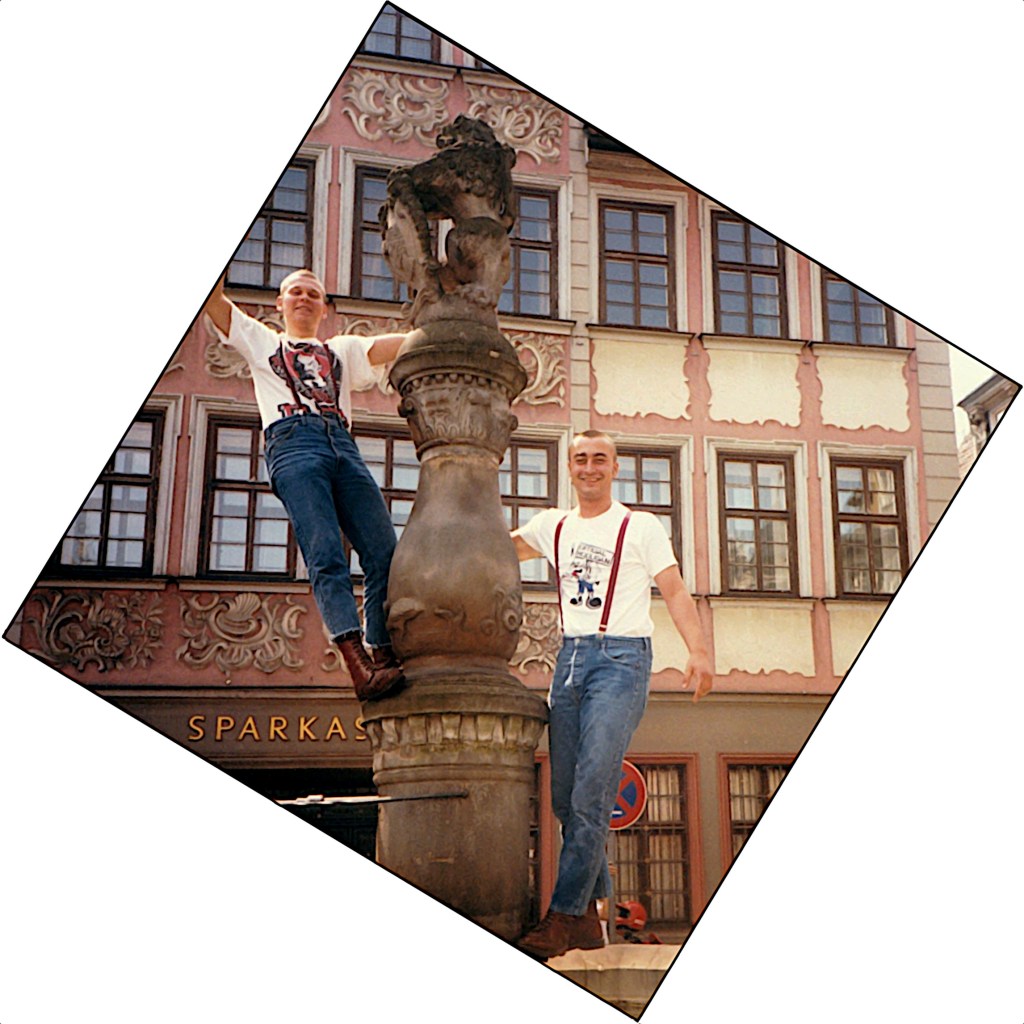
In 1987 you co-founded the now legendary Skintonic zine (which later became Skin Up). What was the idea behind it?
That’s difficult to say. I’m not sure if we had a plan or an idea why we started doing it. Hermann and I decided at some point to do a zine. I think I was really impressed with KB84/Reasons Why and wanted to do a zine like that, which was bordering on blasphemy, really.
At that time there were a lot of zines, but none of them reflected our idea of skinhead, neither musically nor ideologically. So it was only logical to create a mouthpiece. However, it was also the time when I was becoming increasingly politicised. That’s why Hermann started signing off some of my articles with the moniker ‘Der Rote Korsar’ (The Red Pirate), because they went too far for his liking.
The first issue of Skintonic reported on trade union struggles and sided with the workers, but also explicitly dissociated itself from redskins (“… whom we don’t want to support any more than the nazis”). Did you share this position at that time?
For me that was meaningless. We were living in West Berlin, this strange semi-city, and we only knew the scene in other towns from zines and from the few visits we made to ‘West Germany’. Keep in mind that if you wanted to go to Hamburg you had to pass two customs checks by East German border guards. Each one took at least an hour, plus there was the GDR speed limit of 100 km/h [about 62 miles per hour] on motorways that had been built by Adolf and never upgraded since. Today it takes two-and-a-half hours to get to Hamburg; back then, five hours was normal. We were an island city in the middle of a foreign country that was part of a hostile bloc. Plus you needed a car and a driver. We were only 18-19 years old, and who needs a car or a driving licence in a city surrounded by a wall? I still haven’t got one.

Oops, I’m afraid I got a bit off topic. Anyway, we couldn’t really assess the skinhead scene in the rest of West Germany, so it wasn’t unwise to keep things a bit more under wraps in the beginning. After all, we wanted people to read what we were writing. And even though we didn’t really have a plan, we weren’t entirely without success. As I said, I was going through process of gradual ‘radicalisation’, so whatever I wrote one week might be outdated by the time it was published a week later. And if you look at page two in the second issue, that’s straight-up propaganda: “Skins join the red front, for socialism”. The distance we had kept from redskins in the first issue was no longer there.
It seems that you didn’t always get on well with Berlin’s so called ‘left-wing scene’, though? Skintonic often reported that West Berlin skinheads of all stripes were harassed and even physically attacked by the local Autonomen (black bloc types).
Those stories were more typical of Hermann. I didn’t have any such problems, and I don’t really think he did. He probably thought it would be a tactical advantage to present himself as a victim, because having similar problems makes it easier for people to relate to you, and then they’re more open to what you’re saying.
In any case, Hermann was no redskin. He was an anti-fascist, class-conscious working class kid, yes, but neither he nor anyone else considered him a redskin. It is actually quite easy to tell who wrote which article, because we had different writing styles.
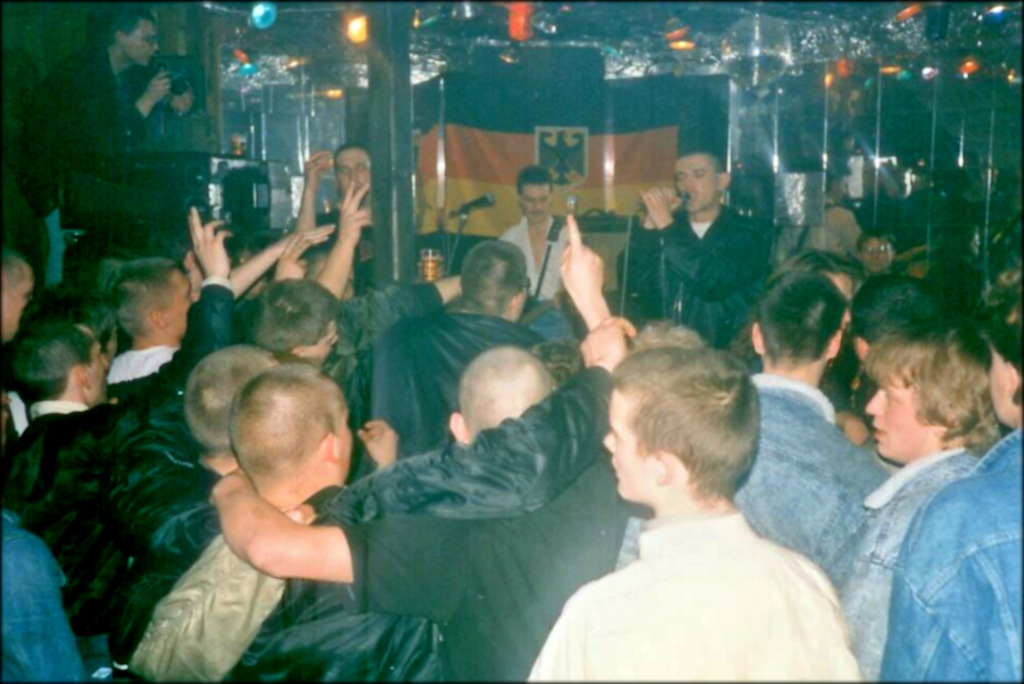
The first issue of Skintonic contains your report from the Daily Terror gig in Schöppenstedt in 1987, which we have already covered elsewhere. However, you mentioned that you were planning to interview Pedder, the vocalist, after the show?
After the show, a few people went to Pedder’s place in Braunschweig near Schöppenstedt. I had already arranged the inteview for Skintonic with him beforehand. When we arrived at his place, there were Pedder and his girlfriend, a mate of mine from Berlin and Uhl from Coburg [of Clockwork Orange zine and later of Dim Records]. Probably a few more people too, but hey, that’s more than 30 years ago.
Pedder had far exceeded his required alcohol level. I started the interview by saying “skinhead is a working-class movement…” I didn’t get any further than that. Pedder jumped up foaming at the mouth and yelling at me, “Get out, you red bastard! Get out of my flat!” I was totally puzzled. Uhl, whom I had only met for the first time on that day, tried to calm Pedder down and defuse the situation. But Pedder persisted in his intention to kick me out. Still confused, my mate and I left the flat and drove back to the border and to West Berlin. A few days later, Pedder called me and apologised. I accepted the apology because he had obviously been pissed like ten Russians. You could tell that he wasn’t really that way.

Some time later I visited him in Braunschweig again because Hertha BSC had an away game against FC Braunschweig. It was the dark days when both clubs were playing in the lower leagues. I don’t remember if it was the second, third or fourth league where they went head-to-head. Anyway, the stadium wasn’t especially packed. The same mate I’d been to the Daily Terror gig with and I were standing there with Pedder at the Braunschweig lads.
At some point – the game was already in progress – we heard fans chanting from near the gate. Pedder went, „That’ll be our Old Comrades“ [an FC Braunschweig hooligan firm]. A mob of around 50 entered the stadium, but in fact they were Hertha lads – which Pedder and his mates also clocked, trying to escape. My mate and I just stayed there. We said hi to the Berliners running past and then kept watching the pointless back and forth of rival hooligan mobs. We were in turn saluting Berlin lads and Braunschweig lads, waiting for things to happen. The situation was not without a certain humour, even more so for outsiders than for the two of us.
Later I spoke to Pedder on the phone a few times. It was a difficult task, because you never knew whether he had hung up or fallen asleep or if he was going to finish the sentence. It took him what felt like an eternity to finish a sentence, which was due to his advanced alcohol dependency.
CLICK HERE FOR PART 2
 Creases Like Knives