
Continued from And then it kicked off: 1996 Interview with Robson, part 2. Original interview by Łukasz Medeksza. Translation by Matt Crombieboy. Comments and footnotes signed “MC” are the translator’s.
When were Konkwista 88 formed?
In 1990 or maybe 91. They played their first gig in 1991.
And you were their manager. Did you write lyrics for them?
Well, let’s say I had my share in their lyrics.
Is it true that you didn’t allow Konkwista 88 to write any songs about Poland?
I’m not sure… But actually, they did have some lyrics about Poland [they had ‘Wolność’ and ‘Niezwyciężeni’ at the time – MC]. Put it this way: I used to laugh at all the usual nationalist stuff. We didn’t use that for our lyrics at all. Greater Poland? What the hell is Greater Poland supposed to mean? What kind of concept is that?
When writing lyrics for Konkwista 88, I tried to strike a leftist tone. I was looking for the left-wing aspect in Nazism, as many people had done in the 1930s. But frankly, there’s no leftism there at all. Nazism uses a leftist image – a similar colour scheme, similar slogans – but that’s as far as it goes. It’s hollow. Nazism is a blind alley, though one that looks quite impressive from the outside so it can attract certain people. That’s all there is to it.
What about Legion?1
They were the ‘Polish’ band – the nationalist one.
When did they start out?
More or less at the same time as Konkwista 88.
Who were the band members?
Tomasz Kostyła on vocals was the important guy. And Początek was playing the drums.
You mentioned earlier that Kostyła was one of your first contacts in the skinhead scene. But since he became the singer in Legion, I assume that your ways parted at some point?
In 1988 we went on a holiday together. He was interested in nationalist politics – the National Radical Camp (ONR) and things like that, which didn’t interest me at all.
Does he still sing in Legion?
To this day.
Do you remember the TV programme where they showed Legion music videos? Who was in those – Kostyła, Początek, and who else?
I don’t know the others. Some younger lads.
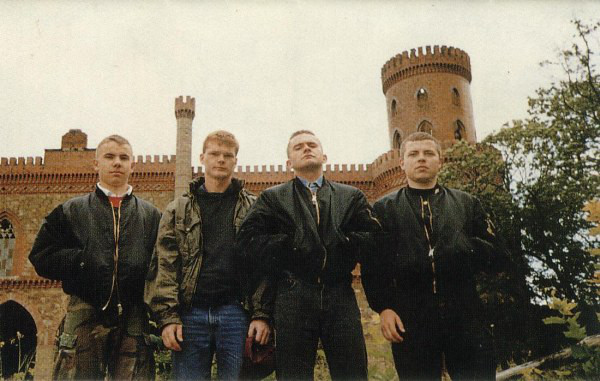
When was it that a wave of younger skins appeared?
When it became fashionable. A couple of new bands formed, and then the clobber became fashionable. That had a great influence: fashionable skinhead clobber from the West. It became trendy to be a skin.
It also became ‘trendy’ to beat people up…
But it all started with the clobber – you look trendy, and suddenly you’re part of the pack.
Are you thinking of characters like Skinol?
No, Skinol was there pretty much from the beginning – 1986 or even earlier. As far as I know, he used to dress in a very orthodox skinhead way back then. He finished grammar school, then went on to study. There was even an interview with Skinol in Słowo Polskie [a local Wroclaw newspaper until 2004 – MC].
Yes, Gajor and Pop were in that article as well. There was a picture of Pop too. That was just after that demonstration that you guys disrupted.
That’s right. The interview was interesting because it tried to rehabilitate the skinheads after the incident in Świdnicka Street. The paper said: it’s true that the lads started a brawl in Świdnicka Street, but they have a right to do that. They have a right to start brawls with blacks in the Market Square, basically. There is freedom now, and nobody can tell them not to start brawls. The article appeared in Słowo Polskie.
Let’s move on to the next stage. Tejkowski crops up, and Smolar is seen in his orbit. At some point, Polish National Community (PWN) comes into being, and around the same time something called Aryan Survival Front (AFP) appears on the scene too.
Exactly – the AFP was our answer to PWN.
Whose idea was it?
I came up with the name, but the idea to start an organisation came from us and the band members of Honor from Gliwice. We thought we should set up something like Blood & Honour. We were driving in the car with Adas and decided that we needed a name. The Honor guys were into calling it ‘White Front’, but we didn’t like that. And we thought the acronym AFP would stay in people’s heads because you already had the Agence France Press, so when you hear AFP you have an association, it rings a bell. Then the first AFP leaflet came out – it basically said that people needed to move away from the nationalist parties.
A funny situation occurred in Zgorzelec. There was an anti-German demonstration taking place there. Tejkowski sent the lads to town while himself hiding out in the railway station. We and the singer of Sztorm 68 [a skin band from Krakow that draws on ‘national-communist’ factions from the Polish People’s Republic – MC] went to the station together and started harassing Tejkowski. He even gave us some leaflets – we just threw them back in his face, swore at him and left. Then they locked all the skins inside the train station, and we jumped on a table and started chanting slogans such as “don’t trust politicians”, “they just want to use you”, and so on.
Who was running the AFP in Wroclaw?
Mainly Konkwista 88. The older skins weren’t interested in political activism or in setting up their own organisations. But for a section of the younger lads, the AFP was an alternative to the PWN.
This was in about 1991?
Yes, 1991/92.
So, two different camps had formed as early as that?
Yes, quite distinctly.
Apart from Smolar, who else was running PWN?
No one else. Smolar was the boss, and he still is. He’s the unchallenged head of PWN. All the others have to subordinate themselves to him. They obey him, and if they don’t obey him one hundred percent they must leave. All kinds of people have been PWN members. I know a homosexual who was one, for example.
But there was no such hierarchy in the AFP?
Nah mate, no way…
AFP cells sprang up in other towns too.
Yes, they did. It was a real phenomenon. AFP was an organisation based on Blood & Honour, a total copy. Bringing nazi slogans to Poland was absolutely shocking. We organised a party called ‘Hitlerfest’ in Katowice. It was basically just a gig in a bar – drinking beer and having fun. But it was the first day of Easter, so you had people walking home from church, and suddenly there’s this bunch of bald guys openly carrying a red swastika flag through town. We nicked that flag from a theatre. Can you imagine what impression that made? People were in shock.
The AFP cells in other cities were quite serious, though?
Some took it so to heart they even organised some kind of summer camp. Then they handed out leaflets in a nearby town, started a brawl there and were locked up. And then they started sending us letters asking us to send them money and help them (laughs).
Does AFP still exist in Wroclaw?
I’ve seen some graffiti.
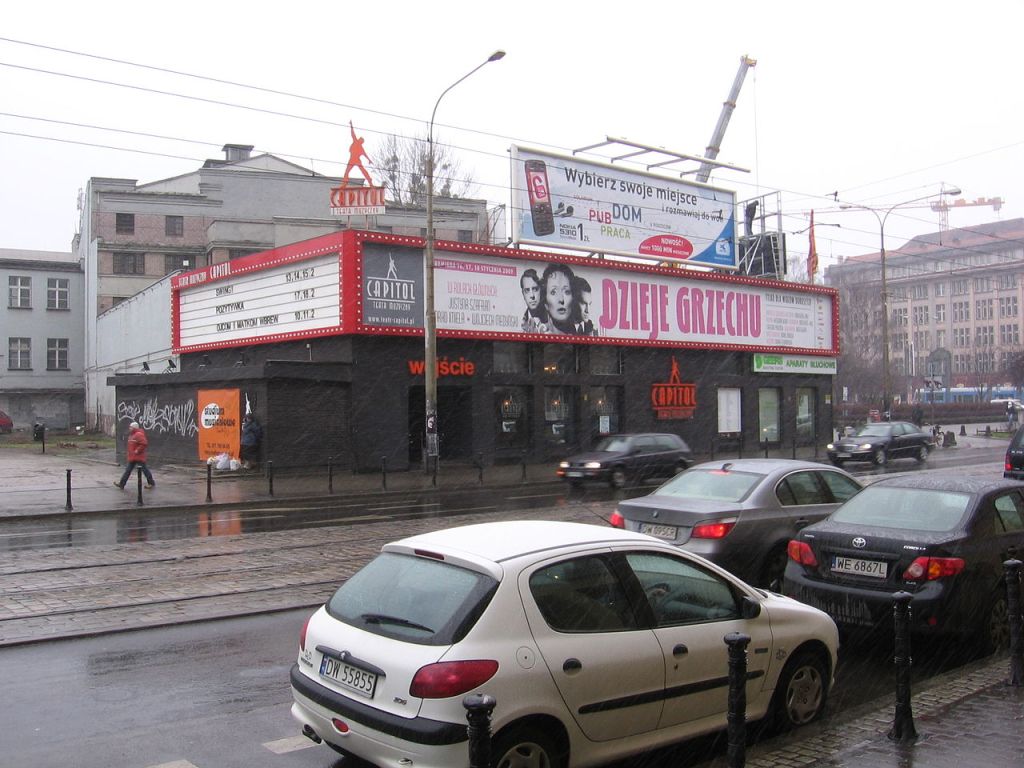
You used to meet up by the poster wall, right?
Yes, there was a period when we used to meet there. The poster wall in Świdnicka Street, right next to the Śląsk cinema.
I remember that’s where the letters ‘AFP’ first appeared on a wall.
Yeah, Czeski spray-painted that one. That was just before the first Anti-Nazi Front (ANF) demonstration took place on 1 May.
Exactly. Were you gathering intelligence about punks?
No. I was only interested in intelligence about the Anti-Nazi Front.2
How did you find out about the ANF?
I saw graffiti on walls. So I decided to research what it is and who’s involved. I started from the top: I found out who Milka and Wardęga were, then I investigated who they were in touch with, and so on. Then leaflets from an anarchist group that was named after Kropotkin appeared. They gave two street addresses. One of them was Piotr’s…
Piotr Żuk, right?3
Yes. There was some other guy too, I think his name was Mateusz. The leaflet gave his phone number. We called him to make him come and meet us, which was great fun. One of our girls called him and said: “I’d like to meet you, I think you’re really cute… I’ll be wearing a miniskirt and heels”. And he came! He was sitting there waiting (laughs). She arranged to meet him at the Powstańców Śląskich roundabout, so that’s where he was sat. We walked up to him and went: “Alright mate, who are you waiting for? A young lady perhaps?” We kicked him twice, then he managed to run off.
Did you have a specific objective when you were collecting information about the Anti-Nazi Front, some particular plan? Or were you gathering intelligence just in case?
You know, I was expecting all kinds of things, including bombs. Fuck knows what could have happened.
When did you fall out with Smolar, and when did the general split occur?
It was more that he fell out with me. Frankly, he’s a crank. At some point he started thinking that he’s the only true Pole, the most decent guy in the whole nation, and that provoked all kinds of arguments. The first time that I got in an argument with him, we were at a gig at the Lucky Music Center in the Nowy Dwór quarter. That’s where he accused me of pulling young people away from nationalist ideals. His crew started shouting ‘Poland’, and someone, I think Gajor, shouted back at them: ‘This is a gig for nazis – if you don’t like it, fuck off’, ‘Poles out!’ and slogans like that. Some of the people there got so confused… I mean, suddenly there’s these lads wearing white shirts, black ties, 14-eyelet Ranger boots, green trousers…
Who do you mean?
I was dressed like that, and Gajor and a few others too. And we made those anti-Polish quips. For some, that became an obsession. It was silly: how can the word ‘Pole’ possibly be a slur?
Let’s talk about state security (SB) infiltration into the skinhead scene. What can you tell me about it?
I can only talk about the people that I knew, but I think it’s unlikely that it was going on. I don’t know about the PWN, on the other hand.
Did you have the feeling back then that you were being monitored or that you had been infiltrated?
No. You see, any contact with us could have brought discredit to the state services. We weren’t shouting ‘Poland for the Poles’, we were going round with swastikas in plain sight. Nobody wanted to be associated with us in any way. A little tidbit that might interest you: the AFP was meeting in a tavern that belonged to Fighting Solidarność [a radical splinter from Solidarność – MC].
I didn’t know that!
Yes, on a weekly basis – every Thursday at 6 pm.
Was that in any way linked to the Strzelec organisation?
Indeed. Strzelec was a paramilitary association – it’s fair to say a pro-state one. I thought: let’s set up a local Strzelec group and officially meet under their banner – hold our meetings under a false flag. They even sent us uniforms! (laughs)
What did Morawiecki make of this?4
Nothing. I don’t know if you’re aware of this, but Morawiecki later organised a joint demonstration that had Fighting Solidarność marching alongside the National Front of Poland. It was a great embarrassment for the bloke [National Front of Poland = Narodowy Front Polski, a small far-right organisation formed in Gdansk in 1991 – MC].
There was also a certain Herman. He was your mate, but at the same time you suspected him of collaborating with state security?
No, I didn’t suspect anything; he was just my mate. But one time I visited him at home, and that’s when his mum suddenly asked me if I was interested in supplying intelligence. She was working for the Security Service (SB) back then, and today she is working for the State Protection Office (UOP). I was shocked. Herman said: “Let’s have a chat with my mum”. So we went to the other room, and she asked me if I was interested in collaborating, providing information and so on, and that they could probably pay me. I said I’d think about it and left it at that. I never talked to her about it again.
When did Jarosz’s tattoo studio and Czeski’s shop open?
More or less at the same time: in about 1992. Jarosz was making good money because he’s a good tattooist. I have a very negative view of him as a person now, but I’ll admit that he’s an excellent tattooist. I’ve seen some of his designs appear in western magazines… He’s really good at it.
One of the squatters once got stabbed in Nowy Targ square. He was hospitalised and even suffered memory loss because he was hit in the head too. Word on the street was that Robson and Herman were the perpetrators. Is this true?
No. I wonder why people thought that? Herman was involved in a many incidents along those lines. I was hanging out with him for a while, but I did have my doubts. He crossed the line for the first time when he gave that girl from Szczecin a kicking. Later he tried to justify himself. He claimed he had approached her from behind and hadn’t seen that she was a girl – something along these lines. But then he gave another girl a kicking in the Market Square. He put his Ranger boot right in her ribcage. That’s when I realised he’s just a cretin. I didn’t want to hang out with him anymore after that happened.
Let’s get to the most important question of all. When did you switch sides and why? Tell us honestly and in detail – what was going through your head, leading up to the moment when you removed that Blood & Honour patch from your jacket and covered up your tattoo?
I started covering up the tattoo later. The patch came first.
What tattoo was that?
An SS Totenkopf [skull]. In the background, a rune used by certain Waffen-SS divisions. And below, a ribbon that read ‘88’.
So how did this moment come to pass?
I just started feeling bad wearing that patch. It made me feel sick walking around with it, so it had to go. Next, after so many years I had to face up to the fact that I had absolutely nothing to do with nationalism. At all. I’d already known that earlier, but it was not so easy to admit that to myself fully and honestly.
I had begun taking an interest in rap music and became intrigued by black racism. I felt that something had to be done about it. There are racists in that genre, and it really bothered me. Then I thought: well, if don’t like that they’re racists but I’m doing the same thing as them, then I’m also against myself. That’s when I entered a period of doubt: “Something doesn’t quite add up”. But it took me more than another year before I became fully conscious of it and worked out exactly where I stood.
Was that 1993?
1992–93. That was the year when I started thinking about such things.
There was the additional fact that punks smoke more weed than skinheads do, right? (laughter)
No, that wasn’t a reason for me. By the way, do you know who was the first person to get me hash? Czeski [the skinhead]! Czeski used to smoke and sorted some hash for me.
OK, but why did you switch to the other side instead of, say, retiring from this kind of lifestyle altogether?
It just felt right. Let me tell you something: I always considered myself a leftist, even when I was wearing a swastika. First I called myself a National Socialist, then a white socialist. I used words such as ‘revolutionism’ and ‘white internationalism’. In my mind, I was…
… on the left side of the barricades?
Yes, on the left side of the barricades. I knew the history behind it quite well, and not just textbook history either – my interest in history ran deeper than that. I knew a lot about the left wing of the NSDAP, the Strasser brothers and the organisation they founded, the Black Front. I knew about strikes where SA stormtroopers had joined forces with the Communists. I read in some anarchist journal – quite possibly in Mać Pariadka – that the Communists [in Weimar Germany] had ‘cooperated’ with the Nazis and so on. But it was actually just workers in a factory all going on strike together. Some were members of the SA, others were members of the Red Front militia – it made no difference in that context. They went on strike together because they all wanted higher wages.
Did you have any doubts when you were crossing over to the other side?
No, not at all. When I feel something, I try to follow my intuition instead of lying to myself. I did get into trouble with some of my old mates. Once, for instance, I was sitting in a pub, and they turned up to take me outside and sort me out.
Was that a kind of sentence they wanted to pass?
Something along those lines. But I felt really awful about it. I felt sorry that they were acting like this towards me as a person. After all, I had known them for so many years…
Who battered you, then?
Nobody – they didn’t manage to take me outside in the end. There was a bit of pushing and shoving, but at some point they gave up and left me alone. Skinol, David and a few others were there.
And how did you get to meet the ‘other side’ – your former enemies?
I didn’t really get to meet any of the people that I had scraps with. No such encounters, no trouble or anything. I hung out with Daniel and Drzazga and felt so at ease with them, I didn’t worry about such things at all.

But the ‘other side’ needed some time to get to trust you…
Oh, sure thing. I was well aware that people might eye me with suspicion. That didn’t surprise me. I had a bad impression of Mokry, because despite the situation I was in, he kept writing stuff about me for various zines. He dragged out my private affairs for Mać Pariadka.5 He wrote that “nazis” are coming to gigs and that “they” are hanging out with punks – in the plural form.
But it’s true that Czeski also started coming to gigs. I think he went through a period of doubt too.
Yeah, he went through a period of doubt as well, but my impression was that Mokry was writing about me. Czeski didn’t really get on with punks – that was me. It was the same thing with Żuk: he wrote about me in the plural form. It wouldn’t have been a problem if he’d written: “One of them, an ex-nazi skin called Robson, was there and did this or that”. That would have been the truth. But if he writes in the plural, pretending that it’s some kind of general phenomenon that Aryan Survival Front members are switching to the ‘other side’ and becoming redskins – well, that’s a lie. No such thing occurred.
[someone named Arek joins in the conversation] He did this in order to discredit a scene that he could not control.
Well, exactly.
[Arek] Żuk used certain formulations to discredit Wroclaw in the eyes of the rest of Poland. In other towns, anarchists and punks stick together, but in Wroclaw they’re separate groups.
Also, consider this statement by Żuk: “There has been a negative phenomenon in the punk scene lately. Punks are starting to hang out with nazi skins who are coming to gigs”. You’re aware how this might be received elsewhere in Poland, right? Nazi skins are coming to gigs, they hang out with a couple of punks, and they batter everyone else… That’s how I would take it.
And that’s how the rest of Poland did take it – that Wroclaw is the city of nazi skins and nazi punks.
Thanks to people like Mokry and Żuk, all of Poland got that impression. I was surprised that nobody replied to Mokry’s article. Only I walked up to him on the day of the Oi Polloi gig. I said: if you think that I’m a nazi, I’d like to fight it out with you right here. He says no, he doesn’t think that. I say: if you’re such a radical anti-fascist, let’s go and get baseball bats, put some nails in them, then go to the Market Square together and kill the first nazi we see. I said that very calmly, just to get a reaction. But he didn’t want to. He asked: why so much violence? He said that just before we all headed off to the Oi Polloi gig…
Let’s return to one of the lost threads, though. At some point, you got involved with the Anti-Nazi Front…
Let’s say I got to know some of the people who were involved with the ANF.
So how did the actual ANF stand up compared to the intelligence you had gathered about it when you were still a nazi?
Very poorly (laughter). It all looked far more effective from the outside, but that was just a facade.
Robson, are you a redskin?
I’m a skinhead and I’m a leftist. Leftist is a very general term, but I absolutely don’t want to narrow it down to any specific position. For example, being a socialist or a communist involves the concrete pursuit of some very specific slogans or dogmas. But being a leftist doesn’t necessarily mean that.
But in a sense, what you’re doing now is a continuation of what you used to do in the past?
In a certain sense it is, yes. I just stopped being a racist. I’m a pragmatic when it comes to thinking, and when something seems illogical to me, I drop it… There was a time when I thought that racism was logical, and I had arguments for racism that seemed logical to me. But over time, these arguments lost their validity – they became untrue. I realised that I had deluded myself.
And now – are you sure of your logic?
Back then, my take was that many blacks in the States and in Europe are criminals, and that they have a low average IQ. However, blacks in the States supposedly have a higher average IQ than Poles in Poland! So if Polish racists were to draw on such criteria to argue that blacks are inferior, the average Pole would end up somewhere near the bottom of the hierarchy! (laughter) I used to base my views on anthropological criteria too. You can read in every book that blacks have a lower brain volume than whites. But also, Asians have a higher brain volume than whites.
But that doesn’t mean anything.
Well exactly, it doesn’t mean anything.
Do you regret certain things that you’ve done?
Do I have regrets? Those were all life experiences. If we began unpicking everything chronologically, then quite possibly we’d find something or other that I regret. But generally speaking, they were all experiences that gave me a certain perspective on things. For example, it’s fun for me to talk to racists or right-wingers now. I can demolish all their arguments… I’m familiar with their reasoning, and I know exactly how they think.

Apart from the one time they tried to batter you outside the pub, what was it like to cut ties with your old mates?
I just stopped seeing them, and they stopped saying hi to me when they bumped into me somewhere. I wasn’t too heartbroken over that. They were actually helping me, you know? If they had stayed on friendly terms with me, I would have found it more difficult to quit… But they started treating me as their enemy, and that cleared things up for me.
Isn’t there anyone you’re still in touch with?
Nope. Who do you have in mind?
Czeski, for example.
Nah – are you joking? I’m at war with him. Especially after that last ska party. What they’ve done is beneath contempt. They invaded a ska party shouting, “We won’t allow the spread of communism in Poland”. What can you say to that?
Is it true that parts of the Aryan Survival Front went over to the ‘other side’ with you?
No. There are only some individuals who are no longer nazis. Greziu Sadło, for example, is just a skinhead now – not a nazi anymore.
Who is your worst enemy today?
Smolar has always been my enemy. And the rest of them? Let’s just say, if something happened to them, I wouldn’t shed tears.
Do you think today’s remains of the AFP and the PWN have any chance of uniting into one organisation?
Yes – I’m sure that’s what will happen. Things have been evolving that way for a few years now, and sooner or later they will unite. These organisations are slowly falling apart, so people are starting to stick together. They’re getting older, and they don’t want to fight each other anymore. They’d rather drink vodka together in the Market Square and bash someone else. It’s more fun that way, isn’t it? That’s the mood right now.
Finally, how do you view chances of National Rebirth of Poland (NOP) in Wroclaw?
I can see opportunities for them. You know why? Because they have a certain legitimacy. They are organised in a way that PWN never was. PWN only had slogans and myths, whereas NOP has a factual legitimacy, meetings, probably a place of their own – they give people concrete things. It surprises me a bit, because Catholic skins are still an absurdity to me.
Thanks very much for the interview, Robson.

Click HERE for Łukasz Medeksza interview (2021): “Wroclaw was a young and embattled city”
- Legion was Wroclaw’s other big RAC band. It existed from 1990–1996 and orientated itself towards ‘national catholicism’ rather than neo-nazism. The group drew on pre-war movements such as Roman Dmowski’s National Democracy (‘Endecja’) and its radical splinter, the National Radical Camp (ONR) – MC ↵
- The Anti-Nazi Front was probably the first antifa-type organisation in post-socialist Poland. It appeared in Wroclaw in early 1992, then spread to other cities – MC ↵
- Piotr Żuk was the leader of the Wroclaw anarchists at the time (yes, anarchists have leaders… they just don’t acknowledge them) – MC ↵
- Kornel Morawiecki (1941–2019) was the founder and leader of Fighting Solidarity, one of the splinters of the Solidarity movement. At the time of translating this interview, his son Mateusz Morawiecki is the prime minister of Poland – MC ↵
- Mać Pariadka: a Polish anarchist magazine published between 1990 and 2005 (with interruptions) – MC ↵
 Creases Like Knives