Click here for part 1 and part 2
 The end of 1984 was a personal low point for Pedder Teumer. Earlier that year, Daily Terror had been on their way up: their first two albums were selling in the thousands, and they were opening shows for big punk acts such as Die Toten Hosen. Yet Pedder’s skinhead turn prompted anonymous threats, cancelled gigs, and ultimately the breakup of Daily Terror.
As he later implied, unspecified problems in his private life hit him around the same time, further escalating his alcohol issues.Drinking himself into depression on New Years’ Eve, he wrote one of his bleakest lyrics in the early hours of 1st January 1985:
A vacuum of illusions
Your future is long past
No glimmer of hope, just an empty shell
In despair you reach for the last beer
And everyone knows you’ve reached the end of the line
And everyone’s just wating for you to piss off
Your halo fools no one anymore
For every man dies on his own
A decade later, he would still refer to Jeder stirbt für sich allein (every man dies alone) as his favourite, most personal Daily Terror song.
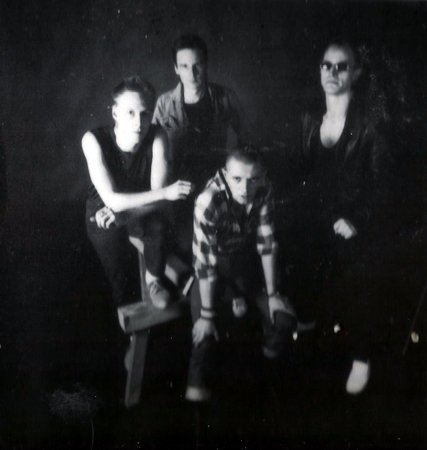
Yet as original guitarist Ebbi Hild remembers, Pedder was also a “stubborn, staunch and consequential person – he unconditionally followed through with everything he had begun”. Thus, by the end of January he had already managed to recruit a new line-up for Daily Terror, this time consisting of three long-haired brothers formerly known as the local rock band International. Pedder fronted this group of experienced musos as its sole skinhead.
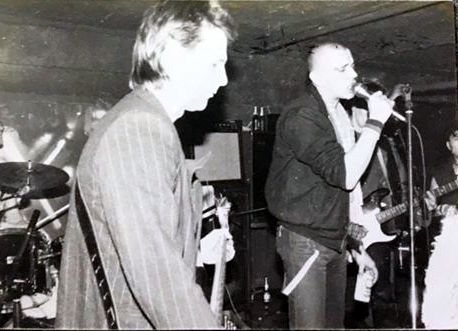
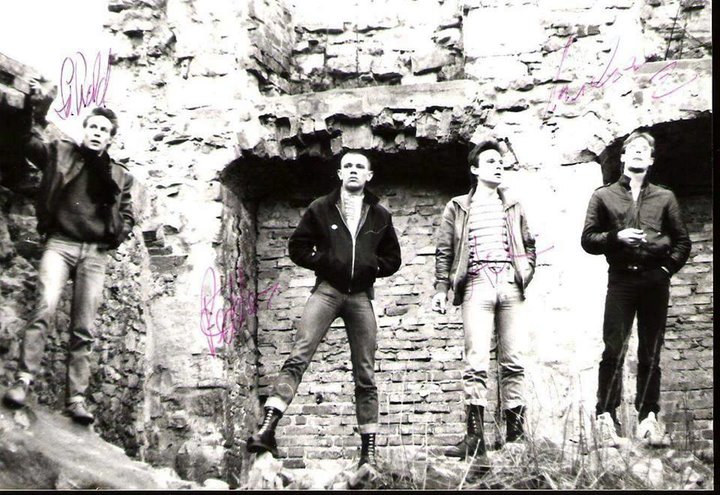 What might sound terrible on the paper proved to be a fortunate choice. A tight unit, the band soon started gigging, and by April a number of news songs were tested on a mini-tour through France.
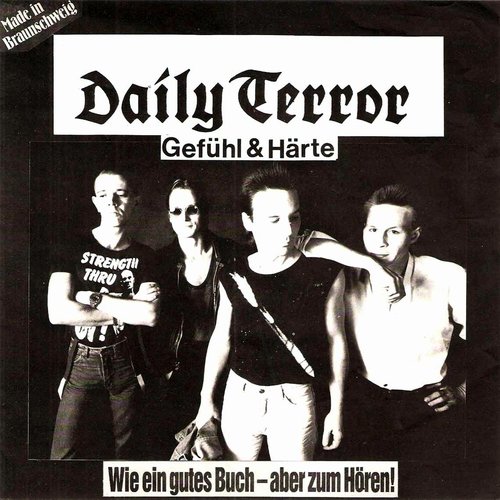
The new line-up’s debut release, the 1985 mini-album Gefühl & Härte – which roughly translates as ‘emotion and toughness’ – combined Pedder’s abrasive singing style with a solemn, dramatic rock style rarely heard in the skinhead scene.
The EP kicks off with the humming noises of an approaching bomber: ‘Dresden’ tells the story of a survivor of the city’s 1945 carpet bombing, who remembers the fateful “night of terror” forty years earlier in which he lost his mother. With its slow, eerie pace, descending chorus, bomb whistle noises and citations from Chopin’s ‘Funeral March’, Dresden’ masterfully captures the oppressive claustrophobia of its subject matter.
While there can be no doubt about the cynicism of mass killings in rich men’s wars, Pedder was now sending out mixed messages by singling out the Dresden bombing. In 1965, the German leftwing journalist and future Red Army Faction terrorist Ulrike Meinhof had written a poignant article on Dresden in Konkret magazine, exposing the bombing as a sordid war crime (among many committed in World War II). Little did she know that the historian whose estimate of up to 200,000 casualties she cited would later gain infamy as a Holocaust denier: his name was David Irving.
By the 1980s, it was well and truly established that Irving had based his estimate on hearsay and official nazi propaganda. Nonetheless, Dresden had become a cause celebre for German nationalists and the far right, who, for obvious reasons, dubbed it the ‘bomb holocaust of Dresden’. In fairness to Pedder, he never used this term, and his song’s guesstimate of “forty thousand dead” was closer to the official figure (25,000) than to Irving’s “between 100,000 and 250,000” (or “up to 100,000” from the revised 1971 edition of his book, The Destruction of Dresden).
This is more than can be said about Force of Hate skinzine, whose editor went into overdrive when reviewing Gefühl & Härte: “Just imagine: 250,000 people asphyxiated, slaughtered, and burned in only two days – dead! The fact that a German band has broken a major taboo by musical means for the first time ever is what impresses me most about Daily Terror’s latest” (FoH #4, 1986).
The album’s other war song was ‘Bis zum bitteren Ende’ (Until the bitter end). Its melody was based on the classical piece Vltava by Bedřich Smetana, a 19th century Czech romantic nationalist composer. It told the story of a young man enlisting in the army for “freedom and glory”. As he dies in the battlefield, his “last cry for freedom suffocates in a scream”. On the face of it an anti-war song, the tone is once again ambiguous: the pathos of Pedder’s delivery works against its ostensible message. Is the soldier’s death futile or a heroic act of self-sacrifice? Pedder screams that “his oath remained unbroken, he truly loved his country”. An ode to the soldier’s patriotism, or an indictment of those who sent him off to die? Quite possibly both.
Finally, there’s ‘Establishment’ and ‘Meineid’ (Perjury). The latter is about a football hooligan facing a few weeks in jail. The theme of class justice is fleshed out in a few succinct lines:
Dressed in black robes they look you up and down
Your testimony doesn’t interest them in the least
You embody a different world
Your cell is already reserved for you
Perjury shall be your oath
What good is a warrior for justice in these times?
A little masterpiece in my humble view, Gefühl & Härte further confused the band’s older punk fans both musically and lyrically. Karl Ulrich Walterbach, the ex-anarchist who produced the mini-album on his Berlin based AGR label, remembers Pedder thus: “I thought Daily Terror were ideologically shady by that point. Pedder was too closely tied to the skinhead and football hooligan scenes. To be honest, he gave me the creeps – even though he always pretended to agree with me”.
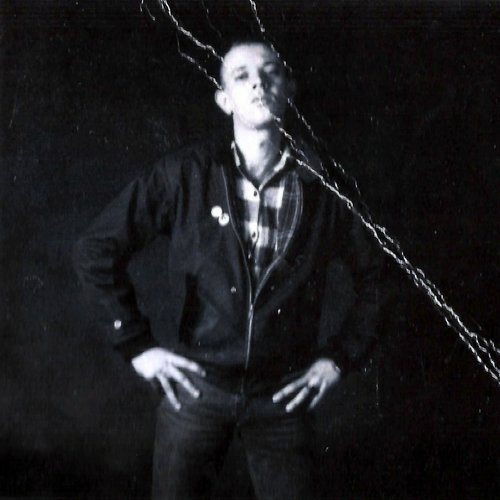
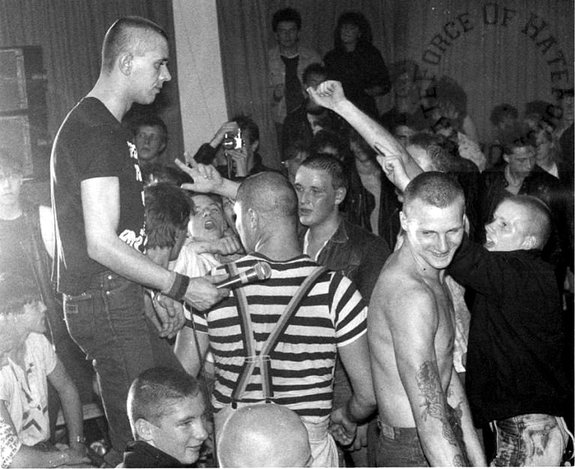
By 1985, all manner of people with rather tenuous links to the skinhead cult had begun to copy the image. That was especially true on the terraces, where hooligan firms such as Dortmund’s Borussenfront and kids who had only recently been heavy metal fans donned a ‘skinhead’ look. However, it’s important to note that the actual German skinhead scene, the first-generation hard core, was fairly small in those days. Gigs were rare, and most skins knew each other, or at least they had seen each other around.
After the Hanover ‘Chaostage’ meetings of 1983 and 84, which had cemented the uneasy relationship between skins and punks into permanent hostility, the motto was ‘all skinheads united and strong’. Aside from exceptions such as the Hamburg redskins who published the KB84/Reason Why zine and similar crews in Berlin, most skinheads heeded that slogan. Their attitudes ranged from apolitical and centrist to far-right. Patriotism of various shades and degrees provided a common reference point of sorts.
Having completed his transition, Pedder immersed himself in the skinhead scene, warts and all. He quickly became mates with all manner of folk – from the anti-political SpringtOifel to the likes of Endstufe, whose main lyricist Jens had clear fascist sympathies.
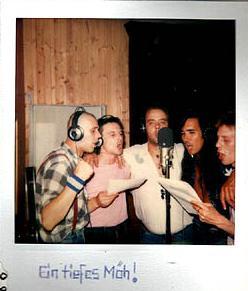
Pedder’s own views during this period are hard to gauge. Like most punks gone skinhead, he had certainly switched from ‘anarchist’ to ‘patriot’ , but – according at least to some who knew him at the time – probably retained some of his earlier leftist sentiments. Some of these views, especially those concerning the withdrawal of Allied and Soviet forces from Germany, were more compatible with his new peers than others. Consequently, he foregrounded them in songs and public statements.
In 2013, the German punk veteran and co-organiser of the original Hanover ‘Chaostage’ meetings, Karl Nagel, would write in a blog entry that he later deleted,
Pedder Teumer denied until the end that he’d ever been a ‘nazi’. Well, he had never been one. But the mobs he hung out with at Braunschweig FC matches and at Daily Terror gigs were chuck full of ‘patriots’ and nazis … Those were Pedder’s friends at the time, and when they got shitfaced together, he would shout many a German slogan, or even raise his right arm in the air. Which he later passionately denied, of course.
And so it happened that a royally shitfaced Pedder Teumer was caught in a compromising pose in August 1985: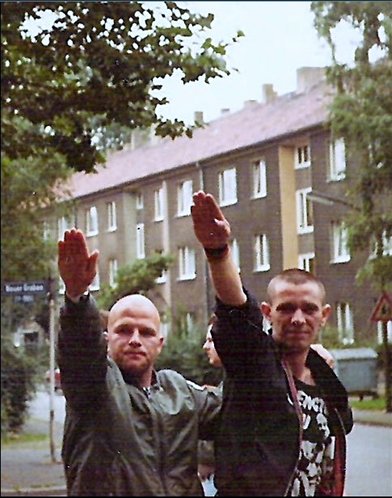
As an aside, legend has it that the gentleman next to Pedder, a bloke nicknamed ‘Schweinebacke’ (literally ‘pig’s cheek’, but meaning all kinds of things from ‘fat bastard’ to ‘dimwit’) was later jailed for six years for beating up a pensioner in Dortmund’s BVB football stadium, who suffered a fatal heart attack as a result. Charming fella.
The full picture: Ironically, the drunken salute occurred outside the Dortmund venue where Daily Terror had just played a benefit gig for children with severe disabilities and birth defects.
Click here for Daily Terror part 4: On a forlorn mission
 Creases Like Knives
Pingback: Until the bitter end: The story of Daily Terror and Pedder Teumer – creases like knives
Hello,
I was at the Daily Terror benefit gig for disabled children’s charity, Aktion Sorgenkind Festival in Dortmund, Germany.
It took place in April or Mai 1985, if I remember correctly.
Other bands playing there were Rim Shout, Idiots, Ausbruch and Torpedo Moskau.
About 300 Punks and the same amount of Skinheads were there, luckily no fights happening.
You can see me in the last live picture – I´m the punk on the far right w/ leather jacket turning his head.
Many greetings from Aachen City, Germany,
Karsten
LikeLike