The 1980s MA-1 explosion
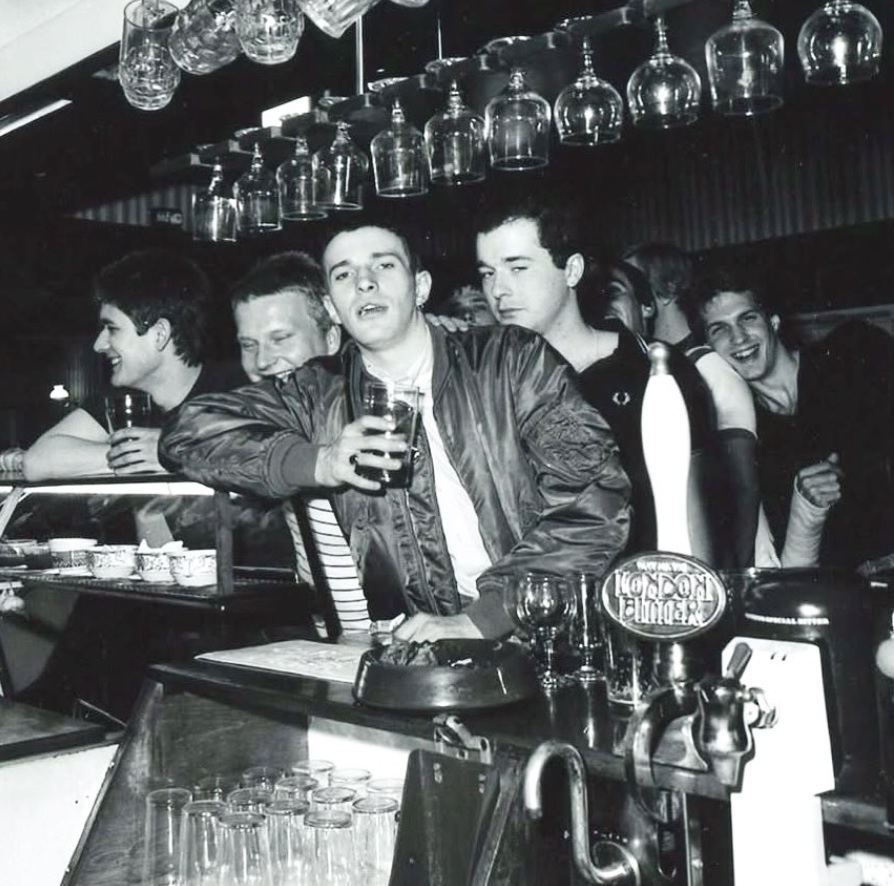
Almost immediately upon taking office in January 1981, the Reagan administration decided to massively increase the size and budget of the Pentagon, triggering a surge in demand from the Department of Defense. It led to a boom in military production, with $1.8 billion spent on clothing alone by the mid-’80s. As a side effect, many more MA-1s began to appear in military surplus shops in the UK and beyond. Micky Fitz from The Business sports a very tidy looking MA-1s, probably genuine military surplus, in photos taken in 1981 at the Lord Northbrook – a Victorian pub in Lee, South London, that is still open:
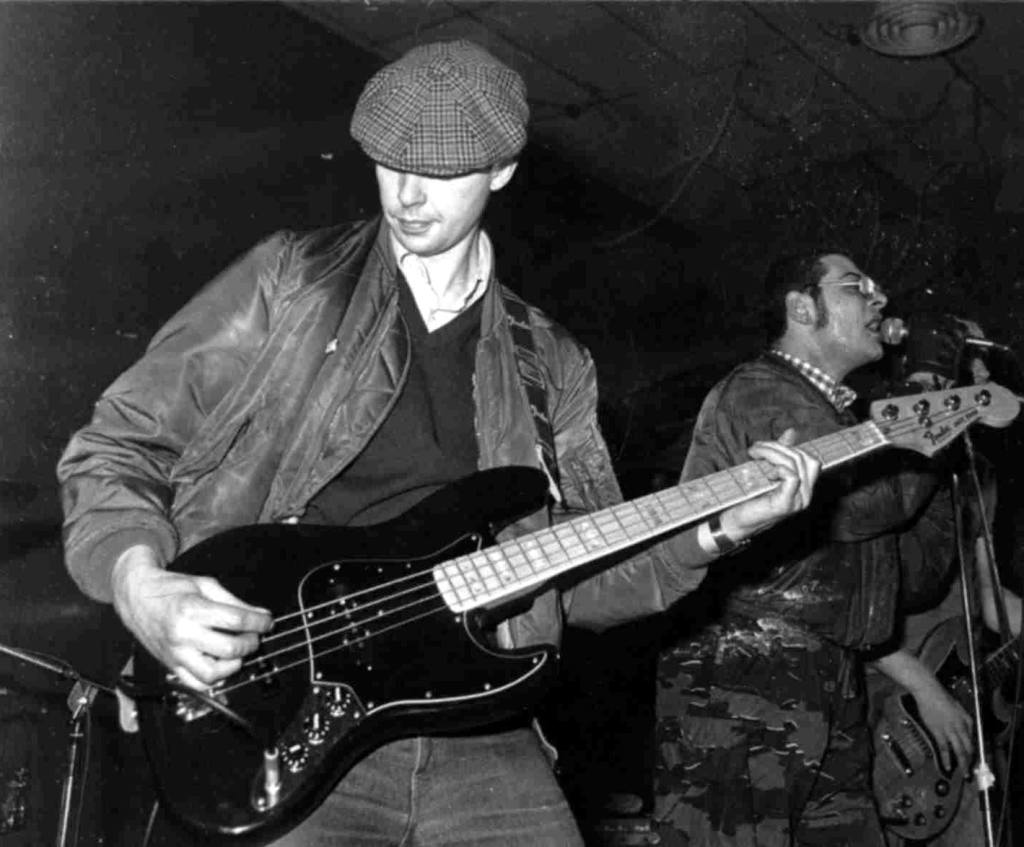
So do Arthur Kay and Roi Pearce from The Last Resort in the same year (although Arthur was a seasoned mod rather than a skin)
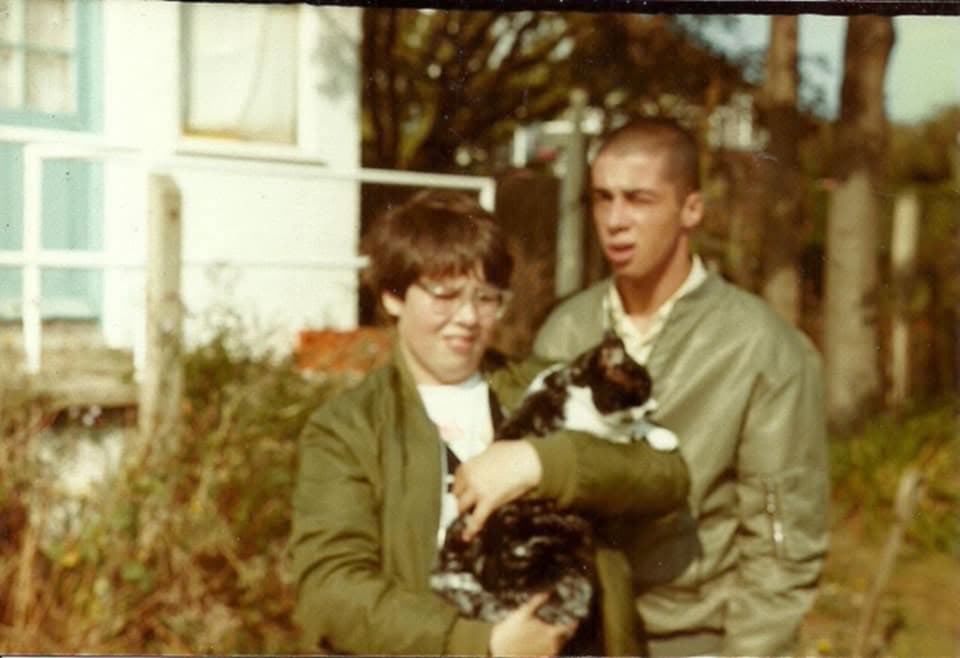
The jackets worn by most skins of the era weren’t necessarily real USAF surplus, though. As the market became flooded with knock-off copies, younger skins wore bombers scored at market stalls or at the outdoor retail chain Millets. David Rumsey from Ramsgate, editor of Tighten Up sussed-skin zine in the ’80s and now publishing the Spirit of ’69 zine, recalls: “I had a cheap one from Millets, as most did back then – we got a few bits from there, like Brutus shirts and the skull-cap type beanies we used to wear. Then I got an army surplus MA-1 – not sure of the make, but it was nice and heavy. Had a few cheap ones, then got an Alpha around 1983 or 1984, as the webbing had gone on the surplus one”. Here’s a photo of David wearing his Millets jacket in what he believes was the summer of 1981, together with his sister in a market-brand version:
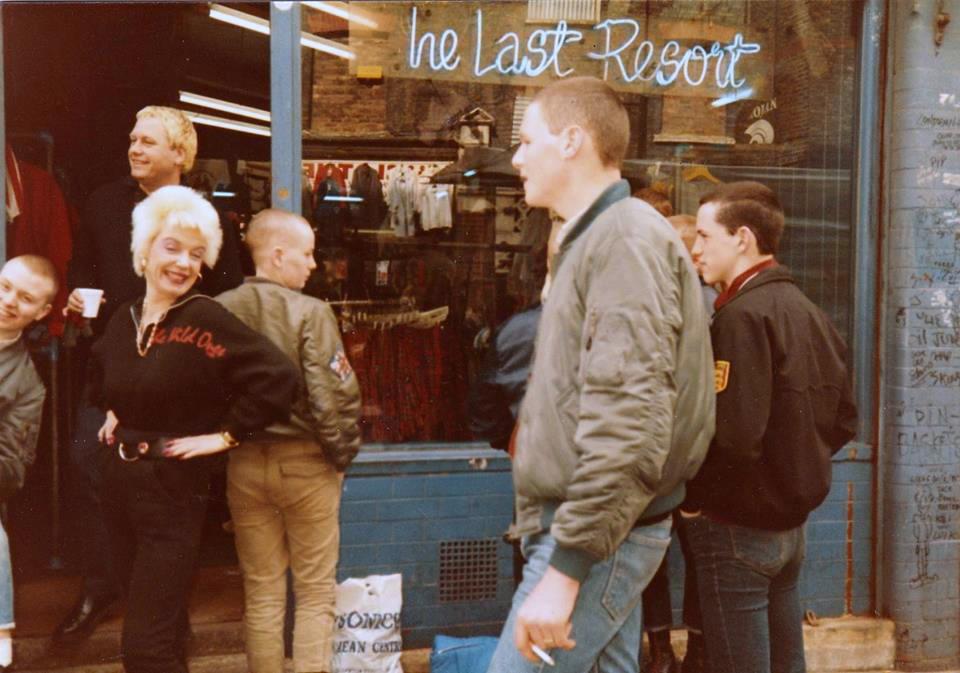
And here we have Symond Lawes from Wycombe again. He’s on his way back from The Last Resort shop, sporting his freshly acquired first true MA-1 in 1981 or 82.
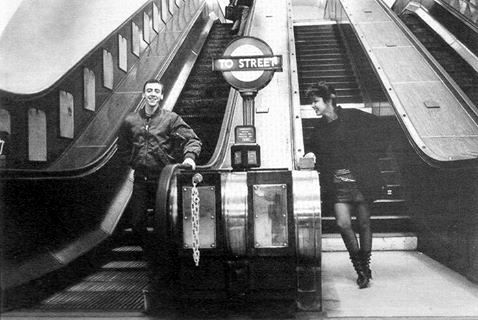
“The jacket in the picture is the first proper flight jacket I owned”, Symond says. “I think it was USAF… It was an army green MA-1 and had the military stamp on the inside pocket. The Last Resort did sell knock-off shit, but sometimes got hold of the real deal. This is the day I bought it – the picture was taken by Gavin Watson near St Paul’s Cathedral in London. We would often wander around causing havoc and sneaking into tourist places… The girl I’m with is Kelley, a mixed English/Pakistani punk girl”.
From about 1982 onward, we witness an explosion of MA-1s on the British skinhead scene. By 1983, they were absolutely dominant and began to displace traditional skinhead staples. Steve from Coventry remembers:
“Like just about everyone my age in Coventry, I was into 2 Tone and had been wearing Fred Perry, Levi’s shrink-to-fit, 6-hole DMs, Sta-Prest, Harringtons and Crombies from 1979/80 onwards. By the time I got my hair cropped in 1982, that was all a bit old hat. While the masses had moved on to legwarmers and The Kids From Fame, the skinhead look evolved and became more of its time. For me, MA-1s tie in with the end of 2 Tone, which in Coventry was dead and gone by 1982. We called them pilot jackets, and they were part of the look that came in around then: stretch jeans turned up half an inch over half an inch of white sock, worn with 14-hole black DMs. In hindsight, that’s what differentiated skinheads from then on”.

In Coventry, genuine USAF jackets were seen – but there too, not everyone wore the real thing. Steve recalls:
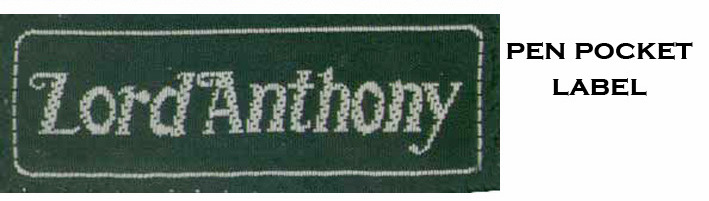
“The city centre lot would generally be wearing military surplus MA-1s, which were more difficult to get and had to be sought out. But the younger, the less committed and girls would be wearing repros from places like Millets, the most derided being the ‘Lord Anthony’ brand with the external tag”.
And what about himself?
“I started out with a Millets repro but that soon got supplanted. I spent weekdays in further education in Birmingham so I got mine in 1982/83 at an outdoor shop that carried some surplus called Oswald Bailey located at the far end of the Bullring shopping centre. After several visits looking longingly at their wheeled rack of fifteen or so surplus MA-1s in various sizes and shades of green, I took the plunge and paid I think £20 which was most of my money for a week. From then on, it was loaned out to girls who would return it freshly washed and dried. I think one of them even ironed it!”
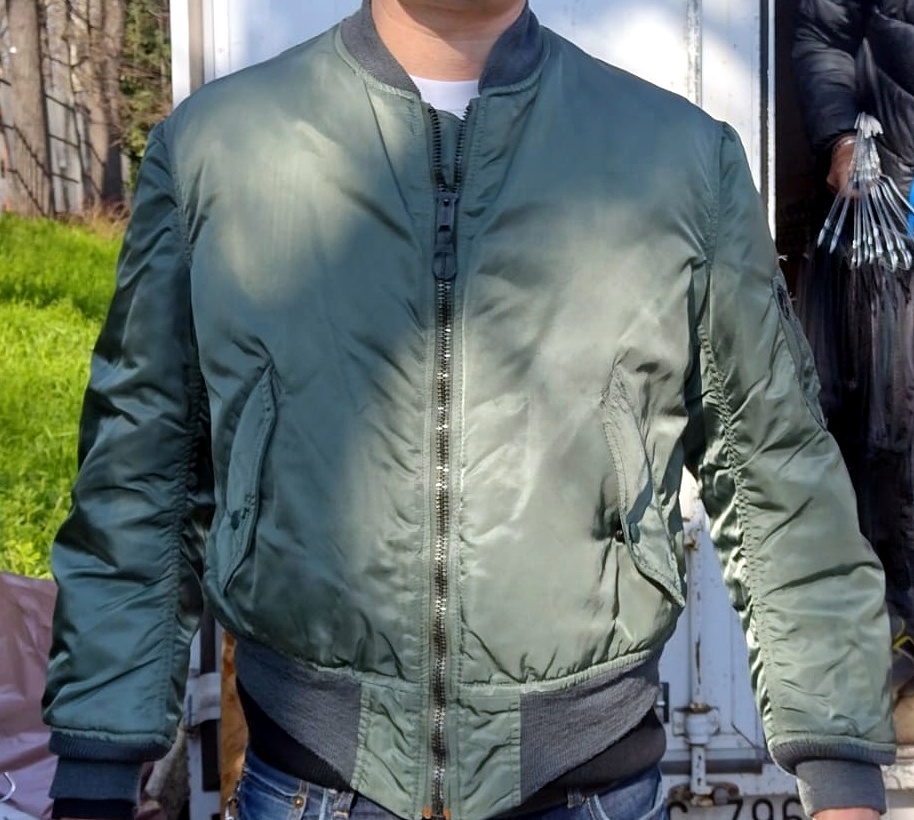
A characteristic feature of true military-issue bombers found in surplus stores at the time was that they came in slightly different shades of green, with the collar, waistband, and cuffs often darker than the body. Steve’s jacket was no exception:
“Mine was a shade of green somewhere between sage and olive with collar, hem and cuffs a darker shade still and it fitted perfectly, the layers of inner, lining, and outer passing sleekly over each other as you put it on, which made you difficult to grab hold of if you ever got into a situation”.
An early ’80s Alpha I tried on at a street market matched Steve’s exactly:
This variety in shades can also be seen in pictures of the 1982 Panther-era 4-Skins line-up, where band members are wearing MA-1s in different greens.

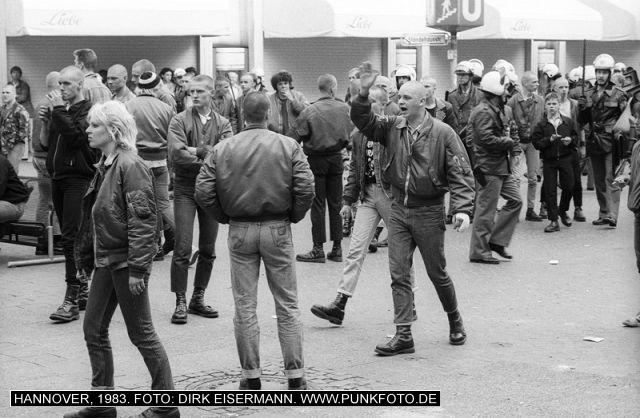
By this time, skins in places like France and Germany had taken to MA-1s:
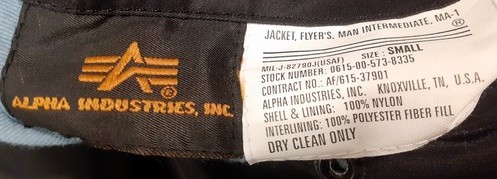
Virtually all skinhead flight jackets were green at the time. In parallel with rising demand for the F-series MA-1 from the Department of Defense, Alpha Industries was also transitioning from a supplier to the US military into a global brand offering military-inspired apparel for the general public. At some point during the late ’70s or early 1980s – the exact year is hard to pin down – the company began producing civilian MA-1s intended for the consumer market. At first, these closely followed the military specifications. Alpha then introduced the fictitious military specs codes MIL-J-82790 E and later MIL-J-82790 J for its commercial MA-1 jackets, allowing for deviation from actual military standards in terms of materials, colours and other characteristics. In time, the civilian models were further distinguished by the addition of three vertical lines on the inside label.


Alpha has continued to use the MIL-J-82790 J code for its civilian MA-1s to this day. These jackets could at best be described as “inspired by” the specifications of the past. Generally, they are great deal lighter than the original military-issue jackets. Once Alpha’s commercial production really got underway, MA-1s in colours such as black and maroon appeared on the market. Chas from Madness wore a black one in the video for ‘House of Fun’ in 1982:

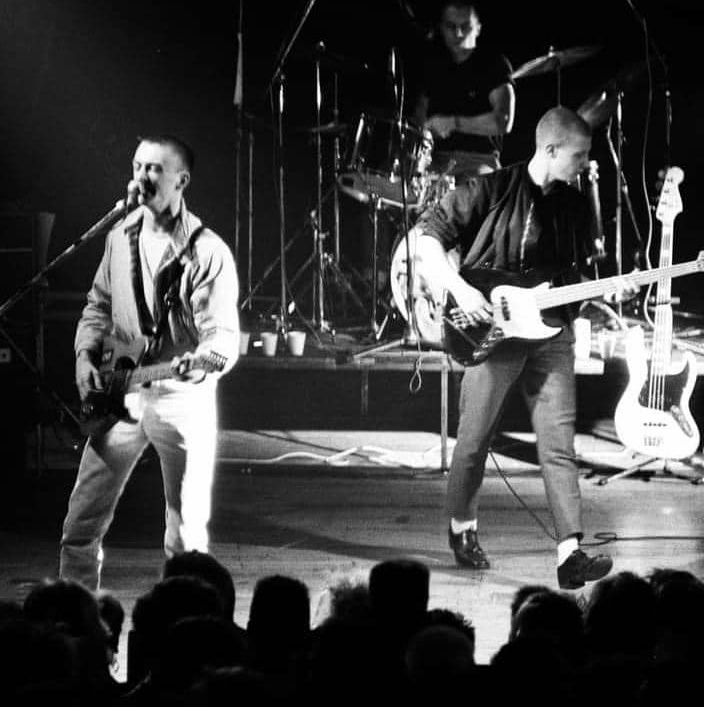
In 1984 or 1985, members of the Redskins deliberately began wearing black MA-1s – precisely to stand out in a sea of sage green and olive worn by other skinheads. Says Martin Hewes, the band’s bassist: “When I bought this it was because it was different. Loads of people were wearing the green ones and I had never seen a black one before. I always thought the green ones were a bit tatty and had never considered wearing one. I preferred a Levi jacket or sheepskin in the winter”.
Martin can be seen sporting his black flight jacket here:
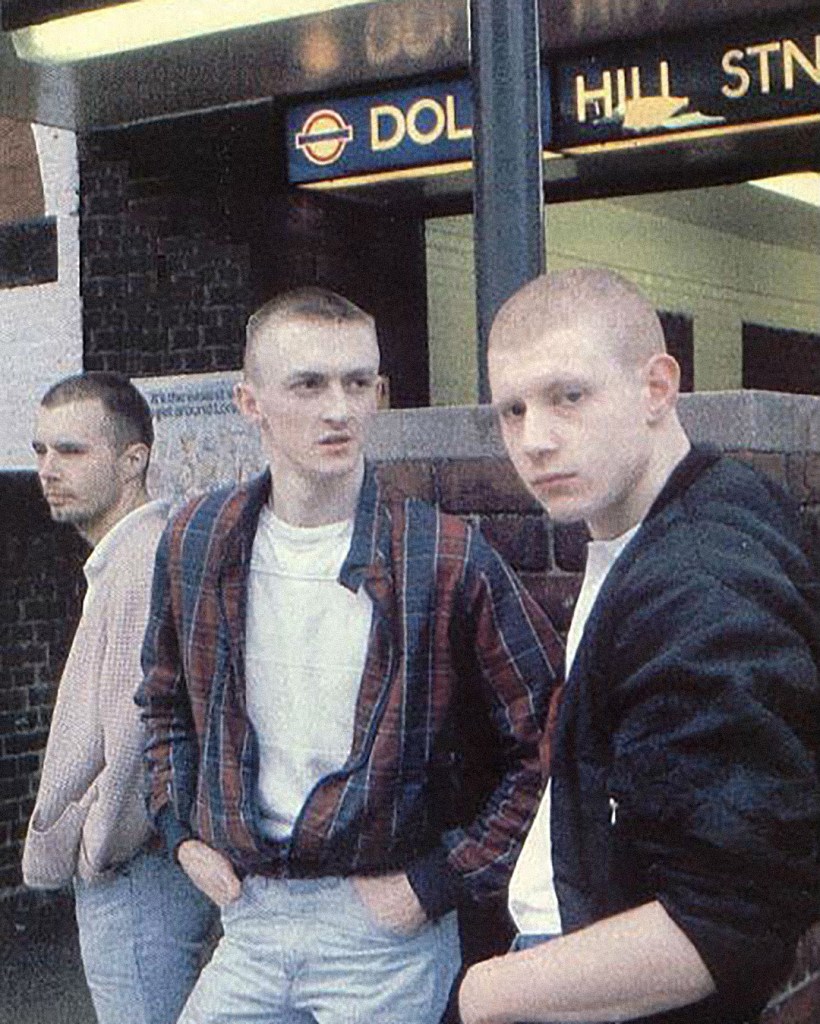
And the other band members? “They just copied me as I was wearing the jacket for at least a year before both Chris and Paul turned up in them”, Martin says.
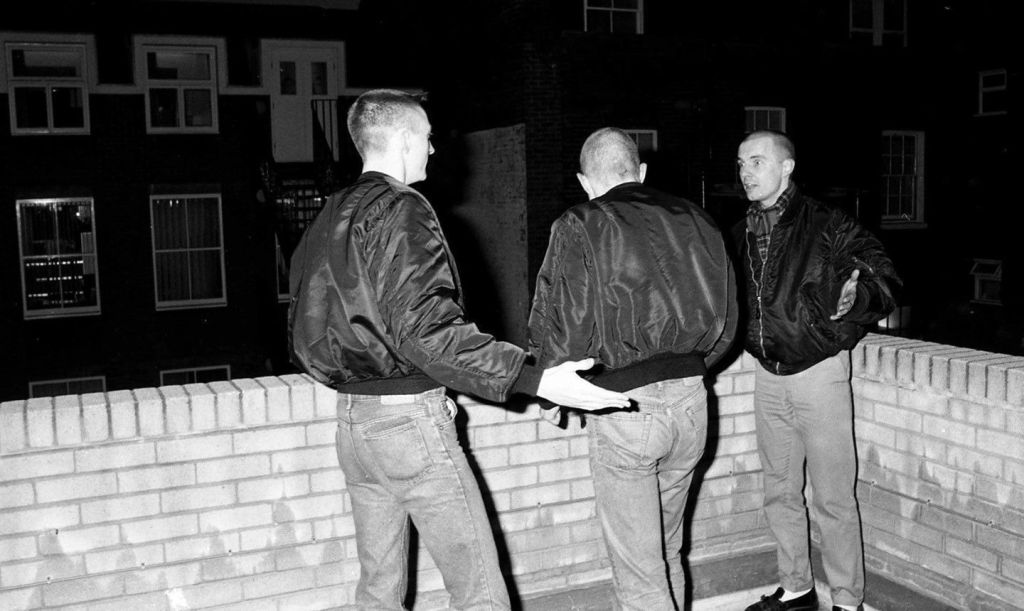
“I think I bought it in the West End (London) and it was probably a ‘no-name’ one”, he adds, “although it was good quality and lasted for years. It’s so long ago now that it’s hard to remember details, though”.
Here’s a shot from a live show he played in that jacket:
But around the same time – or shortly after – Skrewdriver adopted black MA-1s as a sort of fascist band uniform. They can be seen wearing matching black flight jackets on the back cover of the Blood and Honour album from 1985:

I don’t subscribe to the bullshit ‘horseshoe theory’ in politics, but it does hold with respect to MA-1 colours in the second half of the 80s:

Joking aside, Steve from Coventry saw a similar development in his neck of the woods: “I remember a mate in a dark blue MA-1 around 1984 or 85 – and someone in a petrol blue repro around 1984, but never saw anything that looked surplus in that colour. Then NF/Skrewdriver types in black ones from around 1986. Were they proper surplus? I don’t know. They looked like it, but by the time the MA-1 came into fashion around 1990 they no longer were”.
In reality, black MA-1s were never military-issue – not in 1990, nor in the ’80s. But in the second half of the ’80s, they well and truly became part of the Blood & Honour uniform, often complemented by black boots and sometimes black cargo trousers as well. Just to be clear, I don’t wish to suggest that flight jacket colours had ‘meanings’ in the way that journalists have mythologised lace colour codes. Countless skins who wore black MA-1 jackets had nothing to do with white power politics. David Rumsey of Spirit of 69 zine, for instance, also had a black one but was into the Redskins – “It kept you incognito, especially in London”, he says. Conversely, some Blood & Honour supporters continued to wear sage green. Nonetheless, in the late ’80s and early ’90s, there was a clear preference for black flight jackets among Britain’s boneheads – a trend closely mimicked by the fetish skin scene emerging in Britain around the same time.
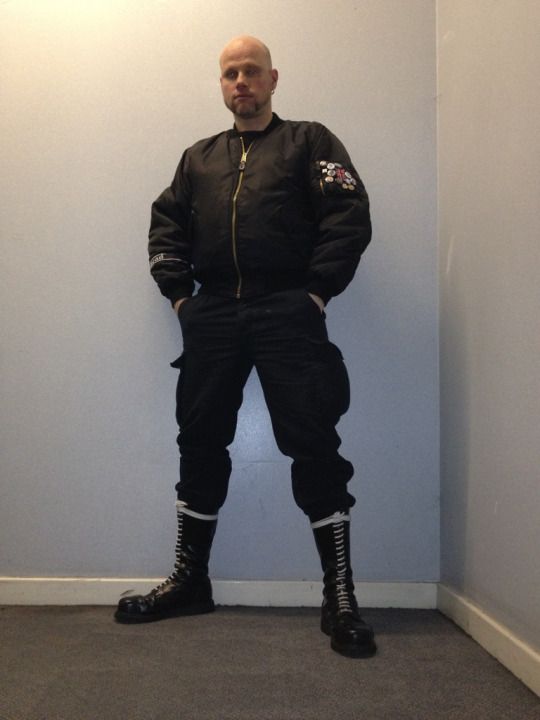
And while the Redskins’ choice of black may have been more or less incidental, it’s not difficult to see why the colour appealed to their opponents on the other end of the spectrum. Black carries historical associations with fascism – think Mussolini’s Blackshirts or the parade uniforms of the SS, whose journal was named The Black Corps. But even beyond these references, a black MA-1 simply looks more aggressive, more paramilitary, more ‘authoritarian’ than a classic sage green one – or, put another way, like something issued to elite troops rather than to regular USAF pilots or ordinary soldiers. All of this fits neatly with the neo-nazi self-image.
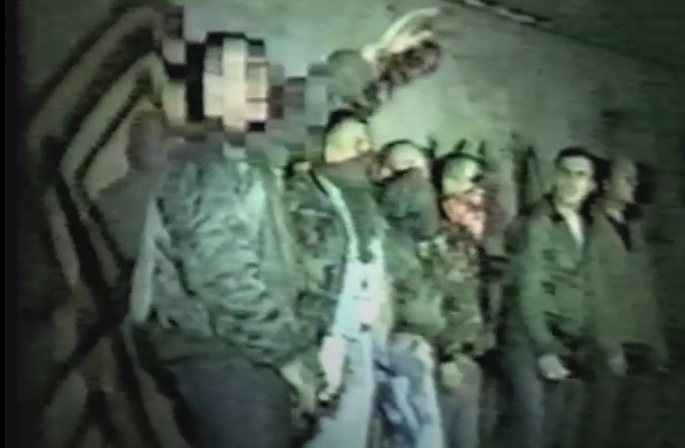
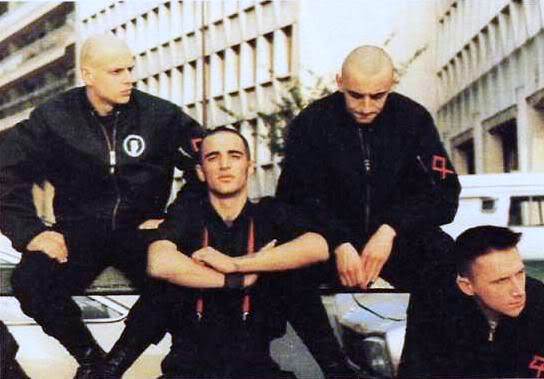
Incidentally, the trend for black also made its way to the European continent, though with varying degrees of delay. In a French TV report from 1986 about the band Evil Skins and their entourage loitering around the Luxembourg area of Paris, most of that crew are still wearing sage green flight jackets (a colour initially also worn by rival redskins, who would simply reverse their jackets to the orange lining and recognise their own in pitched battles). About a year after the TV report, the Evil Skins were photographed sporting a new Blood & Honour-inspired image – dressed in black from head to toe. A truly dismal look for any skinhead:
But the most embittered opponents of Paris’s right-wing mobs in the late ’80s and early ’90s also began wearing black flight jackets: the Red Warriors street gang, who emerged from the security crew of the punk band Bérurier Noir and took their cue from the skinhead look while also incorporating other urban influences:
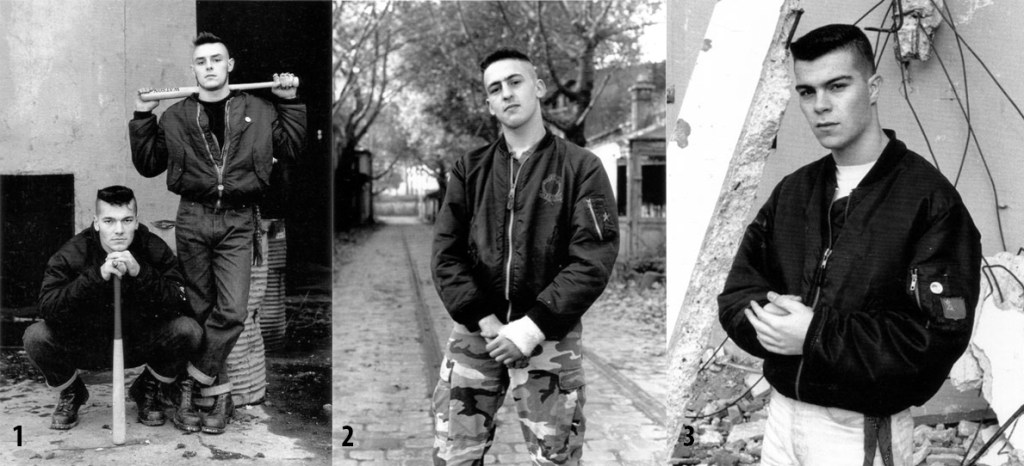
A similar development occurred in Poland a few years later. As ‘Trojan’ related in my four-part interview about Polish skinhead history, “As we moved into the ’90s, pseudo-American flight jackets with orange lining (known as bombery, flyersy, or fleki in Poland) became popular. At first, it was green jackets but as neo-nazism became the dominant trend, black ones became more common”.
Despite all that, I like black vintage MA-1s – even if you can never quite shake off the right-wing connotations. Wearing mine out in Bologna recently, I had someone approach me and ask if I was a member of CasaPound, which isn’t something that happens to me often… Paul Thompson, the original ’60s South-East London skinhead who never got a flight jacket back in the day, now also owns a black MA-1: “I couldn’t give a toss about Blood & Honour”, he says. “When people ask me, ‘Why are you dressed like a racist?’, I answer, ‘I’m not. The racists are dressed like me!’”
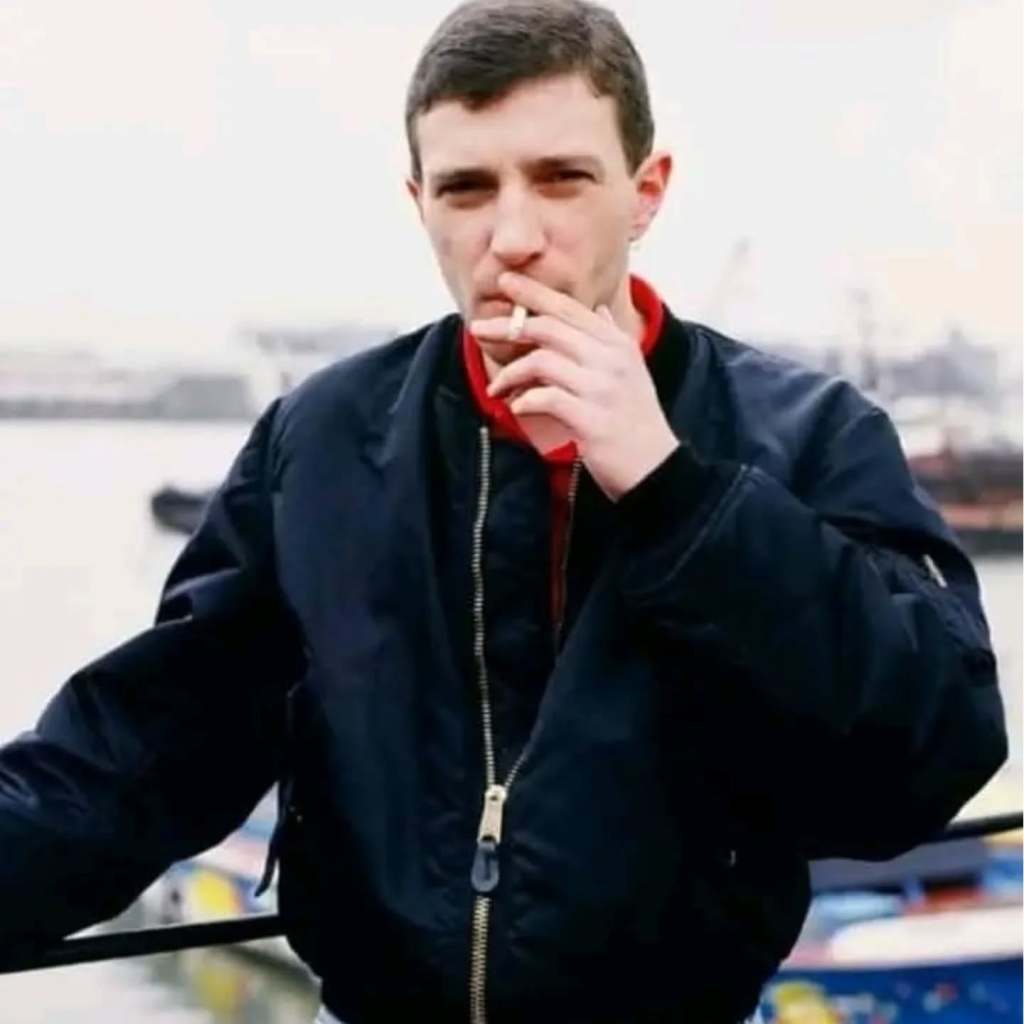
In any case, even in 1988, when Blood & Honour was at its peak, Micky Fitz showed that you can pull off a black MA-1 without looking like a member of Skrewdriver Security:
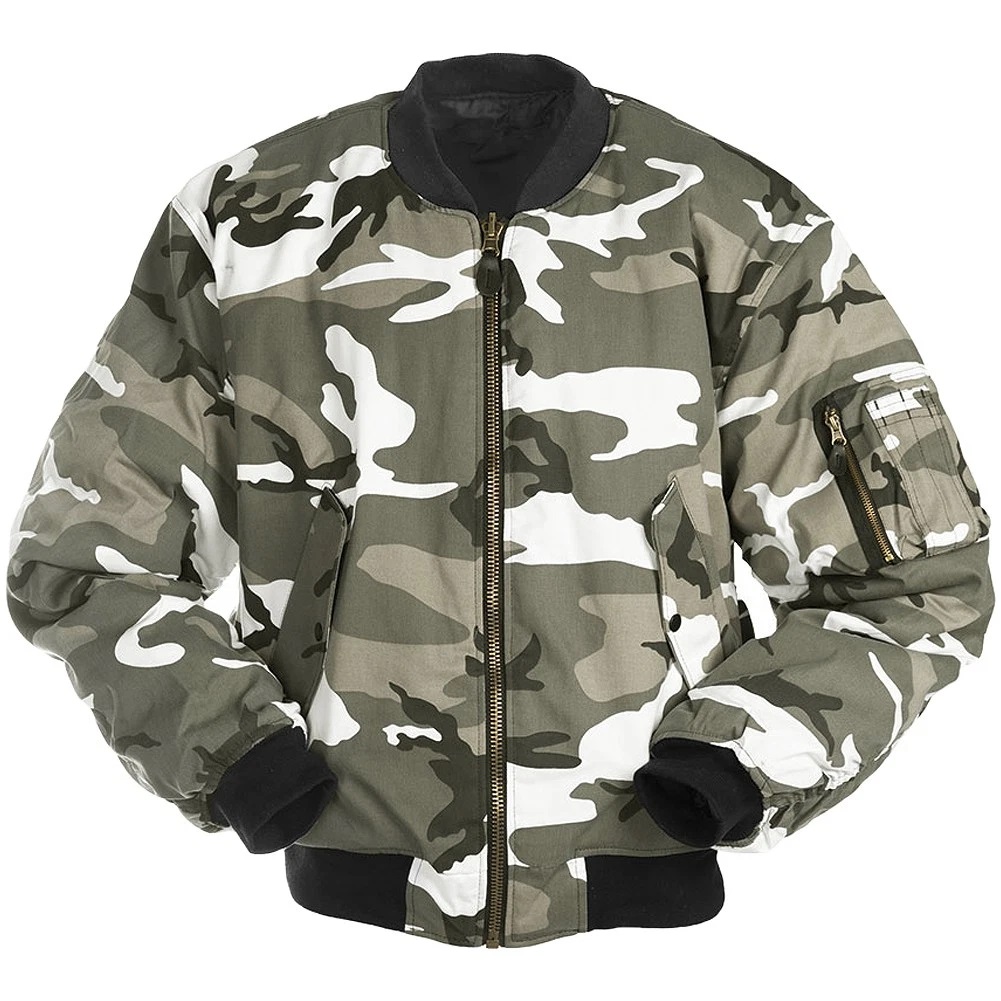
For me anyway, the Blood & Honour uniform of black flight jackets was something I only found out about much later. I grew up in a time and place where nazis wore jackets in all sorts of colours – even garish ones like silver – but generally tried to look as ‘military’ as possible. They were fond of patterns like snow camo (perhaps as a wistful nod to Stalingrad, where their heroes were sent packing for good) and often sported Frankenstein creations that had never been seen in an actual military context – like this one:
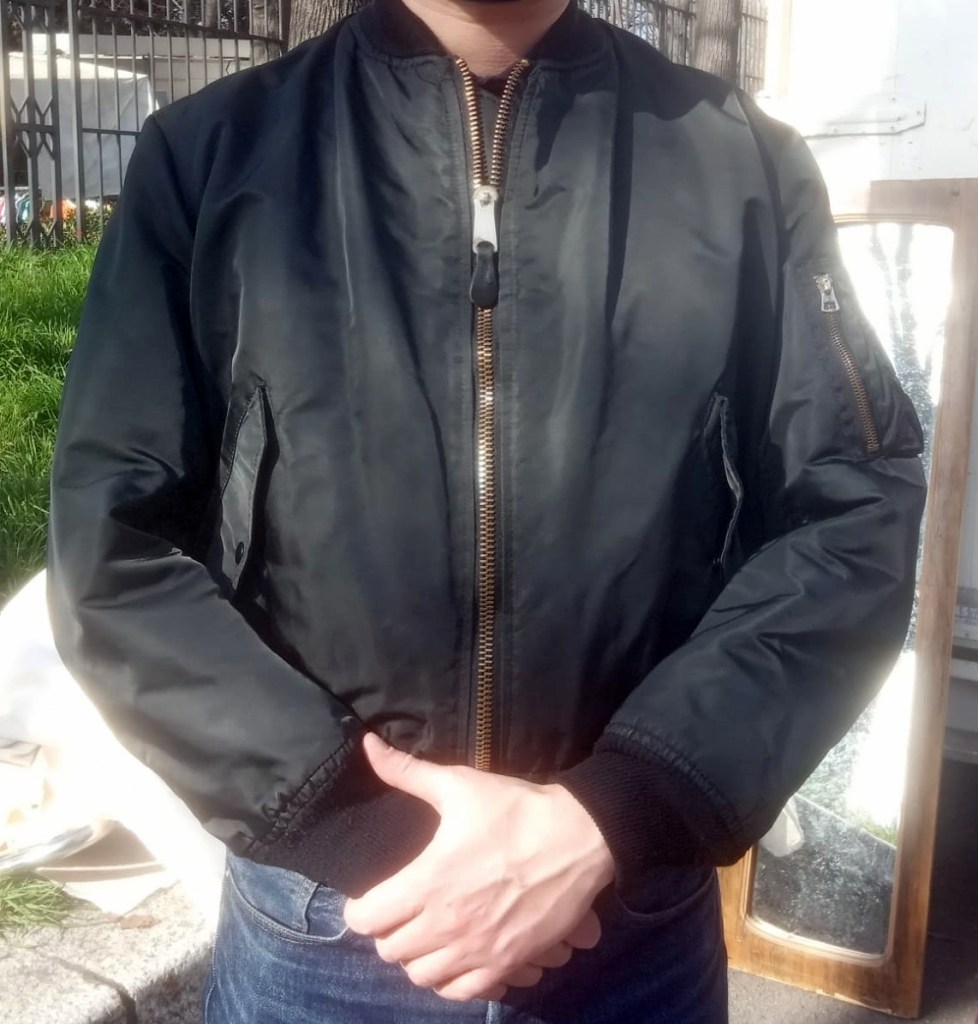
As for black MA-1s, what’s key from my point of view is the more matte finish typical of vintage Alphas from the ’80s and ’90s. A modern sage green Alpha might still look decent, but a black one made from their current super-shiny nylon has a cheap and nasty appearance – like something you’d find in a bargain bin, despite now costing over 200 quid.
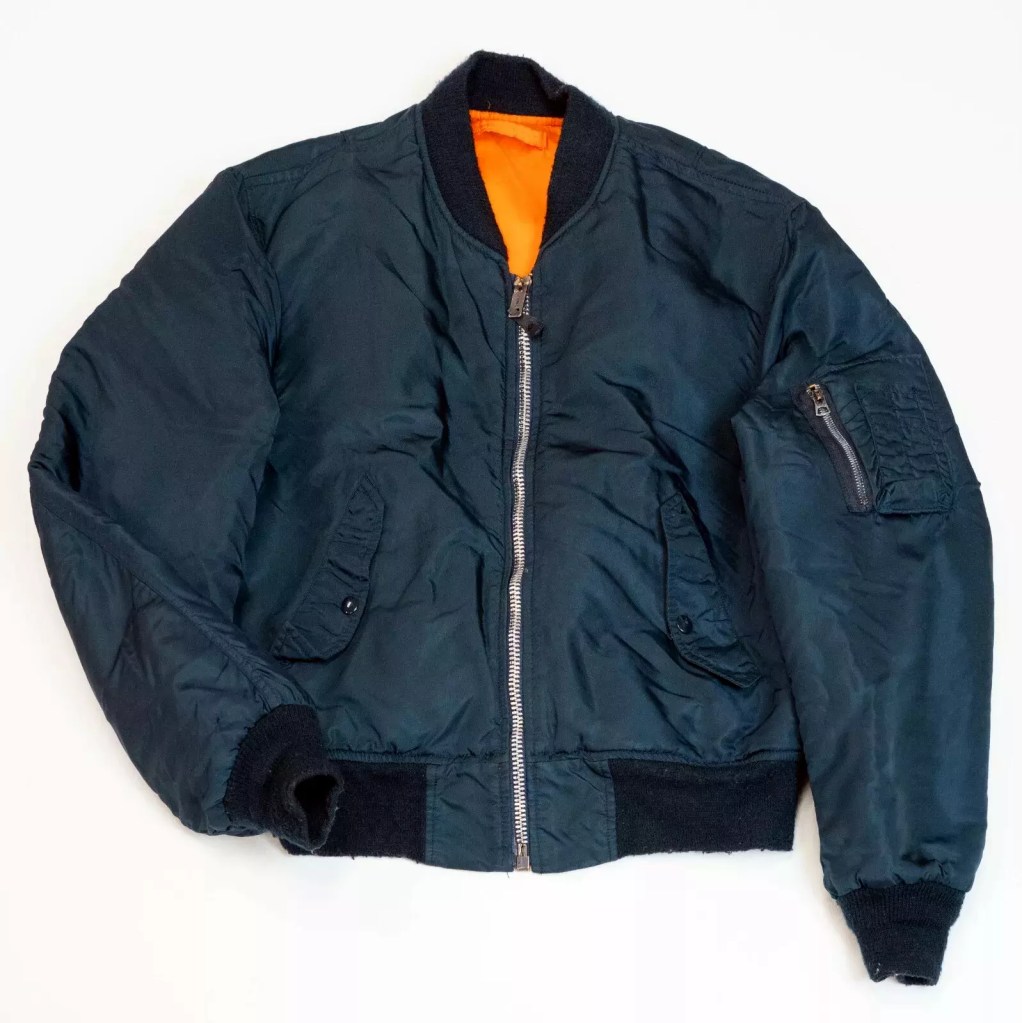
As for other colour variations, the original midnight blue – now known as Alpha Industries’ ‘replica blue’ – looks spot on to my eyes. It has a clean, diciplined, uniform-like appearance and pairs great with oxblood footwear. Still, the classic sage green – especially the slightly greyer vintage shade – is hard to beat.
Since the late ’70s, various manufacturers have released flight jackets in a greenish navy – also known as petrol blue, though listed simply as ‘navy’ in Alpha Industries’ current catalogue. It’s alright, but it does feel slightly more fashiony. I much prefer the midnight blue.
Burgundy MA-1s aren’t bad, but they’re not my go-to. On a flight jacket, that colour feels too over-the-top ‘skinhead’ – it’s trying too hard. There’s an interesting anecdote linked to burgundy MA-1s, though: apparently, they were worn by redskins in East Berlin around 1990. In November 1990, the German news magazine Der Spiegel published an interview with a neo-nazi street gang that hung around the Berlin-Lichtenberg train station:
GANG MEMBER: It’s always us who are getting attacked. On 2 October, the redskins whacked me on the head with a club so hard that the gash still hasn’t healed.
INTERVIEWER: Who are the redskins?
GANG MEMBER: They’re left-wing skins, also from the East. They wear these burgundy bomber jackets and burgundy boots.
INTERVIEWER: And why did the redskins attack you?
GANG MEMBER: We were at the central train station, waiting to meet a few people from Hamburg. The redskins just walked past us and said, “Hey lads, hang on a sec”. Then they pulled out their clubs and started smashing us on the heads straight away. Even the girls.
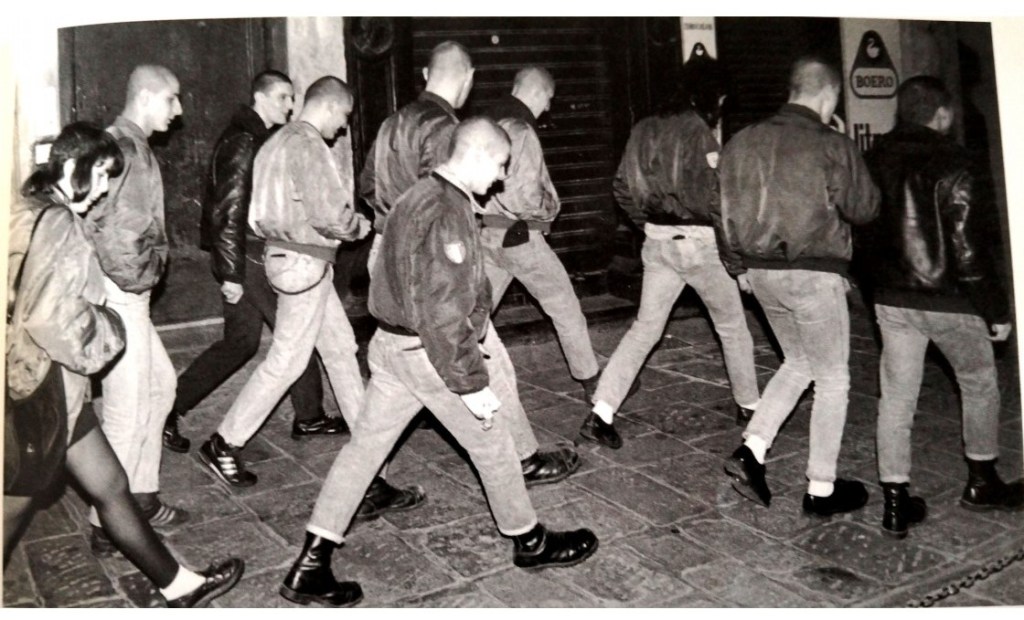
Speaking of girls, I’m not aware that Alpha made women’s sizes of their MA-1s in the ’80s or ’90s, so skinhead girls would just wear the same jackets as the lads. That’s also how Guendalina Buonavita, interviewed elsewhere on our blog, remembers it. Here she is, marching through Genoa’s town centre in March 1992 with her friends while sporting a huge bomber jacket.
And here’s another photo of Guendalina in her green MA-1 with friends, shot in early 1993:
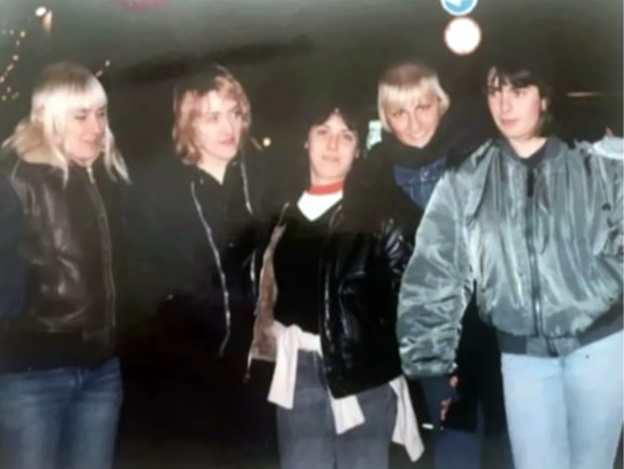
Today Alpha Industries produce not only women’s sizes, but also slim-fit MA-1 variations for women – and I’ve got to admit they don’t look half bad on them.
The MA-1 as a consumer item: the ’90s
In 1988, the MA-1 was phased out for USAF pilots, who from then on wore only the CWU 36/P and CWU 45/P flight jackets – the type seen in Top Gun, the 1980s cult classic of the gay community. That same year also saw the introduction of the final military-issue revision of the MA-1: the MIL-J-8279G type, designated exclusively for ground crews. In some ways, this version brought things full circle: the G-jackets featured blackened brass zips and were sage green inside and out, just like the 1950s models. The key difference was the quilted inner lining, similar to that of the M-65 field jacket liner. The MIL-J-8279 G remained in production at least until 1998 – with one Alpha Industries contract dated 3 January 1994, and another, also from Alpha, dated 22 July 1998.

Sometime in the latter half of the ’80s, Alpha Industries introduced its first real logo, sewn next to the specifications label on its civilian MA-1s. If you find this inside the left-hand pocket, your jacket dates to early 1992 at the latest:

Later that year, the logo was replaced by the ‘flying A’ that Alpha uses to this day:
By the early ’90s, the Cold War was over, and the liberal decade meant to bring about the “end of history” – though that never quite happened, did it? – had begun. With Department of Defence contracts sharply reduced, Alpha Industries shifted its focus from being a military contractor to mainly targeting the civilian market. The MA-1 became very trendy during this period. Take, for example, the video for ‘Move Your Body’ by Xpansions, a highly successful house track released in 1990, which features the keyboardist sporting a black MA-1. Flight jackets began appearing in clubs and streetwear circles.
With military production limited to the MIL-J-8279 G ground crew model, all ‘classic’ MA-1s with orange lining made after 1988 were purely civilian products – in the case of Alpha Industries, tagged MIL-J-82790J. Knock-offs in all colours also began appearing in droves in fashion chains like H&M.
Sometime in the mid-to-late 1990s, Alpha Industries changed its sizing – what had previously been labelled as Large was now relabelled as Medium, and so on (so make sure to size up for vintage jackets made before the mid-’90s). Along with this shift, MA-1s generally became bulkier, no doubt influenced by the oversized fashion trends of the time. The styles of the ’90s were grunge, hip-hop, rap metal, skate punk, and gabber techno, among others – none of which were known for their form-fitting fashions. Most skinheads – and there was a lot of new blood in the ’90s – simply continued buying whatever MA-1s Alpha Industries produced.

As globalisation accelerated in the late 1990s and early 2000s, Alpha Industries shifted production from its original base in Knoxville, Tennessee, to China and other parts of Asia. While there may be some truth to the idea that the company’s standards declined somewhat during this period, the reality is that the quality of civilian-issue Alpha MA-1s was highly uneven in the 1980s. I own two civilian Alpha flight jackets from the late ’80s. One, in black, is fairly heavy for a civilian MA-1 and made from robust nylon – it feels more like gear than fashion. The other, in sage green, dates from the same period and was ostensibly produced to the same specifications, yet it is much lighter, flimsier, and saggier – like many 1980s to mid-’90s civilian Alphas I came across.
There are several possible explanations. Alpha Industries relied on multiple subcontractors, which may have sourced different grades of material. The company may also have produced lighter, spring-weight models alongside heavier cold-weather versions, or cut corners on certain production runs. My suspicion, however, is that Alpha was still experimenting with different types of nylon for its civilian MA-1s, only later settling on the fabric it continues to use today. For me, the mid-to-late 90s are something like the golden age of civilian Alphas. Quality becomes consistently solid, the cut remains traditionally cropped without the aggressive sleeve tapering seen on today’s ‘Heritage’ model, and whether a jacket was still made in the USA or already produced in China makes little discernible difference.
Today’s MA-1s
Alpha Industries has continued producing MA-1s for the consumer market. Every now and again, the company will throw some quality replica on the market, such as this excellent 1968 Naval Aviation D-series reproduction, manufactured in the Knoxville factories exclusively for the Japanese market in the ’90s :
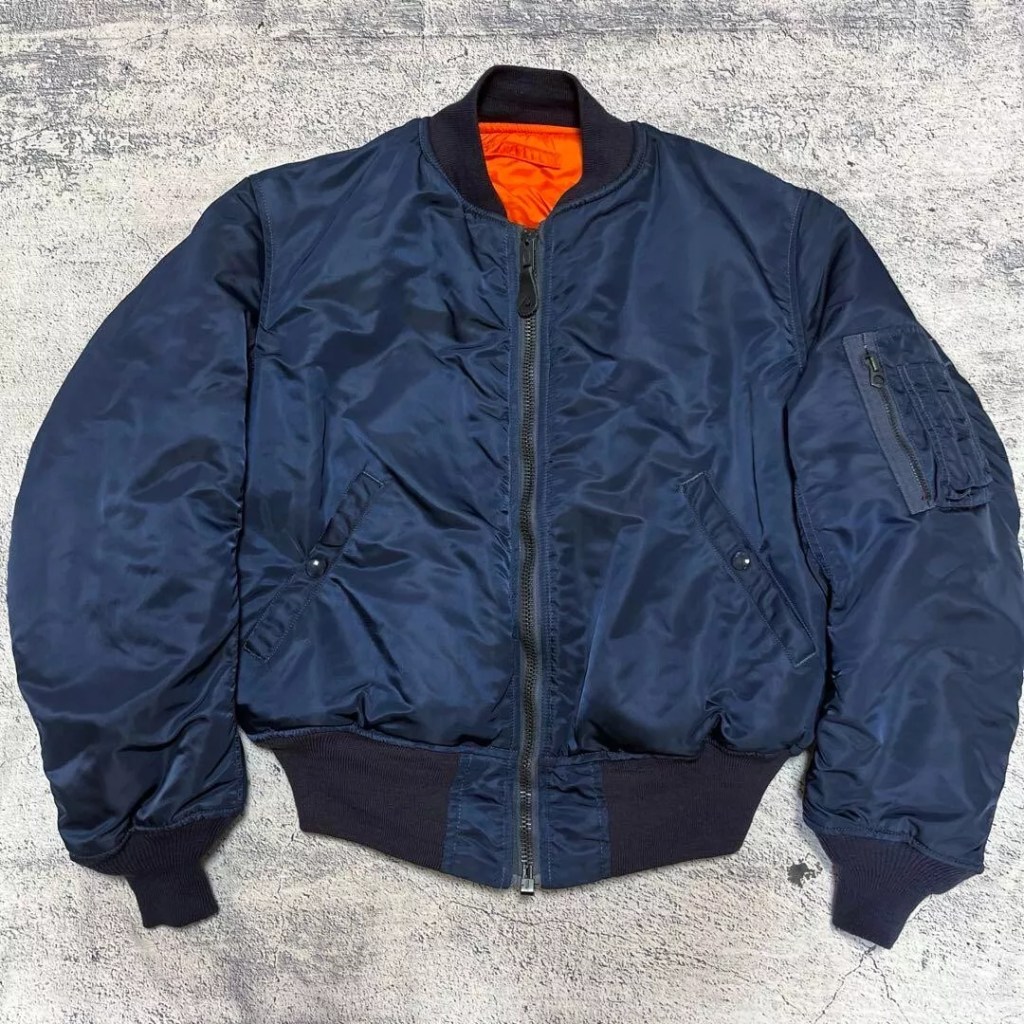
These jackets were of such high quality that Japanese Air Self-Defence Force officers often purchased them privately from air base stores and wore them on duty. As long as the rank insignia and name tag were correctly positioned according to the dress code, this posed no problem.
Hower, I’m not enthusiastic about Alpha’s mainline models. Besides the shrink-wrap VF59 we discussed earlier, Alpha also offers the ‘Heritage’ MA-1, designed to echo the more generous proportions of the classic versions. It’s not a bad jacket if what you want is a functional, low-key bomber for everyday wear – but it completely misses the cropped, sharp-edged USAF pilot look that the MA-1 maintained into the early ’90s. The elongated body of the ‘Heritage’ Alpha, tailored to modern lower-rise waistlines, throws the proportions off for me. It’s puffy but tapered at the sleeves, and paired with the rather thin outer fabric, the padding gives the jacket a bulbous, shapeless look, especially when worn open. The late ’90s Alphas were better structured. Again, it’s not a terrible jacket – but it looks polite and lacks edge. Hardly worth the 200-plus quid they’re charging for it now.
Moreover, while even a budget or off-brand version can pull off a more authentic look in sage green, black suffers more when done cheaply. A black MA-1 in the super-shiny nylon Alpha uses nowadays looks like a puffa jacket in denial – or like you’re trying to look hard at a school disco. If black’s your colour, I’d recommend hunting down a vintage one instead. They were often made from higher-denier, thicker, more tightly woven nylon, which gave them a tougher, more substantial look.
Beyond Alpha
As for other brands, I don’t like Schott – too normie-looking, and with too much branding going on. There are cheaper alternatives to Alpha – Mil-Tec, Brandit, and the like – and maybe it’s unfair that I don’t trust them without having tried them. That said, a shout-out is due to Rothco MA-1s, since Karl from Montreal Oi band Force Majeure recommends them on utilitarian grounds: “Rothco flight jackets – which are ubiquitous in North America – are less puffy and balloon-like than the recent Alpha ones and very warm, which is important in Québec. Plus they’re cheap, so no tears if one gets wrecked at a gig or in a scrap. Function rules!”

Cockpit USA offer a ‘premium’ version of the MA-1, but it’s not clear from the description in what ways it differs from Alpha and the rest, other than being made in the USA. Does it follow the original military specs more closely? And if so, which revision? Does it ditch modern waistline fashions in favour of a classic cropped cut? It’s anyone’s guess.
What is clear, though, is that the interlining is 100% polyester rather than wool. At nearly 400 bucks a jacket, that feels a little cheap. And judging by the pictures, it’s a fairly horrid slim fit – which sits somewhat awkwardly with Cockpit USA’s claims of ‘authenticity’.

Avirex used to do detailed and affordable repros of classic USAF flight jackets in the ’80s and ’90s, but its latter-day ‘Commercial’ model promises to be “updated with a wider and more modern silhouette”. You know what? I don’t want updated or modern – I just want my 1960s Skyline back.
I know I haven’t mentioned Buzz Rickson or The Real McCoy – those Japanese brands known for their incredibly accurate but prohibitively expensive repros of historical MA-1s. For the price of a Buzz Rickson of Real McCoy flight jacket, you can get two or three authentic ‘60s bombers in reasonable condition. Put it this way: if they offered me one for free, I’d take it in a heartbeat. Until that happens, all I’ll say is they’re for people with more money than suss.
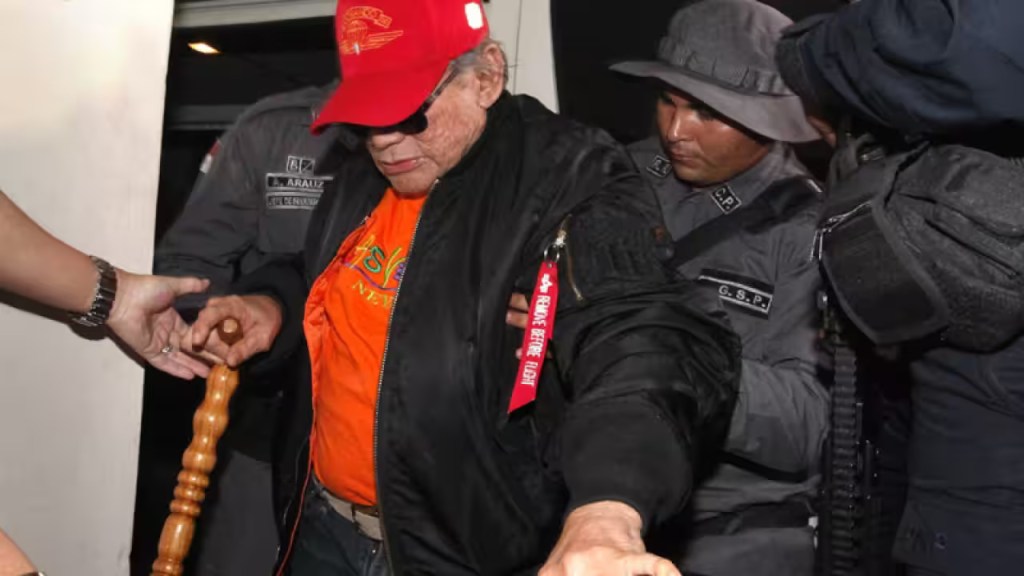
That’s all for now, folks! Have a good one, and don’t forget to remove that silly tag…
 Creases Like Knives