
Click here for introduction. Original interview by Łukasz Medeksza. Translation by Matt Crombieboy. Comments and footnotes signed “MC” are the translator’s.
When were you born?
Robson: On 15 March 1971.
When did you meet skins for the first time?
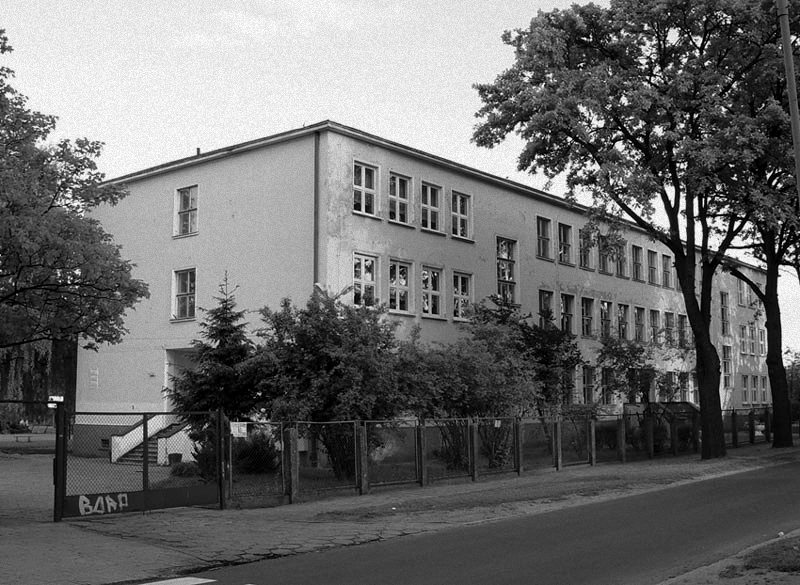
Back in secondary school. I attended the General Secondary School No. VI [in Pilczyce, north-west Wrocław – MC] I came across some skinheads there, and that was around 1986.
Any names?
Kostyła was one of them [Tomasz Kostyła, vocalist of the band Legion from 1990-96 – MC]
So it would seem that Kostyła was one of the first skinheads in Wrocław?
He was.
And when did you become a skinhead yourself?
In 1988.
What inspired you to become a skinhead – what aspect of it appealed to you the most?
Rebellion more than anything. It was a kind of constructive rebellion.
But you could have become a punk, for example?
Well, becoming a skinhead felt more radical to me. It was the most extreme form of opposition to the system of the era, which was the Polish People’s Republic. Swastikas were more harshly persecuted by the authorities than anything else. That’s why I gravitated in that direction.

Apart from Kostyła, who were your skinhead mates back then?
Jarosz. I also met Smolar and Adas at the time [Adas = Adam Bartnikiewicz, later the vocalist for Konkwista 88 – MC].
So, how did you meet this crew?
I met them in 1988 when travelling to Warsaw to attend Róbrege [a punk, reggae and alternative rock festival – MC]. It was my first trip to that kind of event.
The whole crew from Wroclaw went?
Yes, I met a few folks from Wroclaw there. For example Jasio, who later became associated with PWN [Polish National Community, a far-right party led by Bolesław Tejkowski – MC]. I went with Jarosz, and there was another guy named Dominik who hailed from a small town near the Czechoslovakian border, Lądek Zdrój. There were some pretty intense brawls at the Róbrege festival…
How many of you were there?
Well, all the skins from across Poland were present, so it was around 150 of us.
What was the result of these fights?
They weren’t really fights; they were more like one-sided beatings.
You lot were battering the punks?
Precisely.
Was this the first such nationwide display of power on your part?
I don’t believe so. At the Marchewka festival in Warsaw, I had already adopted the classic skinhead attire, although my hair was slightly longer at the time.1
So, it seems like all the various skinhead groups from Poland were already quite closely connected.
Yes, everyone knew each other and greeted each other. At the very least, you would have seen them around.
And how did these connections come about?
It mostly happened at gigs. For example, you’d have a few skinheads hanging out, and then a few more would pass by. They’d approach each other, shake hands, and start talking. Since there weren’t that many skinheads back then, they would instantly form a group, and everyone had each other’s back. That was the spirit of the time.
But how did it all kick off initially? I’ve always been curious about that. I’ve heard one story that it began with an article in Razem [a youth magazine – MC].
The Razem article, yes, that’s correct. It was around 1985 or 1986. I still have that article at home. It said something along the lines of: “The clattering bootsteps, the sound of breaking bones, here we come – skinheads.” [The literal headline was: “Bald heads, beer, the clattering noise of marching steel-toe boots, the sound of breaking bones: here we come – skinheads” – MC]
So, how did it all begin in Wroclaw? Who was the first one? I’ve heard a tale that there were a few skinheads in Wroclaw as early as the early 1980s, possibly in the Krzyki quarter. They were part of some short-lived group, I believe.
Does the name Bonanza ring a bell?
Yes.
He’s the man in question.
Bonanza was one of the first punks in Wroclaw.
And one of the first skins too.
So what was the skinhead movement all about in the early days?
In those early days, it was a completely apolitical movement, despite occassional shouts of “Heil Hitler!” But that had nothing to do with politics. It was mainly about brawling and some traveling – to Gdansk, for example, where we had skinhead friends. Gigs, drinking, parties, things like that. That’s all there was to it.
How about football – did you attend Śląsk Wrocław matches?
I’ve only been to one football game in my entire life, and it was only for the second half, purely by chance.
Wasn’t attending football matches a part of the skinhead lifestyle?
Many skinheads did go to football matches, but for some reason, I didn’t.
How did other football fans get along with skinheads?
We’d say hi to each other and sometimes meet them in the Market Square [Rynek], but not much more than that. I wasn’t too keen on mingling with the football hooligans because they didn’t have a good sense of style. They tended to favour that untidy Turkish style – you know, dirty white socks, grubby shoes with tassels, unkempt tracksuits, dirty Turkish jumpers and so on….
Did the untidiness or the Turkishness bother you more?
Well, I just didn’t like the style. Besides, they would drink cheap wine at the turnstiles… I never drank cheap wine in my life. They’d sit there and drink wine, talk about bitches and discuss who’d given whom a kicking. That wasn’t my idea of great entertainment.
What were the topics of conversation in your skinhead crew, then?
If we talked about brawls, we were usually discussing our own skirmishes! (laughs). I wasn’t interested in the hooligans and their brawls. In general, there was an understanding among us that you had to bash punks.
Was it just you lot bashing punks at the time, or was there a certain balance, where punks would sometimes retaliate against you as well?
I never saw that happen. But I lived in the Popowice neighbourhood, and there were no punks there.
You mentioned that you had some trouble with metalheads there?
Yes, but that situation was quickly pacified. Two of us came to Popowice and restored order.
You and Mareczek?2
Yes, exactly. Later there were three or four more skins in Popowice – but they no longer have anything to do with it.
Do you agree with the theory that skinheads were set up by state security (SB) to counter punks – that there was some sort of scheme at play?
Not at all. The reality is that a few punks came across the Razem article about skinheads in the west and found themselves more intrigued by skinhead culture than punk.
There was a rumor, for instance, that Siudy enjoyed immunity because he had ties to the police.
Immunity? At a certain point, he did become involved with drugs, but I can’t provide any specifics because I’m not informed about that. What do you mean by “immunity”, though?
That he can get away with things that others wouldn’t get away with.
If he assaults someone, he won’t get away with it. If the victim reports the incident to the police, they will investigate and identify the assailant. The victim can then file a private prosecution at the prosecutor’s office, and the perpetrator will have to stand trial. The police may be reluctant to cooperate, but that’s beside the point. If they refuse to help, the victim can go to the chief of police and file a formal complaint. The cops will get themselves into serious trouble if they refuse to accept a crime report.
Well, exactly. So what was your actual relationship with the police?
In 1989, I wrote a few slogans on a wall in Legnicka Street: ‘Down with Communism’, ‘Skinheads’, ‘Poland’ – stuff like that. The next day, the police arrested all the skins in the Market Square and interrogated everyone quite harshly to find out who had done it.
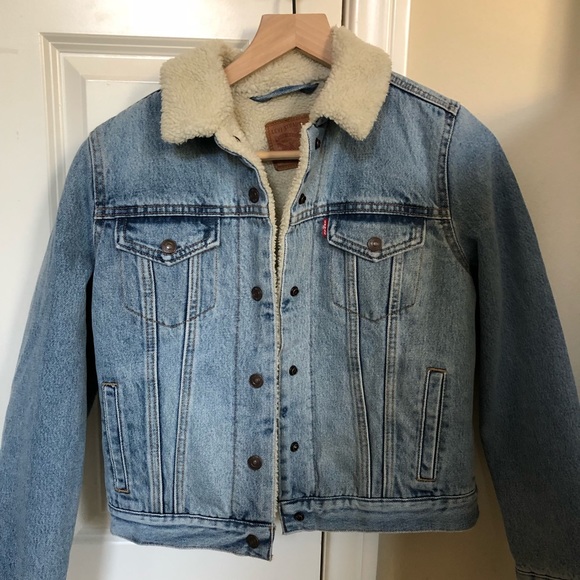
When did skins start hanging out in the Market Square [Rynek]?
By 1988. It was completely deserted otherwise. From 8pm or so, there were five or six skins sitting there and nobody else. Even ordinary people didn’t go – after 8pm, the Rynek was empty.
You said you were with a different crew at the time?
I knew Jarosz from the Rynek lot, but he didn’t really keep in touch. My main hangout was in Popowice. But I was still attending secondary school then, so I spent more time studying than hanging out. I knew Smolar and Adas [later the vocalist for Konkwista 88 – MC]. I met Adas in 1987 at his cousin’s place, whom I knew.
So who were the crew hanging out in the Market Square?
Korek, the old bullshitter. I know that Smolar and Siudy were part of that crew as well. Smolar and Adas really outdid themselves when they stabbed that gipsy. I think it was in 1986 or 1987 during some party at Adas’s place, possibly for his birthday. Smolar and Adas went outside, and there just happened to be a gipsy walking past the block. They wanted to kill him. I don’t know if they stabbed him once or twice or more often, but he did get stabbed for sure. They got nicked, and well – there was a big scandal. They were both very drunk and kept shouting ‘Sieg Heil’ as they were being driven away…
Did the gipsy survive?
Yes. Adas and Smolar both got suspended sentences because they were still minors at the time.
Was there any hierarchy among skins then?
Not really, but Siudy was probably the toughest guy around, and everyone was a bit scared of him. Even Smolar was wary of Siudy.
When did Siudy start getting into drugs?
It was around 1989, but I reckon he might have been experimenting with them even before that, just like Soltys.
Do you recall an interview with a skinhead from Wroclaw that was published in Non Stop in 1988?
The one with Róża?
Yes, that’s the one. Who was he?
That person didn’t actually exist. It was bullshit, and the journalist got a beating for it later. It was a fake interview.
But the article cited two names: Soltys and Marchewa.
Marchewa didn’t exist either. The writer must have heard somewhere that there was a skinhead named Soltys and then simply invented the rest.
The journalist used his real name for a fake interview?
I can’t recall if he did, but he did face consequences because they went looking for him and tracked him down somewhere.
Did you have a specific name or label for your group during that period?
No, just skinheads. The vibe was really funny at the time. For instance, Smolar, Sylwka, and someone else in that crew went through a phase where they identified as German. They believed they were Germans and meant to fight Poles.
There were a couple more press write-ups at the time. I think Iglica magazine published one.
Yes, it ran a feature about skins. It even had a picture of Blondas, and the caption read something like, ‘The club of a Śląsk Wrocław hooligan’.
What did you dress like at the time?
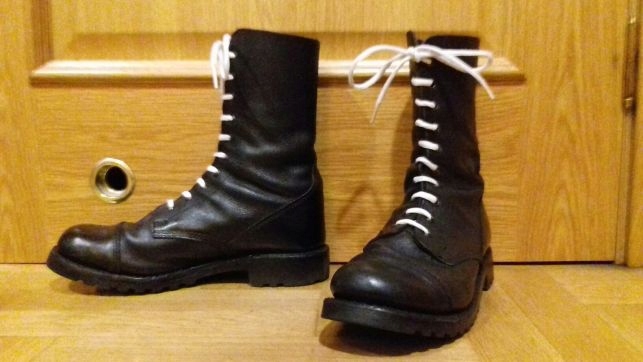
Romanian boots [read more about them here – MC], turned-up jeans, and ideally a denim jacket with sherpa collar.
How about the famous lace colour issue?
In Wroclaw and Gdansk, we sported white laces, while in Warsaw, they went for red laces. For about three years, we opted for white laces fastened in a ladder pattern. Eventually, we decided to switch to black laces. The ladder pattern was purely a style choice because it looked cool.
When did fascist or nationalist themes start becoming prominent?
As I mentioned, initially, some members of the group identified as German and were keen on beating up Poles (laughs). I declared that I was Polish, not German, and they just looked at me disapprovingly and shrugged it off. That was at some gig at the Centennial Hall.
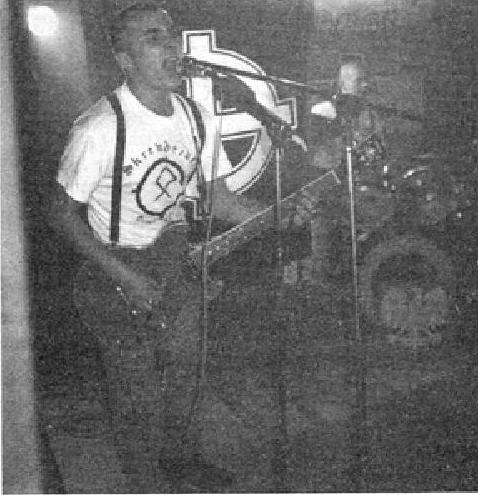
At the festival of the National Youth Scene [an alternative music movement in late 80s Poland – MC], which I think was in December 1988?
Yes, exactly! I remember there was a brawl up front, near the stage. Later on, Smolar decided that he was a Pole after all, but that he still liked Germans. People felt the need to shout ‘Sieg Heil’ and ‘Heil Hitler’ to live up to the article in Razem. It was simply the most provocative thing one could do at that time – yelling ‘Sieg Heil’ in Poland was profoundly shocking to people. But as time passed, we became interested in various small political parties, which was a consequence of our actions. Take Smolar, for example: he had a strong anti-party stance for a long time. He was just a nazi. But then, one month, Smolar established the local chapter of the Polish National Community (PWN) in Wroclaw. That was around 1991, I think.
When did you begin forming connections with people abroad?
Our initial contacts were established with Czechs, mainly through Opole. I’m aware that Jarosz used to visit the Czech Republic and Germany. These contacts were more like personal friendships. Nowadays, the nazis have an extensive network of contacts throughout Europe. But for nazi skins, these contacts are more centred around gigs and mates rather than being ideological. In practice, their ideology comes down to being a nazi skinhead – that’s as far as it goes.
Well, but sometimes projects like the ‘Anti-Antifa’ emerge [in 1990s Germany – MC]…
Yeah, but I’m not sure that one’s run by skins. I suspect regular nazis have set it up. Nazi skins in Germany are far too conspicuous to get involved in such projects. They draw too much attention – you can spot a skinhead from a mile away.
Were there any skinheads in Poland during the 80s who weren’t far-right?
Not really. In Poland, skins are generally nationalists. Almost all of them.
But people from Sosnowiec say there has always been a ‘normal’ skinhead crew there.
Sosnowiec is where the gig featuring Honor and others took place – the one that was preserved for posterity in the Oi! documentary on TV Polonia [Honor was a well-known neo-nazi band from Gliwice – MC]. This gig took place in Sosnowiec and was organised by people from Sosnowiec.
But in that documentary, you’ve got a guy from Sosnowiec talking...
… who looks like a cross between a punk and a Rastafarian!
… and he says there aren’t any nazis in Sosnowiec.
What does he have to do with skinhead, though? People tend to forget that being a skinhead is mainly about a particular look and lifestyle. Whether you’re a communist, anarchist or nazi, or even have specific sexual preferences – like being a gay skin, for instance – those are secondary. The main thing is that you’re a skin and have the look. That’s what really matters. You can be a punk without a mohican – it’s not mandatory for punks to have one. But to be a skin, you’ve got to have short hair. You can’t have long hair or wear sandals. You need heavy boots and short hair – there’s no other way around it. These are the basics that many people in Poland seem to be forgetting.
Who established that rule?
The rule pretty much established itself back in the sixties. There are certain rules, even though there can be some variations within those rules. In Britain, skinhead clobber is just regular clothing like anything else – it’s only in Poland that it’s so expensive. Martens are the most popular shoes of all in England. All Brits wear Dr Martens.
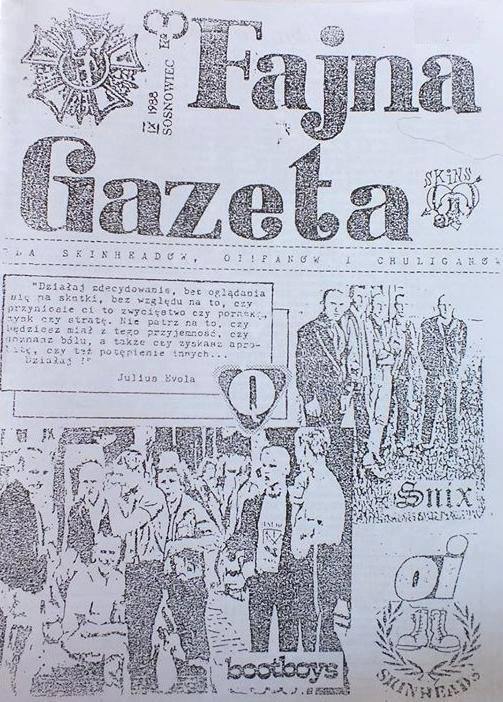
Speaking of Sosnowiec, there’s also a claim from there that the first Polish skinzine originated there.
Fajna Gazeta, that’s correct. I had a copy of it at one point. [There were three issues in total, all of which came out in 1988 – MC]
Was it really the first skinzine?
I think it was – I’m not aware of any that came out earlier. I got my copy at the Róbrege festival in Warsaw 1988.
What were the contets of Fajna Gazeta?
They featured reviews of various records, ranging from the Redskins to right-wing bands.
A kind of mish-mash?
Yes, and Fajna Gazeta said that a skinhead could be a leftist, a right-winger, a nationalist, apolitical and so on. It also said that being anti-political was the most suitable attitude for a skinhead.
What did you make of that?
I didn’t think much of it, to be honest; it was just this little zine… It also had an interview with Kortatu, a fairly left-wing skin band, which was a reprint from QQRYQ punk zine. I found it funny that Fajna Gazeta reprinted content from punk zines. They also published an article from QQRYQ titled ‘Oi! Movement’, which argued that Oi bands like 4-Skins and Blitz had no connection with nazi bands like Skrewdriver. That was actually the main point of the piece.
Were there any other zines during that period?
I didn’t come across any for quite a while. Then, I got my hands on a zine from Bygdoszcz called Legion. That one was terrible, on a level roughly equivalent to a punk zine written by a 12-year-old. It had snippets from all sorts of newspapers, letters that were an inch tall – just dreadful.
Isn’t that Legion zine still going today?
Nah, it only came out for a little while. Then the geezer started putting out a zine called Skinhead Polski, and then he stopped. I’ve no idea what he’s up to now.
You guys had some contacts with people from Bygdoszcz [a city in northern Poland – MC], right?
At the time, I was corresponding with a bloke who was doing a zine there. He later started the Błyskawica [lightning bolt] zine, although I’m not sure if it’s still going. We used to argue quite a bit in the letters section because he had a quite narrow nationalist attitude. He kept writing things about Germans: how many Poles the Germans had killed, how we needed to exterminate the Germans, and so on. I kept questioning him: “What’s the deal? Where do you see nazism in Germany today? Maybe one percent of the German population are anti-Polish chauvinists, but 99% aren’t”. It was a waste of effort, though.
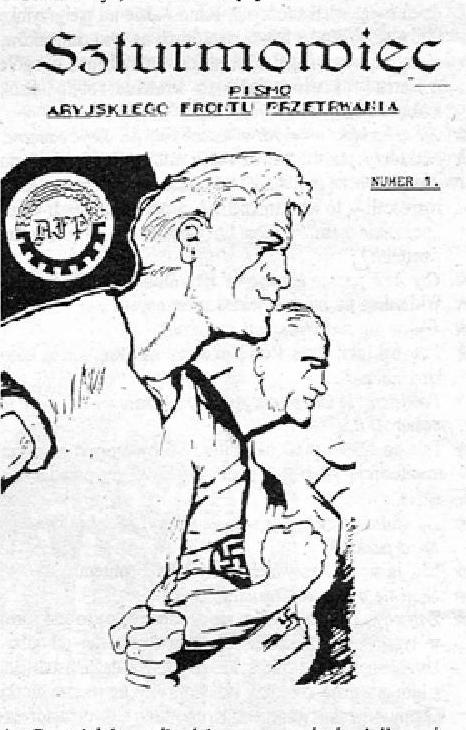
I remember your article from Szturmowiec [stormtrooper] zine…
I’ve heard differing opinions about that article from both sides. Some thought it was a far-left, Marxist piece. They argued that the only thing setting it apart from the left was a single sentence at the end that mentioned a white Europe.
Definitely not in line with Polish nationalism?
Not at all. The zine also featured articles that were anti-American, anti-capitalist, and even anti-totalitarian. The anti-totalitarian aspect was quite evident.
Around 1991, I began to hear that if you gathered five or six skins in the same room, each of them would hold different positions: one might be a Polish nationalist, the second a National Socialist, the third a Fascist, and so on. To me, it seemed like the initial signs that the movement was on the verge of dividing into various factions. Was it genuinely the case?
Yes, everyone had their own ideas. Everyone was their own authority. It was the most anarchic subculture you could imagine. Everyone wanted to do things their own way, and everyone wanted to be the leader. That’s how it was.
CLICK HERE FOR ROBSON INTERVIEW PART 2
- Robson seems to misunderstand the question: “on your part” refers to all skinheads, but he thinks the interviewer means him personally. He also contradicts his earlier statement that the trip to Róbrege in autumn ‘88 was his “first trip to that kind of event”. The following acts played at the Marchewka festival at Warsaw’s Hala Gwardii from 7-8 May 1988: New Model Army, Armia, Kult, Anonimowy Balladzista, JAD WIO, zwuki mu, T. Love, Clan of Xymox – MC ↵
- Mareczek was a well-known Wroclaw skinhead notorious for his fighting prowess and aggression. After a few years, he disappeared from the scene, ended up in Wroclaw’s criminal underworld and was killed in a feud – MC ↵
 Creases Like Knives