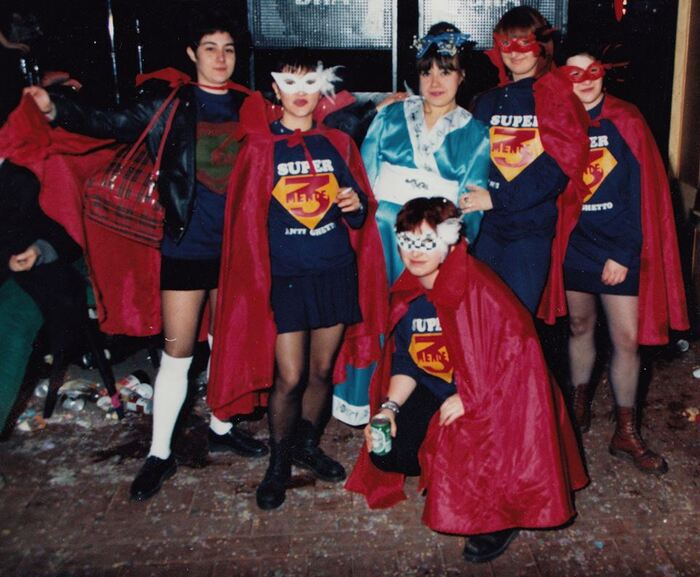
Creases Like Knives presents itself as a webzine dedicated to “reggae, punk, Oi, hardcore, soul, clobber, style” and “strong views” (that’s our description on X). But since the founder mainly listens to Oi, punk and glam/bovver rock, the articles tend to revolve around those genres. I figured it was about time to make space for other things as well. And what better way to start than with Tremende, one of Italy’s longest-standing ska bands, active since 1989, based in Bologna, and almost entirely female? Matt and I met up with their vocalist Antonella, who was more than happy to chat, at Serena 80, a club with a football ground and rehearsal space. Later on, the rest of the band joined us, and we got to watch some of their rehearsal.
Here’s what came out of our conversation. We’re also publishing Tremende’s rare self-released 1993 tape on our YouTube channel, so make sure to check it out!
Francesca Chiari
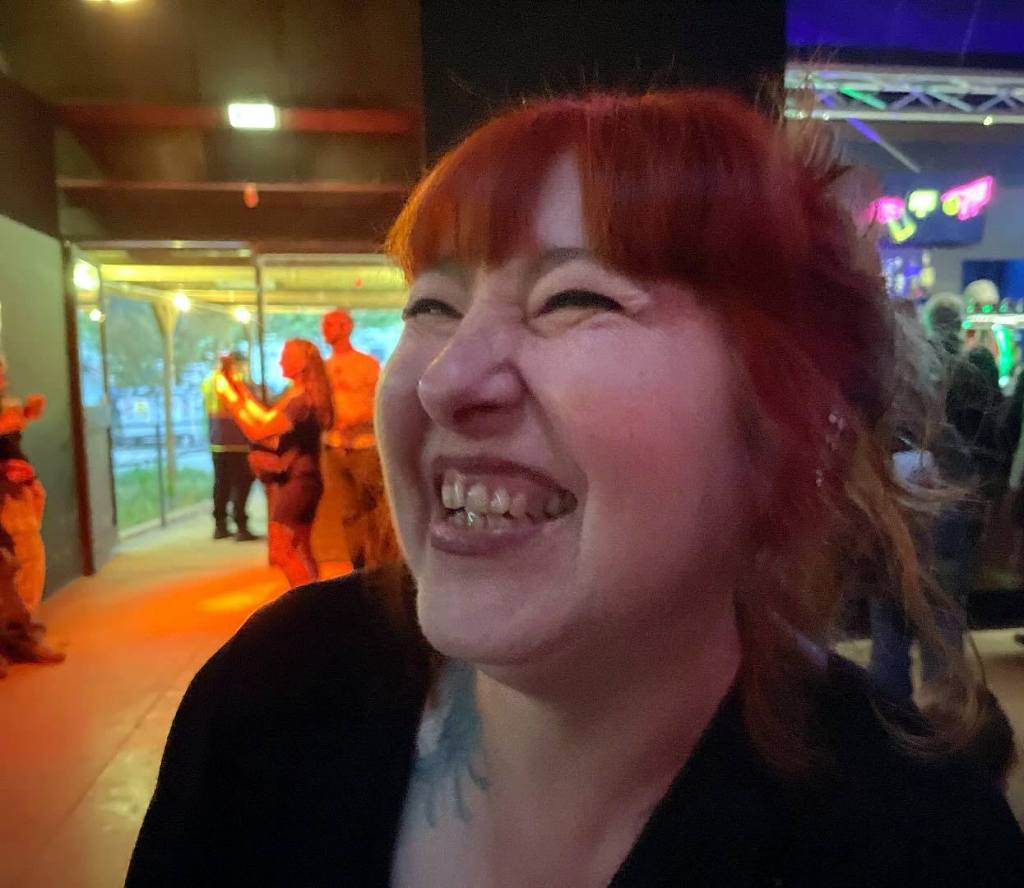
Francesca: Hi Antonella, thanks for your time. You’ve been in Tremende since the beginning, in 1991…
Antonella: Yes, although they started out as an instrumental band. They played a couple of experimental gigs… There was Katia, Chicca, Giusy from the stadium, and some other girls who aren’t with us anymore. After a little while, I joined… they had no singer, you know?
F: Did you sing in other bands before?
Never. In the beginning it was wild because nobody really knew how to play and I didn’t know how to sing. After years I took singing lessons – just a few. It seemed like a good idea.
F: How did you come to love ska and reggae music?
It all started with my love for 2-Tone and the ska revival. Then I discovered Jamaican reggae and ska, and I completely fell for it. But 2-Tone was where it all began, especially with Bad Manners, who have always been my favourite band. I saw them live and was instantly hooked. This was in the early 90s, at Cryptonite in Baricella. The event was organised by Radio Città del Capo. Later on, we even had the chance to share stages with them.
When I was younger though, I listened to rockabilly. In fact, at thirteen, I was even a bit goth. But I never stuck to just a couple of genres. I remember going dancing at the Mascotte in Nonantola [a small town about 50 minutes from Bologna] on Saturday nights. They played a bit of everything there, even reggae and ska… I was underage at the time, so Romano, who was dating a friend of mine, would pick me up. [Romano is the singer and guitarist of The Stab, a ’77 punk band formed in the 80s with members of Nabat.] The club is still around, but they don’t host gigs like that anymore. We were also really close with The Stab.
F: But were there rockabilly bands in Bologna back then?
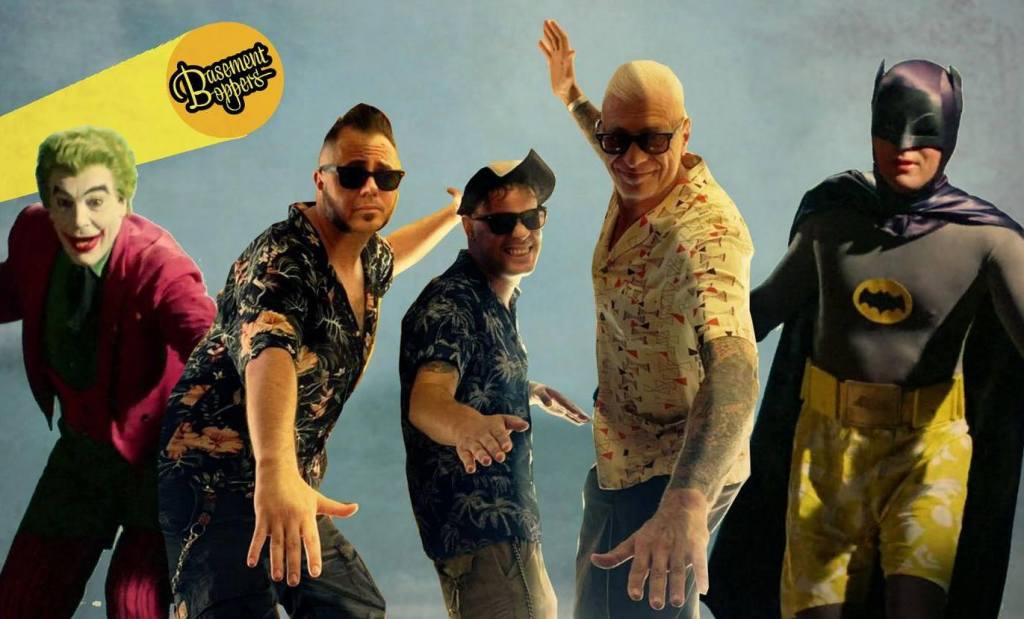
Of course, there were – and still are. Just last Saturday, the Basement Boppers were playing, and I told the drummer I’d first seen him when I was 15, performing at Radio City. Back then, they had a bit more of a rock vibe than the Basement Boppers do now. Then there was the band led by Cesare Ferioli, the drummer of Tribal Noise, who was also the husband of our keyboard player. Bologna had a bit of everything, even at the parties we threw together. I remember Baffo’s parties—he had these little houses in the mountains with a stage and everything. One was in Ozzano, the other in the hills of Imola. We used to play there, along with Ghetto 84. We were all musicians.
F: Where did you play your first gigs?
Our first gig was at a festival in what later became Livello 57. [Antonella is referring to the Pellerossa squat in Piazza Verdi. After it was vacated, the squatters moved into another space owned by the Bologna city council, which later became Livello 57 – Editor.] This was in 1993. That night, we opened for Ghetto 84. In the early days, we often supported them when they played, mostly because we shared the same rehearsal space.
F: Which rehearsal space was that?
It was one in Via Fratelli Rosselli, close to where the Museum of Modern Art (Mambo) is today. There’s nothing there anymore, but back then, it was a self-managed neighbourhood school. Upstairs was a drama school, and downstairs were the rehearsal rooms.
F: Were you friends before you formed the band?
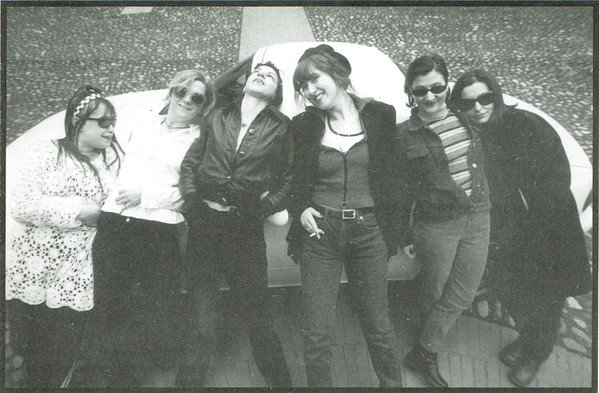
We had mutual friends and knew each other from gigs, moving in the same social circles. There was Breno’s crew, who used to hang out at Disco d’Oro [a legendary record shop in central Bologna, important for the early punk and skinhead scenes in the region – Editor], and I’d meet most of them at Casalone [a key music venue for skinheads, hardcore kids, and other subcultures]. At the time, I lived in Pilastro [a working-class neighbourhood on the outskirts of Bologna] and would take the bus to get to gigs.
F: Was that in the late 80s, when the Casalone was famous for Oi?
Yes, exactly. I was young when I got into punk music. I swear everyone hung out at Disco d’Oro: skins, punks, metalheads. I used to go there on Saturday afternoons, where you’d meet all the old guard, like Rude from Ghetto 84, Steno, and Riccardo Pedrini from Nabat. The Casalone was fantastic. There were rehearsal rooms upstairs and a sort of pub downstairs, and it was always open, not just for gigs. You could drop by just to play cards if you wanted. The Irish pub on Via Paradiso was another hangout, along with the stadium, of course. But I was never part of the football crowd.
F: Back to the rehearsal room. How did Tremende come about?
Tremende came about because people were making fun of us, saying that women never do anything! Let’s just say we were a bit pissed off about that. Anyway, at some point, Mirko joined us as our first bass player – he was the only one who could really play. It was me, Mirko, Katia, Chicca, and Sandra on drums. Then Levi came in on keyboards; she was more of a composer and arranged some of our songs.
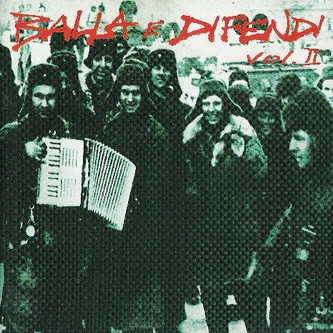
F: Before your 1997 debut album, you something for the Balla e Difendi Vol. 2 (1996) compilation, published by Gridalo Forte Records, the label of Luca and David from Banda Bassotti?
Yes, we contributed two tracks, ‘Vorrei’ and ‘Africa’, both of which we recorded in Rome. That’s where we met Kaki, the guitarist from Negu Gorriak, who did the recording.
Matt: When you started playing, was your audience mostly skins? Because when you go to reggae or ska gigs in Italy, you also get a lot of fricchettoni [long-haired freaks stinking out the place with their marijuana]. That seems to be an Italian thing – hippies into reggae. In England, they listen to rock.
Yes, they were there, skins were the majority. Especially when we played outside Bologna. And even when different factions attended, there were almost never any trouble. I know a thing or two about fighting because my husband is from Genoa (laughs).
F: Do you often play in Genoa?
Very often, yes – our first gig there was at the original Zapata squat. But apart from Genoa, we played a lot in Florence, Perugia, Rome… They were mostly social centres [political squats]. We’ve always had a very good relationship with the people of Genoa, especially considering how close Bologna and Genoa are in terms of football…
M: Did you play outside Italy in those early years? I’m no big expert on the ska scene, but generally speaking, Italian bands tend to stay in Italy.
Yeah, we played in Germany. They used to have great ska festivals like This Is Ska and they still do. We played with Bad Manners, and we’re still good friends with the Malarians. We met them at Casalone [important music venue in Bologna] at the gig organised by Gridalo Forte Records.
F: Tell us about your early recordings!
At first, we only had four or five tracks. These included covers like ‘L’uomo nero’ (basically Madness’ ‘Baggy Trousers’ with different lyrics), Nabat’s Martò, and ‘Non ti fermare’ (a rework of the 4-Skins’ ‘Plastic Gangsters’). Some of that stuff ended up on our first cassette, recorded in 1993 at Steno’s studio from Nabat, which was located at the Casalone at the time.
M: I think I like your version of ‘Plastic Gangsters’ even better than the original.
I still have the four-track reels of that recording. It’s not easy to find the tape, but I managed to transfer it digitally, though it’s a bit noisy. The Pingone brothers [Fratelli Pingone, Bologna’s first reggae band] worked with us on that recording. They weren’t playing reggae anymore, so they came to help us out. I still have a sealed cassette, but I think it might self-destruct if you try to play it! I also have the cover art, made by our friend Pedro – he was a skater, really old school.
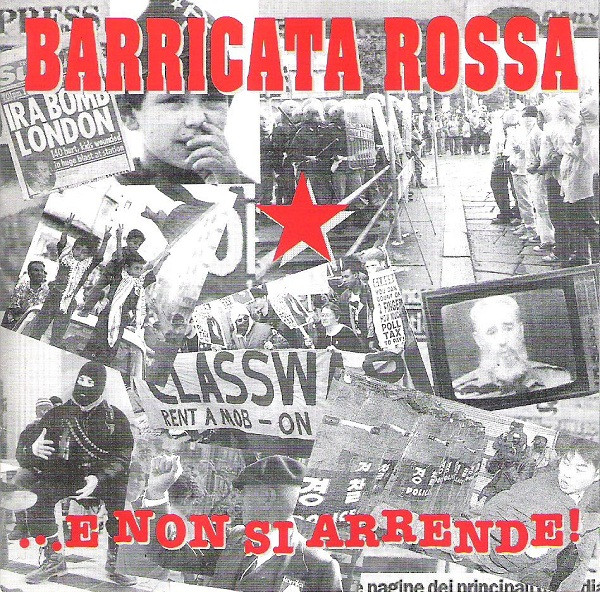
F: You also took part in festivals organised by Gridalo Forte [a ‘combat rock’ label founded by the communist skinhead band Banda Bassotti from Rome – Editor]. For example, you played one in 1998 with Senza Sicura and Barricata Rossa, two ‘combat rock’ bands [a term describing militant left-wing skinhead and ultras bands in Italy]. Let’s say you took part in festivals of a certain political character. Have you ever considered yourself, how shall I say, militants?
Militants, no – but definitely anti-fascist. But we were always happy to take part in solidarity gigs, even for free. If it was for a good cause, we were fine with it.
F: Where did you record your 1993 debut album, Non ti fermare?
In Bologna. Kaki did the mixing later, but over in the Basque country. We loved how he mixed the two tracks on the compilation, so we went with him again. His studio’s amazing, up in the hills. I remember asking David from Banda Bassotti for Kaki’s address, and he just said, “When you get to town, ask the first person you see on the street”. And that’s how I found him!
It would’ve been great to record something there, but it was just too tricky to organise. We also had to turn down a chance to play in Japan when Gridalo Forte Records asked us to join Banda Bassotti and Ramiccia on tour – work and logistics got in the way, as always.
(Claudia enters the room)
F: Who writes your lyrics, then?
Katia and I do. Her lyrics are way more political than mine, though.
F: Was ‘Fede, politica rabbia’ [Faith, Politics and, Anger] written about anything in particular?
Antonella: No, not at all. At least, I don’t remember it. But the one about Berlusconi, yes, I remember that. During the election, there were posters of him in various guises all over Via dell’Industria… Berlusconi the metal worker, Berlusconi the fireman, and so on.
Claudia: Well, then there’s the piece on Cardinal Biffi – the ‘Biffi Song.’ He was the archbishop who decided to excommunicate all of Bologna for being ‘too vicious and perverse.’ I think that was in 1995.
F: Let’s move on. In 2006, you recorded your third album, Ancora Tremende – also at Steno’s studio?
A: No, we recorded it at Pekos in the Scandellara quarter for Ansaldi Records.
F: …and now there’s another one in the works, if I’m not mistaken?
A: Yes, that’s the one we’re trying to put together! Katia wants to do a double 7-inch. Right now, we’ve got four songs, although one is already planned for a compilation dedicated to Bologna. Of course, there will also be Nabat, Ghetto 84, Avvoltoi… all local bands. It’s a compilation supported by the Bologna ultras, and the proceeds will go towards a children’s hospital.
M: There’s an old song of yours that I really like… I can’t remember the title – something about the portici [the porticoes of Bologna, which are long covered walkways in the historic town centre that stretch for over 24 miles, providing shelter for pedestrians from rain and sun – Editor].
A: Merde a Portici [Shit under the porticoes]. Yeah, I wrote that. Actually, no, it was Mimmo! Our dear friend Mimmo wrote it.
M: What is it about?
A: It means there’s shit under the porticoes! Like, dogs poop there, but there were also some shitty people. You know, the ones with the Mercedes and the mobile phones (not everyone had them back then) – the rich folks, basically. And there really was loads of dog shit – there was even a period when they brought out a little poop-sucking machine.
F: Your last album came out 18 years ago.
A: What, 18?
F: Yeah, from 2006 until now, that’s 18 years.
A: Damn, we’re old!
F: So what have you been up to in these 18 years?
A: Oh, we’ve got a lot of tracks! We’ve written so many we could do double albums. But we start a lot of things and don’t finish them. And of course there’s everyone’s personal problems, so we often have to stop for one reason or another…
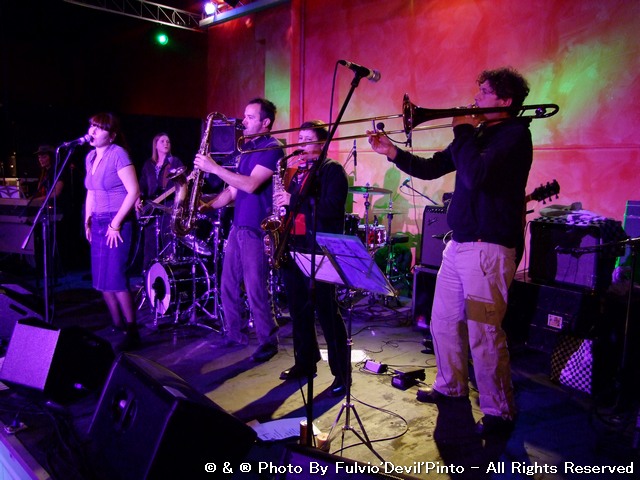
M: But you’re still playing gigs, right?
A: Yeah, we manage to do three or four a year. Less than before, but it’s fine.
C: There’s a certain inconsistency to our rehearsals, with people coming and going… especially the brass section. You know, some people show up once and then never again. Some had kids and disappeared… plus, there was the Covid period.
F: Any teasers about the new album? Spoiler alert!
C: There will be mostly educational songs, like ‘Have a Drink and the Trouble Will Pass’. If you want, we can give you a sneak peek if you’re not in a hurry…
M: Yeah, we’ll stick around for a bit later. Who’s producing the album?
A: From what I understand, since Katia and Nadia are handling it. We should be working with Hellnation, even though we’ll record it ourselves.
M: Vinyl would be nice; you’ve never released any, right?
A: Nope. The only music we released on vinyl is that Spanish compilation, the tribute to Joe Strummer, The Clash Goes Jamaican from 2013.
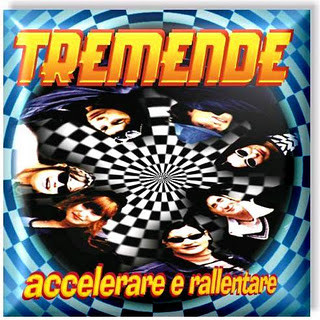
C: It’s a double vinyl, and we participated with the cover of ‘Wrong’em Boyo’, which we recorded together with Rude from Ghetto 84. It was an honour, really a fantastic compilation with one amazing cover after another. I remember Rude got so excited about it that he decided to join in with his German band. As far as Italian bands go, we were the only ones; the rest were mostly Spanish.
F: You were also part of the ‘Tribute to Joe Strummer’ concert at the Estragon, right? In 2009. Ray Gange, the star of the Clash movie Rude Boy, was there too.
C: Yes, we played both at the Estragon and at the Joe Strummer tribute organised by Fulvio Pinto at the Crash squat [the Italian tribute to Joe Strummer, 10.000 giorni di rock ‘n’ roll, was initially held in December 2004 and December 2005 in Bologna, featuring bands such as Klasse Kriminale, Klaxon, The Stab and Gang – Editor].
I imagine you didn’t see the famous Clash gig in Bologna in 1980?
A: No, I was too young! But I have the CD recorded by Alfredo.
C: I was only 13 and not allowed out yet. But I knew all about them; a friend of mine gave me a tape in middle school, and I was hooked right away. I remember the drummer got lost in the city centre, so they started with the drummer from the opening band, the Whirlwinds. And then when Topper Headon finally arrived, the bouncers didn’t want to let him in because they didn’t know who he was…
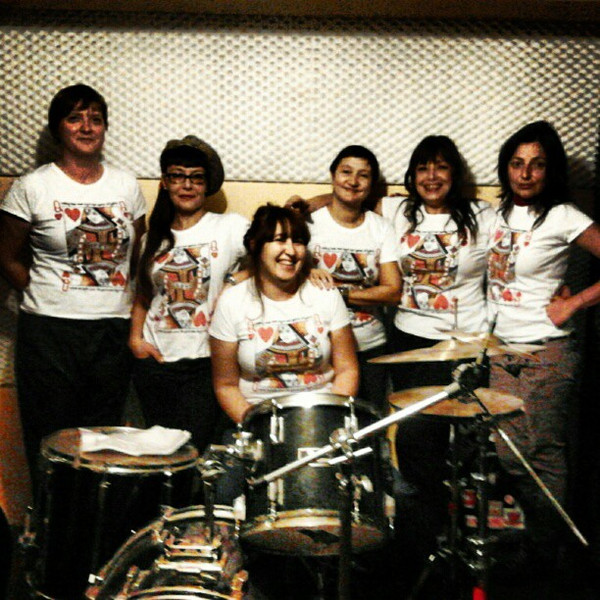
(Katia and Nadia arrive)
F: We’re nearing the end, ladies. Any other festivals or concerts you remember?
C: The Workers’ Day Festival in 1998. We played on a bus. The union of TPER [the public transport company in Bologna] provided a bus for a band to perform. We were supposed to accompany a representative of Peruvian workers’ rights to Piazza Maggiore with our music. People could hop on and off as they pleased. The driver was a volunteer, but he had never driven an old bus with an even older clutch, so the journey was a bit chaotic!
F: When can we expect to hear your latest work?
Nadia: We’ll be recording this summer. We’re aiming to release a double 7-inch in 2025 to celebrate 35 years of Tremende. After that, we’ll start up the gigs!
F: Last question for Katia: you’ve always been part of the skinhead scene, right?
Katia: Always, and still am – but I’ve never been a skin. I’ve always been like this, just as you see me now.
F: A rudegirl?
K: Yes, I’m a rudegirl, but skinhead culture has always been in my heart. I was with Tato, the drummer from Ghetto 84; we’d been together since I was 17 and he was 18. Tremende began around the same time they did, although they started playing concerts a few years earlier. Our first gig was in 1989 at Sottotetto, before Antonella joined us. We played just four instrumental pieces before Gutalax and Nabat went on. Antonella was training in ju-jitsu with me at the time. One day, I heard her singing in the shower and asked her to join us. That was the moment Tremende were born!
Check out below the rare first Tremende tape of 1993, published exclusively by Creases Like Knives!
 Creases Like Knives