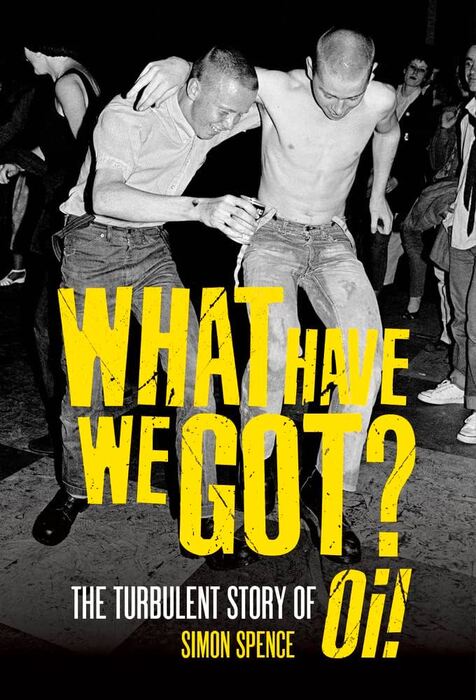
What Have We Got? The Turbulent Story Of Oi! by Simon Spence (Omnibus Press 2023)
This is the heartwarming story of a journalist who, having written extensively about britpop, discovers and falls in love with Oi. Now Simon Spence is spreading the good news about skinhead rock to a whole new audience – and so, his book is very much pitched towards those who have discovered the genre even more recently than he did. Spence’s opening sentences are: “A definitive history of Oi!? Yes and no”. Serious historians don’t do definitive, not even a hedged definitive.[1]

There is a foreword by Cock Sparrer founder Gary Lammin, and the book concludes with a chapter on Lammin’s old band, among other things. This sets Cock Sparrer up as the founding fathers of Oi. However, Spence begins with a chapter entitled ‘The New Breed: Crown Court’. Lots of people like Crown Court, but for me the band’s name was almost enough to put me off ever listening to them. The name is shared with a really boring and thankfully now defunct TV show. That isn’t why the band took the name, but anyone my age who grew up in the UK is likely to make the association. What next? Oi bands called things like Strictly Come Dancing and Good Morning Britain? Incidentally, ‘the new breed’ is a phrase I first came across in Richard Allen skinhead novels when I was reading them in the 1970s, but there’s no mention of that here.
Moving on, there is a delve into Oi precursors, including Sham 69, Menace and Angelic Upstarts. Spence opts for a very conventional view of the bands that inspired Oi, despite the fact that genres evolve and their boundaries change. He very much works with a pre-existing template on the origins of Oi and seems uninterested in broadening this out. Nonetheless, what some early Oi musicians enjoyed musically went way beyond this narrow range of influences.
Spence doesn’t mention west London band Neat Change, who had members geared up as skinheads back in 1967![2] Or, indeed, any of the far-out bootboy glam outfits who paved the way for punk – and with this, you could go all the way back to tunes like ‘Factory Grime’ by Crushed Butler. There are some lines in the book about the influence of dystopian tales such as 1984, Brave New World and Clockwork Orange on Oi culture. From this, it could be argued that some minor league London punk bands such as The Unwanted – whose simplistic vinyl releases included ‘Freedom’ (on the first Live At The Roxy LP), ‘Secret Police’ and ‘1984’ – were also precursors to Oi.

The singers of both Sham 69 and Angelic Upstarts are portrayed as troubled and complicated men. Alongside this, there is much about politically motivated violence at their gigs. The notion of political extremism becomes something of a motif for Spence, who is constantly referencing debates about who is and isn’t fascist on the scene. While what’s said isn’t laid out as ‘the far-right and far-left are equivalent to each other’, it nonetheless leans into neo-liberal rhetoric that attempts to portray capitalist exploitation as the answer to a single swap of undifferentiated ‘extremism’. Obviously, fascism and anti-fascism aren’t the same thing, and in an exploitative and politicised world, claiming to be ‘non-political’ is in itself a political line.
Jimmy Pursey of Sham and Mensi of the Upstarts – whose gigs were targeted by fascists after they made anti-racist statements – come across in this book as having similarities to the right-wing Combat 84 singer, Chris Henderson. Pursey and Mensi were working class, but Henderson had a privileged upbringing and attended a fee-paying private school. Nonetheless, Henderson is depicted as troubled due to his adoption, which, to me, parallels Spence’s suggestions that Jimmy Pursey may have been a victim of sexual abuse at a young age by a paedophile ring that operated at a youth disco he attended.[3] Likewise, the words expended on the time spent in Thailand by Mensi and Henderson, and to me discourse around sex tourism is implicit in this, creates an equivalence between them.
The book rocks on documenting the continually disrupted progress of bands like the Cockney Rejects, 4-Skins, The Last Resort, and The Business, largely due to politically motivated violence at their gigs. About two thirds into the book there is a chapter dedicated to openly nazi bands. Following this, there are a series of brief chapters that provide an overview of the Oi scenes in various countries around the world. These accounts are presented, in part, as ‘histories’ of both fascist and non-fascist bands, with the author seemingly favouring non-political acts over either anti-fascist or fascist groups. Very noticeable by their absence are London’s The Blaggers, who started as an Oi band in the eighties and morphed into a fabulous musical hybrid as Blaggers ITA in the 1990s. Throughout this, they were closely associated with Anti-Fascist Action.
When dealing with the 4-Skins, Spence draws all the problematic connections one would expect from a mainstream journalist writing about them. But he overlooks certain factors that seem to have created a dividing line between at least one member of the band and the Rock Against Communism (RAC) and Blood & Honour (B&H) scenes. Like the National Front, which gave rise to RAC, these organizations had close ties to Ulster loyalists and espoused loyalist ideologies. This connection runs much deeper than the song ‘Smash The IRA’ on Skrewdriver’s 1983 White Power EP.
By way of contrast, 70s punk rock figurehead Johnny Rotten AKA John Lydon came from an Irish family, and many London punks also had, and still have, Irish heritage. Given his surname and the fact that his Facebook page currently lists him as having attended a Catholic school in London,[4] it would seem that 4-Skins bassist Hoxton Tom McCourt was one of them. No one who felt much sense of positive identification with their Irish family roots was going to have any time for the loyalist line of RAC or B&H[5]

I suspect that Spence would have benefitted from reading up on fascist ideology before writing his book. At one point, he appears to express surprise that a fascist musician supported animal rights, when this was official (British) National Front policy in the 1980s. Prominent fascists of the post-war period, such as Savitri Devi, were animal rights advocates. These and similar far-right positions are sometimes traced back to the ‘ecological’ blood and soil polices of Richard Walther Darré, the Reich Minister of Food and Agriculture in Hitler’s nazi regime.
I disagree with the inclusion of bands such as Skrewdriver in a book on Oi. Skrewdriver clearly started as a pub rock turned punk act, and their transformation into being openly neo-nazi was part and parcel of a desperate ploy to gain attention. Likewise, band leader and RAC/B&H figurehead, Ian Stuart, doesn’t fit the working-class profile Spence gives Oi. The same can be said for some other ‘leading lights’ of the RAC/B&H scene, such as members of No Remorse. I’m not suggesting that Spence shouldn’t have written about openly nazi bands, but I do believe he should have made a clear distinction between them and Oi.
Another issue I had with the book was its gender bias, which ratchets up imbalances on the Oi/skin scene. A few female musicians are mentioned, but only in passing. While she doesn’t get much space, Klasse Kriminale’s long-departed far-right bassist Antonella, also known as Annie Riggs,[6] is the most prominent among these. My favourite Oi band of the past decade is Philadelphia’s all-female act The Droogettes – but they don’t even get a mention, despite Noel Martin of Menace appearing as a guest vocalist on their album Clockwork Girls.

I’ve focused on what I don’t like about this book, but it certainly isn’t all bad.[7] After all, I’m mentioned a couple of times, and so is Creases Like Knives![8] Joking aside, Spence sketchily covers a lot of Oi ground, missing much of what he should be covering in Europe and even more outside the overdeveloped world, but he does try to be broad-ranging. So, even for old hands, who probably won’t learn much from the earlier chapters – and I suspect won’t like them either – there will be odd bits here and there that are new. If you’ve been waiting for a big book about Oi, then my guess is you’ll probably buy this regardless of its flaws. We’re unlikely to see another tome on the subject with such a mainstreaming agenda at any time in the near future.
Stewart Home
[1] Here’s an example of the type of historical inaccuracy the book suffers from (page 310): “I’d read a 2018 article in the Guardian about how Dr Martens ‘stomps to strong profit on back of nineties fashion revival’. It said sales of the British bovver boot brand were up by a fifth to almost £350 million that year, led by a surge in demand across Europe, where the company opened sixteen new stores. The article did mention the impact skinheads had had on the brand: ‘Dr Martens first set trends when it was adopted by skinheads, a sixties youth subculture whose style expressed working-class solidarity’. But, of course, there was no mention of the second wave of late seventies/early eighties skins, who were the ones who actually had started the trend, no mention of Oi!.” – Back when I was a boot boy in the early/mid-seventies, what every kid into that scene coveted was a pair of cherry red Dr Martens boots. My understanding is this didn’t originate with my generation, but tracked back to the original skinheads, something that is pretty much suggested early on in the book when Spence is writing about Noel Martin of Menace (page 49): “The Menace look was very down-at-heel, boot-boyish, ‘I used to wear the tank top,’ Noel said. ‘Dr Martens were standards, and in the very early photographs we had done I think Steve was wearing a Ben Sherman shirt, so there was still a bit of the skinhead iconography. People thought we looked hard, had an aggressive image’.“ Likewise, Spence misleadingly writes about (page 273): “the Fred Perry polo popularised by the American far-right organisation the Proud Boys, black with yellow trim.” The Proud Boys were founded in 2016. Back in 1979, during the skinhead revival, pretty much everyone I knew into the scene had a black Fred Perry with yellow trim. I’d argue with mates about who was going to wear the most favoured FP when we went out because we didn’t all want to be geared up in the same clothes. The black Fred Perry with yellow trim had been popular for decades when the Proud Boys appropriated it. ↵
[2] For more on Neat Change see my interview with singer Jimmy Edwards (RIP), who also had a long running involvement with Sham 69, here. ↵
[3] The immediate results I got when web searching “Jimmy Pursey sex abuse” were pieces about the Sham 69 singer being on the UK sex offenders register after receiving a caution for a sex assault on a minor in 2002, which Spence covers in his book. From a quick look online, I could see nothing about Pursey being a victim of sex abuse as a child. So, Spence’s clearly speculative line on this doesn’t appear to have gained much traction yet. ↵
[4] According to his Facebook page, Tom McCourt attended St Richard of Chichester Roman Catholic School, Royal College Street, Camden. ↵
[5] Menace is a good example of a London band having a lot of Irish heritage, with two of its four original members being born in Ireland. The book also has some nice lines from Menace drummer turned singer Noel Martin – “I am about equal rights for everybody from gays, lesbians, trans”. In relationship to this, see also the story of Irish band Control Zone covered in Creases Like Knives here. Control Zone appeared on the United Skins album connected to The Last Resort shop, but dissociated themselves from the release due to the union (British) flag being featured on the cover and other matters, which included their song ‘Left-Right March’ about the Republican H-Block campaign being dropped from the compilation. Spence doesn’t cover this, but it is indicative of how obnoxious many found the loyalism – as well as the nazism – of Skrewdriver (also featured on the United Skins album, much to Control Zone’s disgust) and other bands with connections to the RAC and B&H scenes. The issue of Ireland and Irish heritage isn’t the only instance of Spence overlooking major geo-political divides – there are no qualifications when he writes about Catalonia, Valencia and the Basque Country as being ‘Spanish’. For those from those regions who don’t identify as Spanish, this is clearly obnoxious. I don’t know a lot about Oi from those parts of the Iberian Peninsula, but I do know that Basque identity was a massively important issue within the broader Basque punk scene. I’d like to learn something of how this spilled over into Oi on the Iberian Peninsula, but Spence says nothing about it despite the fact it must have created divides within and between scenes. Creases Like Knives has given some coverage to Catalan Oi – see here and here. ↵
[6] Spence overlooks a story about Antonella/Annie Riggs and her partner Paul Riggs that appeared in the mainstream British media – Mirror, Sun, Mail etc – in 2021. Those outlets reported that the “heavily tattooed” couple were being persecuted by their neighbours in Chatham (a town outside London). Tacking back to the original source of the story in Kent Online, some of those commenting on the piece suggest it was actually Paul Riggs who was threatening those living around him and the story as run by the press is a complete fabrication. The tale as it appeared as a news story doesn’t ring true to me, but the photographs accompanying it are curious nonetheless, because some show the couple in Hells Angels t-shirts – for example with the letters 81 on them, 8 standing for H and 1 for A, or Hells Angels. From this it looks very much like Antonella/Annie Riggs has moved very far indeed from the skinhead scene. ↵
[7] Obviously there will be readers who are grooved by things I don’t like about the book. For example, the construction of many chapters to the template of long form Guardian features is not something that thrills me – but there is clearly an audience that likes this style of writing and Spence’s copy more than meets professional requirements for the field. ↵
[8] I really am mentioned – and so is Creases Like Knives. I’m name checked for stuff about Oi in my 1995 book Cranked Up Really High: Genre Theory & Punk Rock – sadly not for my super-dumb two-chord thud as featured on my album Stewart Home Comes In Your Face. There’s a music video for my song Destroy The Family from that album here. ↵
 Creases Like Knives
It’s a terrible book, riddled with factual errors, and as you say he use smear tactics and absurd speculations to link a solidly pro working class movement with the far right. Pitiful
LikeLiked by 1 person
Hmm… Neat Change “geared up as skinheads” in 1967? I would hesitate to say that. I did not hear the term “skinhead” used (as anything other than an insult) before late 68 (at the very earliest), and it certainly describe a youth “movement” until 1969. Neat Change’s aesthetic was late mod, which had carry-overs into what became skinhead. And that is despite what the late Jimmy Edwards says. I think that “We were the first…” rhetoric of his (see the link to footnote [2]) is a bit of retrospective wishful thinking.
I speak as a late mod (1967), early skinhead (by 69) myself.
LikeLike
I hear what you’re saying and you’re much kinder about Jimmy Edwards than some of those once close to him who contacted me about that interview before he died. That said, obviously boundaries of musical genres shift and so do the styles associated with subcultures – so there is some room for interpretation. That said, even for those who view Jimmy Edwards as over-egging matters as far as Neat Change being the first skinhead band go – & I understand why you take that view – elements of the style they adopted at the very least feed into skinhead culture and so regardless of whether the band are viewed as “late-mod”, “hard mod” or “skinhead” (depending on perspective), from all of these positions they could still be considered a precursor to Oi; which was the main thrust of the argument above. Consideration of them as a precursor to Oi isn’t the same as accepting them as one and I’m not really that bothered about whether they were or weren’t – I just wanted to show that the possibilities for what might be considered precursors to Oi extend a lot further than the usual suspects in Simon Spence’s book…..
LikeLiked by 1 person
Fair dos. 🙂
LikeLike
This is a fair review of a book that really should have been a website. It’s lazy prose that, IMO, doesn’t justify full book treatment. There are two bright spots, here. 1. The Combat 84 chapter with the honest memories from Deptford John Armitage and the highly-enjoyable (for me) chapter on Cock Sparrer. The Deptford John material is exactly what I’ve long wanted to hear from the people who were in the middle of it all. No punches pulled. No riddles. Just clear expression of what they did, what they didn’t do, and what they remember. The Cock Sparrer chapter was funny and enlightening. It made me go looking for the band’s memoir but at the moment it’s priced beyond what I’m willing to pay.
How this author managed to NOT do serious consideration of Roddy Moreno’s Oi! Records is beyond me. That operation was keeping Oi! afloat during the drought and provided a platform for an important wave of bands like Oi Polloi, The Magnificent, The Betrayed, Barbed Wire, etc. each of whom turned in underground classics. The author says that he was at a gig where Roddy was also present but he failed to recognize Roddy and so the two never talked. Huh? That’s it? That’s all the legwork you can do? I have a hard time believing that Roddy was otherwise inaccessible. Back in the 80s I used to call Roddy at the office number and he never failed to pick up and answer my stupid questions – except on Saturdays. Haha. He didn’t want to hear it.
As I said, this is a lazy revue (intentional word choice) of a broadly under-reported musical period. Does Oi! deserve a book? Maybe, but this ain’t it.
LikeLiked by 1 person
You guys beat me to the punch, but here’s my review: https://thecoldestzine.com/2023/10/23/review-what-have-we-got-the-turbulent-story-of-oi/
I think I’m both more positive and more negative than Stewart here.
LikeLike
really disappointing book, usual lazy wikipedia extracts. a lot of lies and gossip. basically its by a middle class clueless lazy writer,for the coffee table middle upper class guardian reader. he is obsessed with the far right like all his class,and accusing everyone working class as being a nazi. why right a book you know nothing about. saying that his stone roses book was garbage compared with jon robbs. boring bland clueless. do not buy.
LikeLike